



 Instagram for Fashion: The Ultimate Guide to Sales & Style
The popular advice says influencer marketing builds awareness while affiliate marketing drives conversions. That distinction is useful, but it's no longer sufficient. Short-form video, creator commissions, and in-app checkout have pushed both channels into the same commercial workflow, where one creator can introduce a product, demonstrate it, attach a trackable offer, and influence the purchase without sending the viewer through a separate funnel.
The better question isn't which channel is universally superior. It's which combination of compensation, creative control, attribution, and distribution matches the buying journey. Influencer campaigns can produce reusable content and long-term demand, while affiliate programs can tie creator payouts directly to measurable sales. Modern social commerce increasingly makes those roles overlap.
| Factor | Influencer marketing | Affiliate marketing | Hybrid creator commerce |
|---|---|---|---|
| Primary payment | Flat fee, product, or negotiated hybrid | Commission on attributed action | Content fee plus commission |
| Main strength | Reach, trust, storytelling, creative assets | Direct-response efficiency and attribution | Distribution, content, and measurable sales |
| Main risk | Upfront spend without guaranteed sales | Weak awareness and dependence on trackable conversion | More complex contracts and reporting |
| Typical tracking | Reach, engagement, conversions, assisted sales, content value | Links, codes, clicks, conversions, revenue | All of the above, separated by creator role |
| Best use | Launches, discovery, consideration | Established offers and purchase intent | Social commerce, scalable creator performance |
Table of Contents
Understanding Influencer and Affiliate Marketing Foundations
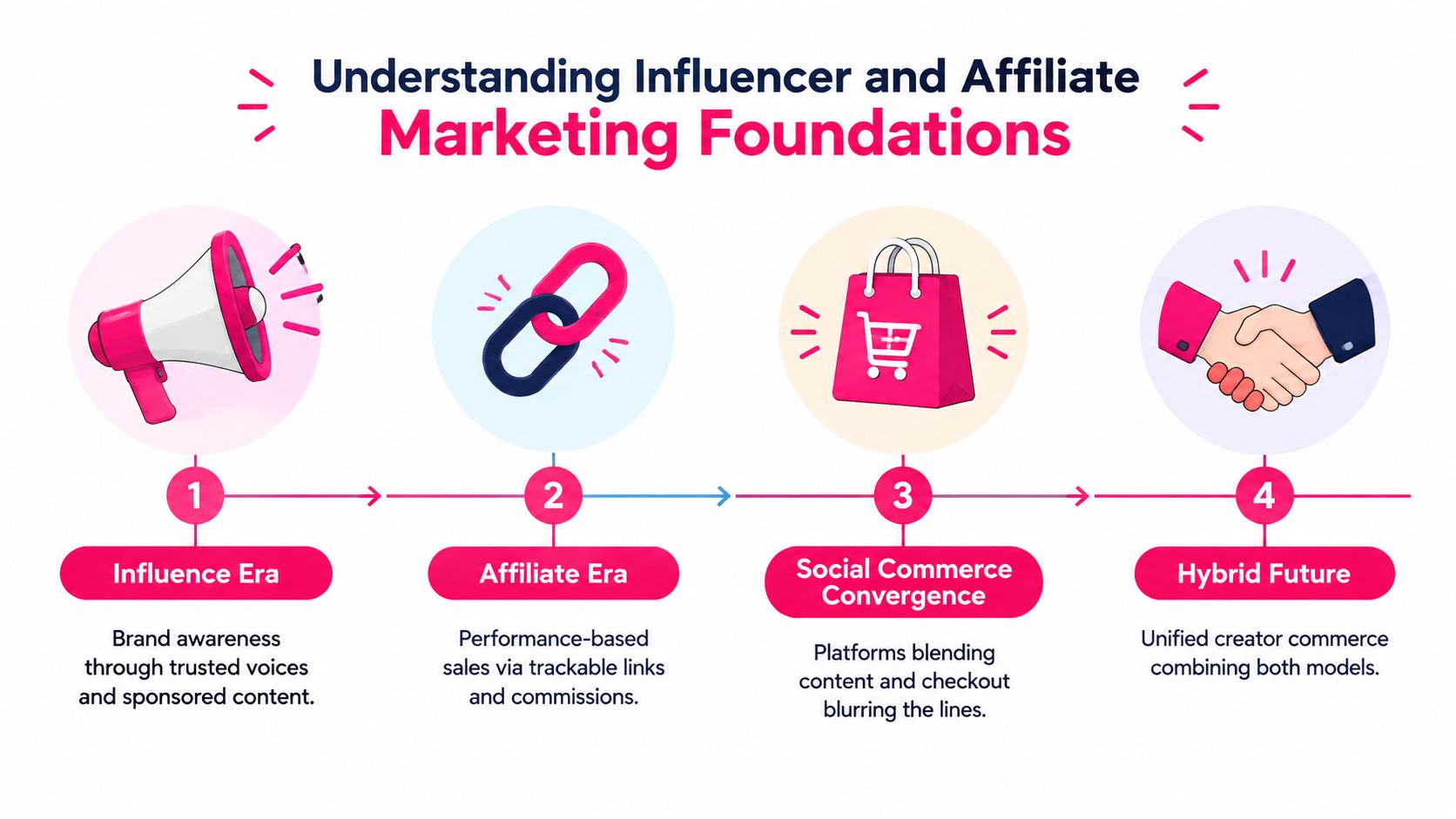
Most comparisons treat these channels as competing disciplines. Historically, they did start from different foundations, but the modern creator economy has made the boundary far less rigid.
Affiliate marketing scaled with Amazon's Associates Program in the late 1990s, when publishers earned commissions for referred sales. Influencer marketing accelerated later through social platforms such as Instagram, YouTube, and Vine during the 2010s, where creators built distribution through personality, community, and recurring content. A 2024 analysis of affiliate and influencer marketing's evolution describes this movement from the dot-com era toward the social media celebrity era and today's commission-based creator programs.
Two origins, one commercial workflow
Influencer marketing traditionally sold access to attention and creative credibility. A brand paid for a post, video, story, or other defined deliverable, then judged success through exposure, engagement, brand response, and eventually sales. Affiliate marketing sold measurable action. A partner received a unique link or code and earned a commission when the tracking system attributed a qualifying purchase or lead.
Those mechanics still matter. An affiliate program generally transfers more conversion risk to the partner, while a sponsored influencer deal gives the brand a clearer commitment around content and distribution. Neither arrangement guarantees the complete customer journey.
The convergence happens inside social platforms. TikTok Shop affiliates, in-app product discovery, creator storefronts, and shoppable short-form video let creators perform both jobs in one piece of content. The creator can provide the narrative and trust associated with influencer marketing, then earn a commission through the same interaction that captures purchase intent.
Practical rule: Treat influence and attribution as separate jobs, even when the same creator performs both. Pay for the work you need, then measure each contribution with the right signal.
Independent 2026 market summaries place global influencer marketing at roughly $32.6 billion to $45.2 billion, depending on scope, while global affiliate spend is estimated at around $19.4 billion in 2026, compared with about $8.6 billion in 2017, according to the same industry data summary. The figures are not perfectly comparable, but they show that both channels have moved well beyond niche digital tactics.
The strategic implication is straightforward. A creator who produces a convincing product demonstration can be paid for the asset, compensated for distribution, and rewarded for the resulting sale. Calling that activity only “influencer” or only “affiliate” hides the economics that determine performance.
Comparing Business Models and Cost Structures
The financial difference between the channels comes down to when the brand pays and what the payment buys. Influencer marketing usually starts with a fee for defined creative and distribution. Affiliate marketing usually starts with an agreed commission and pays after an attributable action.
That doesn't mean influencer marketing is automatically expensive or affiliate marketing is automatically cheap. A low commission may fail to motivate a skilled creator, while a well-negotiated influencer asset can continue working in paid media, email, product pages, and retargeting. The right comparison is contribution margin after considering media value, content rights, production effort, and incrementality.
How the money moves
Influencer compensation can include a flat fee, gifted product, usage-rights fees, paid amplification terms, or a performance bonus. The contract should separate these components. If a creator is producing a video for the brand's paid social account, that's a content and licensing transaction. If the creator is publishing to an audience, that's distribution. If the creator is using a link or code, that's attributable performance.
Affiliate programs are more variable than many guides suggest. Credible 2026 data places the global average commission rate at 9.2% of sale value, with common program ranges between 5% and 30%, according to affiliate commission and program statistics. The same source gives vertical examples including 4.2% median commission for travel and hospitality with a 30-day cookie window and 3.5% median commission for Amazon Associates with a 24-hour window.
Those examples explain why a commission rate can't be evaluated in isolation. A creator selling a high-margin subscription can justify a different offer from a partner promoting a low-margin physical product. Cookie duration, returns, exclusions, coupon rules, and the definition of a qualified sale all change the payout.
Cost Structure and Compensation Models
| Feature | Influencer Marketing | Affiliate Marketing |
|---|---|---|
| Payment trigger | Contracted deliverable, publication, or milestone | Attributed sale, lead, click, or other qualifying action |
| Budget exposure | Upfront commitment is common | Payout generally follows performance |
| Creator incentive | Fixed payment, reputation, relationship, and possible bonus | Commission and recurring sales opportunity |
| Brand control | Stronger control over brief, timing, format, and approvals | Less control over how partners prioritize and present the offer |
| Content rights | Must be negotiated explicitly | May not include usable brand assets |
| Margin pressure | Fee is paid regardless of conversion | Commission reduces margin on attributed orders |
| Best structure | Fee plus rights, with optional performance upside | Commission calibrated to margin and customer value |
The most practical structure for many DTC brands is a modest production or distribution fee plus commission, provided the creator accepts clear tracking. That arrangement gives the creator compensation for work that exists before a sale, while giving the brand a variable cost tied to performance.
Don't hide poor economics behind a generous headline commission. Build the offer from contribution margin, refund behavior, repeat purchase value, and the amount of creative labor required. A creator who must script, film, edit, publish, answer comments, and optimize a storefront needs a different deal from a partner who places a link in an existing review.
Evaluating KPIs and Performance Metrics
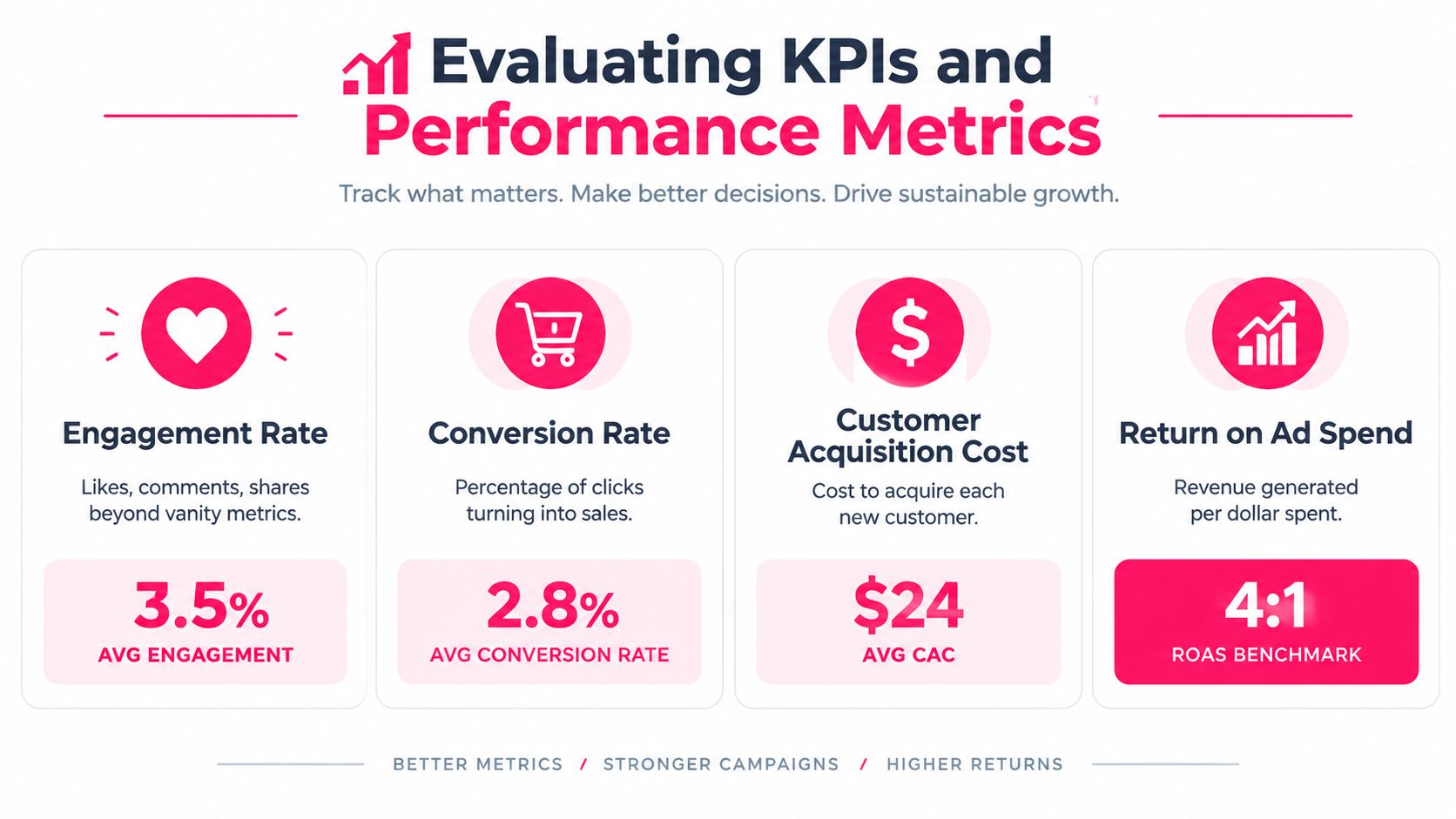
Likes and follower counts can help with audience diagnostics, but they don't answer the commercial question. The useful KPI depends on the creator's assigned role. A creator hired to generate discovery shouldn't be judged only by last-click revenue, while an affiliate promoted for direct sales should be evaluated against attributed action and economics.
Influencer measurement is already moving toward business outcomes. In 2024, Linqia data cited by eMarketer's analysis of influencer marketing measurement showed conversions at 46.0% and sales at 44.0% as the most-used success metrics for influencer campaigns. That's a strong reason to put purchase and lead tracking into the campaign design rather than treating measurement as a reporting task after launch.
Give each channel a fair scorecard
Affiliate reporting is strongest where the conversion path is visible. Use unique links, creator-specific codes, UTMs, landing pages, and a consistent definition of an approved order. Review clicks, conversion rate, revenue, commission expense, refunds, average order value, and contribution margin. Promo codes remain widely used, but they can over-credit a creator who influenced the buyer earlier or who captured an existing discount seeker.
A 2026 benchmark reports that 45.9% of marketers rely on promo and discount codes as a primary measurement method, while affiliate links account for 26%, as reported in Awin's affiliate marketing statistics. The difference reinforces a practical warning: codes and links improve visibility, but neither proves that every credited order was incremental.
Influencer campaigns need a wider measurement window. Track views, watch quality, saves, comments, branded search behavior, direct traffic, assisted conversions, new-customer rate, and the performance of reused creative. Where possible, compare exposed audiences with a reasonable control or holdout design. Don't force every result into the same last-click model.
Long-term value changes the verdict
A benchmark indexed influencer marketing at 151 for long-term ROI versus 77 for paid social and reported a 3.35× long-term ROI multiplier, according to SocialPilot's influencer marketing ROI analysis. The useful lesson isn't that every influencer campaign produces that return. It's that creator content, audience trust, and delayed purchase behavior can create value that immediate conversion reporting misses.
A separate 2025 benchmark found influencers generated 6% of transactions and 3% of consumer spend, while transaction volume grew 65% year over year and conversion rates improved 8% year over year, according to impact.com's affiliate marketing benchmark. The same benchmark reported that technology-solution affiliates increased conversion rates 25% year over year. These figures describe different performance profiles, not a universal winner.
Use affiliate KPIs to manage payout efficiency. Use influencer KPIs to understand demand creation and asset value. For hybrid campaigns, keep both views visible instead of collapsing them into one blended ROAS number.
Matching Strategies to Campaign Objectives
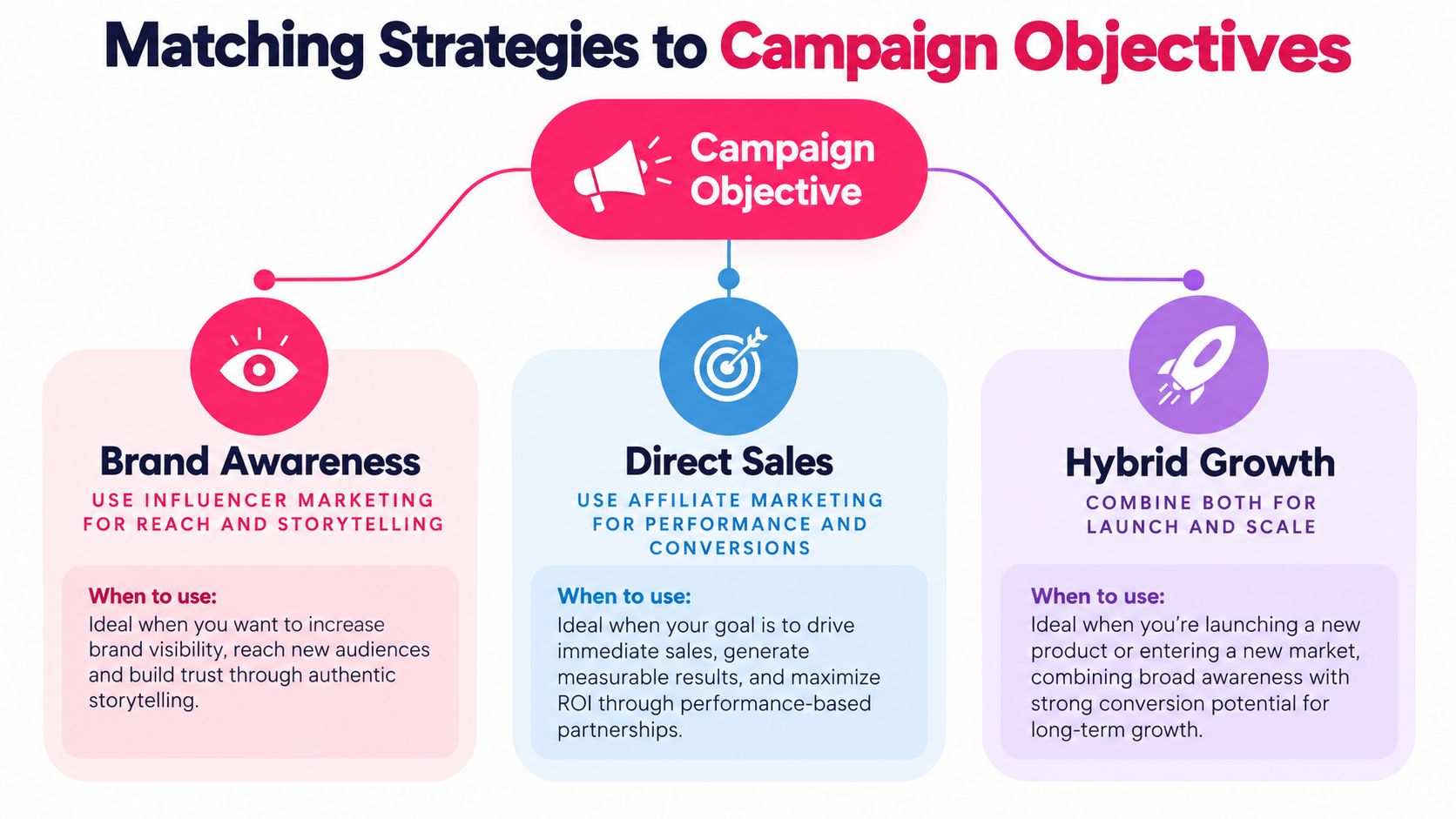
Start with the business objective, not the creator type. A product launch, a profitable sale, and a library of paid-social assets require different commitments. The same creator may be suitable for all three, but the brief, compensation, and KPI cannot stay identical.
A practical decision matrix
| Campaign objective | Primary choice | Why it fits | Add-on |
|---|---|---|---|
| New product discovery | Influencer marketing | Secures storytelling and scheduled distribution | Add a trackable link for early sales signals |
| Immediate direct sales | Affiliate marketing | Aligns payout with attributed action | Fund creator content when production quality matters |
| Premium or considered purchase | Influencer marketing | Trust and explanation can precede conversion | Use assisted-conversion and delayed-purchase reporting |
| Proven ecommerce offer | Affiliate marketing | Lets brands scale partners around measurable demand | Offer paid creative support to high-potential creators |
| Short-form social commerce | Hybrid | Combines creator demonstration, product placement, and commission | Test paid amplification and in-app checkout |
| Content production for paid media | Influencer or UGC deal | Makes the asset the primary deliverable | Negotiate usage rights before production begins |
For a launch, secure the story first. Give creators a clear problem to demonstrate, a reason the product belongs in their routine, and a defined publishing window. Add a link or code, but don't judge the first wave only by direct sales if buyers need education before they purchase.
For an established product with proven demand, affiliate marketing can provide a cleaner operating model. Recruit partners who already publish reviews, comparisons, tutorials, or shopping content in the category. Then give them a commission that leaves enough room for discounts, returns, payment processing, and margin.
A conversion-first offer can't repair weak positioning. If people don't understand why the product matters, a better tracking link only measures the failure more precisely.
Hybrid campaigns work when roles are explicit. One creator might receive a fee for producing a vertical product demo and a commission for sales. Another might be commission-only because the creator already has a strong shopping workflow. A third might produce UGC for paid ads without publishing to an audience at all. Calling all three “influencers” creates confusion about what the brand is buying.
Short-form video makes this especially important. A creator placement can behave like brand media when it generates attention and social proof, like performance marketing when viewers click and buy, or like a hybrid asset when the brand turns it into paid inventory. The platform, checkout path, rights agreement, and measurement window determine which role dominates.
Navigating Implementation Workflows and FTC Rules
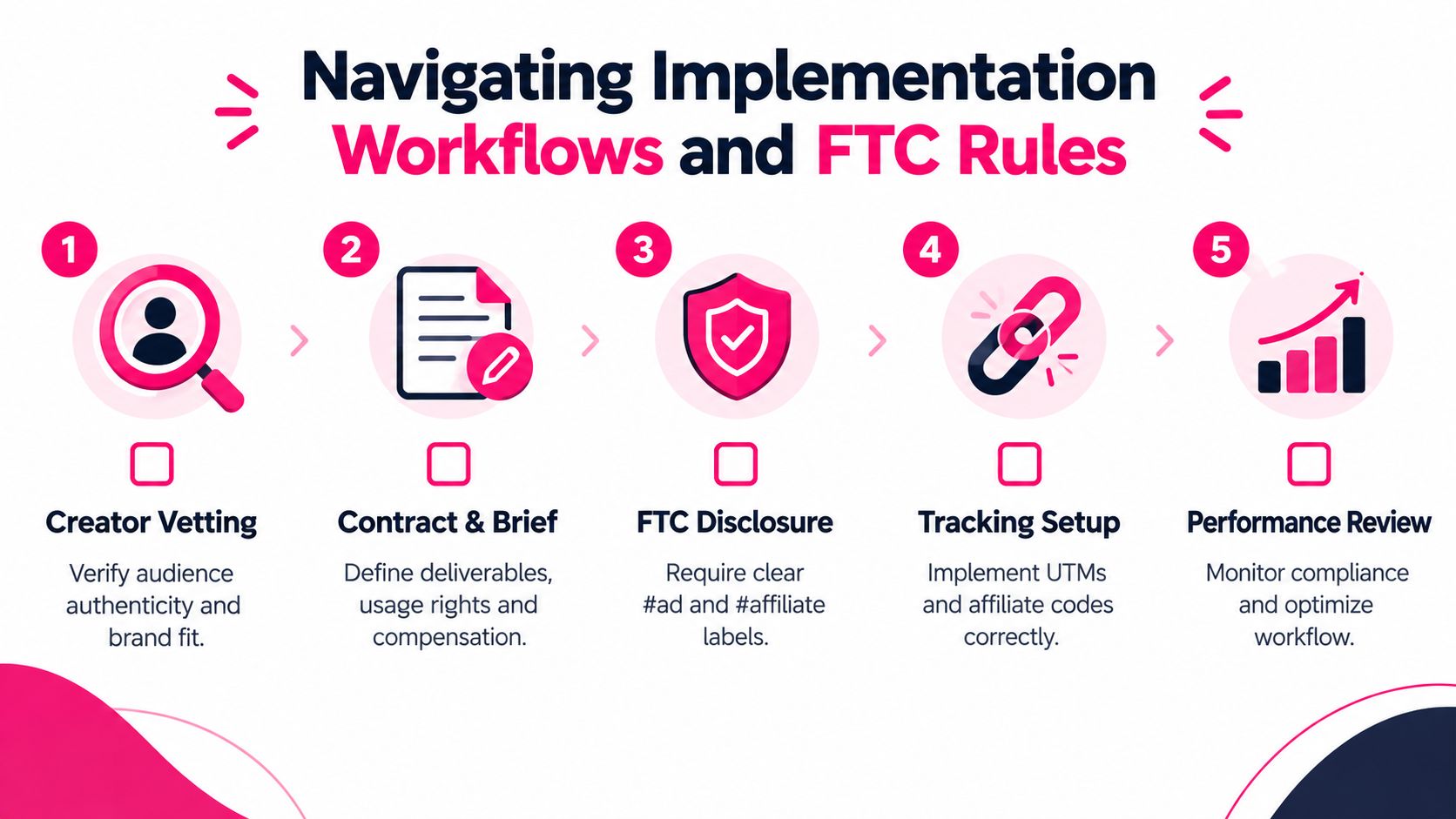
Channel strategy becomes operational work as soon as creators are involved. Someone must find suitable partners, verify audience fit, negotiate the brief, ship products, approve content, secure rights, configure tracking, and reconcile results. A spreadsheet can coordinate a small test, but it becomes fragile when deadlines, revisions, links, codes, and usage permissions multiply.
Build the workflow before recruiting
Vet creators for audience and fit. Review recent content, comments, audience geography, product category alignment, and signs of artificial engagement. A large audience that doesn't match the buyer is an expensive distraction.
Write the contract and brief together. Define the format, talking points, prohibited claims, deadlines, revision process, compensation, tracking method, and content usage rights. If paid amplification matters, negotiate it before the creator films.
Approve disclosure language in advance. The FTC Endorsement Guides guidance requires a connection between an endorser and seller that could materially affect how consumers evaluate an endorsement to be disclosed clearly and conspicuously. The FTC explicitly says a compensation relationship counts as a material connection.
That rule applies to paid sponsorships, gifted products when the connection is relevant, affiliate links, and commissionable codes. The disclosure should be easy for an ordinary viewer to understand and placed where the endorsement appears, not hidden behind a profile link or an ambiguous label.
Treat tracking as part of production
Create the creator link, code, UTM structure, landing page, and attribution rules before the post goes live. Test the path on the actual device and platform where the content will appear. Confirm that the commission excludes canceled or refunded orders and that the creator understands what counts as a conversion.
A centralized platform can reduce email chains by keeping briefs, creator portfolios, approvals, deadlines, rights, and performance data in one workspace. It also gives the brand a record of what was approved and when, which matters when a creator changes a caption or republishes an asset.
Run a final compliance review after publication. Check the disclosure, destination link, claims, product availability, comments that make unsupported promises, and whether the creator used the approved version. Legal compliance isn't a final checkbox. It belongs in creator selection, contracting, review, and monitoring.
Building Hybrid Creator Commerce Programs
The hybrid model starts with a simple change in thinking: the creator is both a media partner and a performance partner. The brand pays for the creative work or planned distribution, then gives the creator a financial reason to improve the path from attention to action.
Short-form video makes that model practical because the same asset can travel across organic feeds, creator storefronts, paid media, and in-app shopping. Coverage of creator marketing economics notes that brands are shifting spend toward paid media inventory and scalable affiliate formats such as Spark Ads and in-app shopping, while traditional sponsored posts represent a smaller share of creator revenue, as reported by Digiday's analysis of creator marketing investment.
Structure the program around creator roles
Begin with a content hypothesis, not a generic request for “a viral video.” Decide whether the asset should demonstrate the product, answer objections, compare alternatives, show an unboxing, or dramatize a use case. Then determine whether the creator will publish organically, add a shopping link, authorize paid amplification, or do all three.
A workable hybrid agreement can contain:
- Production compensation, covering the creator's time, scripting, filming, editing, and agreed revisions.
- Distribution compensation, when the creator publishes to a defined audience on a defined schedule.
- Affiliate commission, tied to a unique link, code, storefront, or platform-native shopping event.
- Usage rights, specifying where the brand can repost or run the content, for what duration, and under which account.
- Optimization permissions, allowing the brand to test hooks, captions, thumbnails, calls to action, and paid placements without changing the creator's original claims.
The brand should retain clear ownership or usage rights for high-performing assets, while the creator keeps upside from the sales they help generate. This creates a feedback loop. Organic content identifies which angle resonates, affiliate tracking identifies which creators or hooks produce action, and paid amplification gives the brand a way to scale validated creative.
Keep attribution honest
Don't attribute every sale to the last creator who posted a link. Separate organic sales, affiliate-attributed sales, paid media conversions, assisted interactions, and repeat purchases. Review incrementality through holdouts, geo tests, audience splits, or controlled creative comparisons when the program is large enough to support them.
A 2025 survey covering more than 1,500 marketers, publishers, and creators found that 59% of brands planned to allocate at least 25% of affiliate budgets to creator partnerships, while 94% were experimenting with or planning alternative attribution models within the following year, according to impact.com's State of Affiliate Marketing research. The operational message is more important than the headline: creator affiliate programs need compensation and attribution rules designed together.
The strongest hybrid programs don't force every creator into the same contract. They use commission-only partnerships for proven shopping creators, paid content deals for production specialists, and fee-plus-commission structures for creators who can both tell the story and drive measurable demand.
Choosing the Right Strategy for Your Brand
The influencer marketing vs affiliate marketing decision should end in a test plan, not a permanent label. Choose the channel based on margin, purchase cycle, content needs, audience access, and the quality of your tracking. Then let performance determine which creators receive more responsibility.
Use this starting sequence:
Define the commercial event. Choose the sale, lead, trial, subscription, or qualified action that matters. Document how refunds, cancellations, repeat purchases, and coupon use affect payout.
Separate the creator jobs. Decide whether you need reach, storytelling, production, direct sales, or a combination. A creator who produces excellent UGC may not have the audience or intent to operate as an affiliate.
Recruit a deliberately mixed cohort. Include creators who can publish organically, creators who understand product-led demonstrations, and creators with established shopping behavior. Give each group a brief and compensation model suited to its role.
Run one measurement framework with multiple views. Track direct conversions and commission efficiency, but also monitor content reuse, assisted demand, audience response, and delayed purchases. Don't compare a content producer and a sales affiliate using only the same metric.
Scale the economics, not just the reach. Promote creators whose incremental contribution remains profitable after commission, discounts, production fees, media spend, returns, and rights costs.
The market is already moving toward this blended model. Recent reporting says 74% of marketers plan to increase influencer budgets and 80% of enterprise organizations increased influencer investment year over year, while affiliate-oriented reporting estimates that U.S. advertisers will spend $13.81 billion on affiliate marketing in 2026, as summarized by Awin's affiliate marketing statistics. Those trends don't remove the need for discipline. They make disciplined role definition and attribution more valuable.
Start with a controlled hybrid pilot, document the economics, and expand only after the content and compensation model prove they can work together.
JoinBrands connects brands with creators for campaign management, content production, creator collaboration, and formats such as Reels, Shorts, B-Roll, and Spark Ads. If you're ready to test a creator program that combines reusable short-form content with measurable affiliate performance, visit JoinBrands.