
 Product Page Optimization Playbook That Lifts Revenue
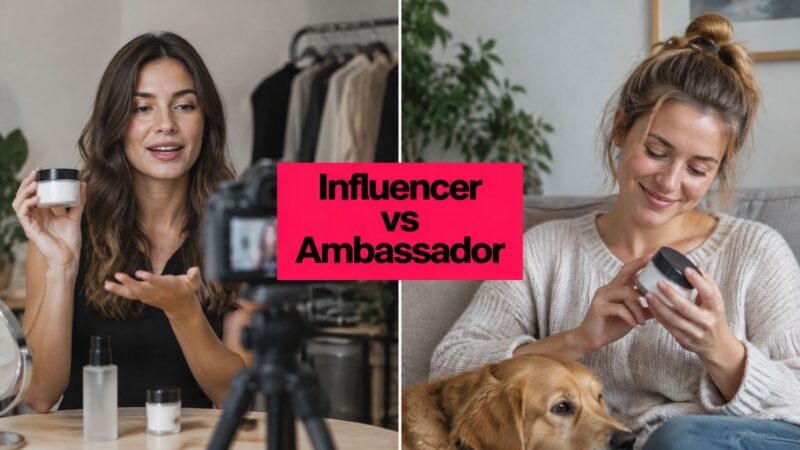
The popular advice on Influencer Marketing vs Brand Ambassador programs is that ambassadors are the more authentic option, so serious brands should move everyone into long-term deals. That's backwards. Authenticity comes from product fit, honest claims, and content an audience wants to watch. It doesn't come from contract length. A paid ambassador reading your brief for the twelfth month can sound more scripted than a new creator testing your product once.
Treat the choice as an operating decision. An influencer campaign buys speed, testing, and controlled exposure. An ambassador program buys continuity, but it also buys monthly management, repeated disclosure checks, and a longer payback window. If you can't staff and measure that continuity, you haven't built a better program. You've just signed a longer version of the same campaign.
Table of Contents
Influencer Marketing and Brand Ambassadors Side by Side
Influencer marketing buys reach through independent creators on a campaign basis. A brand ambassador program builds repeated advocacy from people who already use, understand, or identify with the brand. That's the core distinction, and it explains almost every practical difference that follows.
Academic work summarized in a study of social media influencers and brand ambassadors describes influencers as independent third-party endorsers who shape audience attitudes through blogs, tweets, and social networks, while ambassadors maintain a more formal and lasting relationship with the company. Influencer campaigns are therefore suited to rapid reach, product launches, seasonal promotions, and creator testing. Ambassador programs fit recurring content, community building, brand education, and cumulative trust across multiple touchpoints.
| Criterion | Influencer marketing | Brand ambassador program |
|---|---|---|
| Relationship | One-off or short-term deal | Ongoing, repeated advocacy |
| Typical duration | Single campaign, usually 2 to 12 weeks | Recurring terms, often 6 to 12 months or always-on |
| Selection logic | Audience size, niche fit, engagement, content quality | Existing product use, brand-image fit, credibility, loyalty |
| Typical advocate | Creators on TikTok, Instagram, YouTube, Amazon | Loyal customers, employees, creators, celebrities |
| Main purpose | Reach, launches, creative testing, promotions | Continuity, education, community, cumulative trust |
| Content output | Campaign-specific posts and ads | Recurring posts, reviews and reusable assets over time |
| Main risk | Weak audience fit and fast fatigue | Concentration risk and growing disclosure workload |
The table answers two different questions. The influencer column asks how you get qualified attention fast. The ambassador column asks how familiarity compounds when the same person shows the product in real routines over months.
Selection Logic Is Where the Models Separate
Pick influencers for a campaign job. You're screening for audience size, niche relevance, engagement quality, and the ability to produce campaign-specific content on deadline. A creator doesn't need a long history with your product if the brief is to test five hooks for a launch, drive traffic to a landing page, or produce ad-ready video for TikTok Shop.
That logic also explains why follower count misleads. A micro-creator whose audience asks detailed questions about acne-prone skin, home espresso, or postpartum fitness can beat a macro creator on a niche launch. Their audience is smaller, but it's specialized and interactive, and their comments tell you whether the product claim lands.
Pick ambassadors for repeated advocacy. The first filter is existing product use or clear identification with the brand, followed by brand-image fit, credibility, and willingness to recommend without turning every post into a hard sell. Loyal customers, employees, creators, and celebrities can all work, but they bring different risks. An employee knows the product and needs clear review boundaries. A celebrity brings reach and less day-to-day product familiarity. A loyal customer may bring the strongest routine-based proof.
Influencers are chosen per campaign. Ambassadors are chosen per product line.
Say a supplement brand is choosing between a large wellness creator and a customer with a few thousand followers who repurchases monthly. For a one-time launch announcement, the larger creator is the better choice if the audience fit checks out. For a six-month routine series, the repeat buyer is the better choice. She can show refills, travel habits, missed days, and questions from followers who've watched her use the product since the first bottle. The large creator can introduce the product. The customer can normalize it.
That edge case matters because repeat purchase categories reward proof over time. Skincare, supplements, pet food, coffee subscriptions, and fitness apps all need more than a first impression. Buyers want to see whether the person sticks with it after the sponsored post disappears from the feed.
Neither Label Guarantees Trust
Don't assume an ambassador is more credible because the relationship lasts longer. Duration can strengthen familiarity, but it can also expose weak fit. If an ambassador promotes three competing routines in a quarter, repeats the same talking points, or stops using the product between briefs, the audience will notice. The same applies in reverse. A one-off influencer who gives a balanced review, names a limitation, and shows real use can earn more trust in one post than an ambassador earns in a quarter.
Start with the job, then choose the relationship. If you need market learning, new audiences, or a dated launch window, run campaigns and keep your options open. If you already know which creators explain the product well and convert repeat buyers, formalize them. For the mechanics behind campaign setup, see this guide on how influencer marketing works.
How Long Partnerships Run and What Each Produces
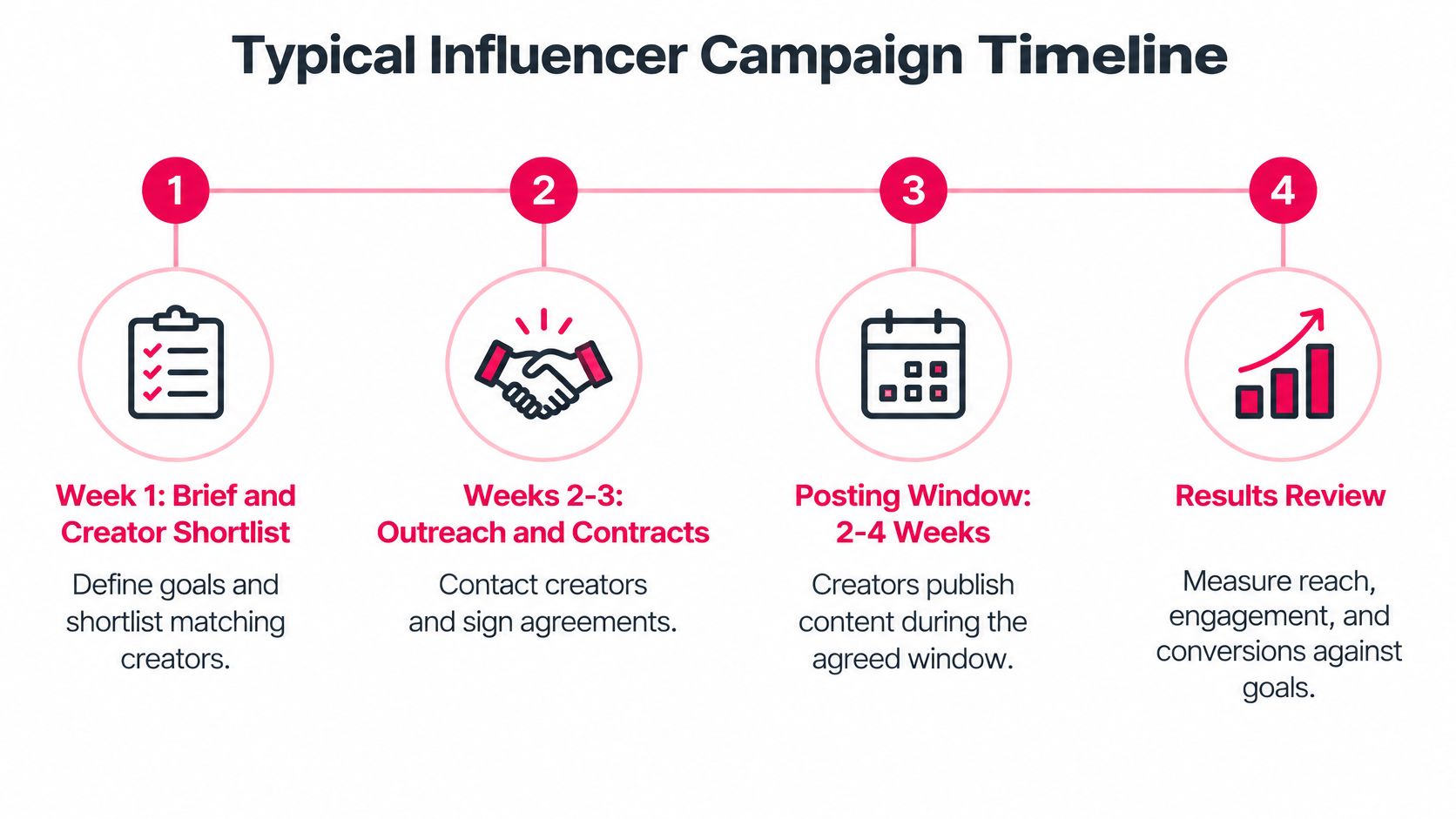
A typical influencer campaign moves like a sprint with a fixed finish line. Week 1 is the brief and creator shortlist. You define the offer, target buyer, claim boundaries, deliverables, posting window, and tracking method, then shortlist more creators than you need because response rates are never perfect.
Weeks 2 to 3 are outreach, negotiation, and contracts. Usage rights, exclusivity, revision limits, and payment terms belong here, not in a panicked message after the video performs. The posting window usually runs two to four weeks, followed by a results review around week 6. Many brands run one or two waves, cut the weak half, and brief the winners again.
The visual timeline below shows that standard sequence in one view.
Ambassador Work Runs on a Calendar
Month 1 is onboarding, and it's heavier than many teams expect. You cover product education, claim do's and don'ts, disclosure training, content approval steps, usage rights, and the code or link each ambassador will use. Skip this work and you'll spend the next quarter correcting captions and chasing missing labels.
After onboarding, the rhythm becomes quarterly briefs with monthly deliverables. A strong active ambassador might produce two to four posts a month in a hypothetical program, but the right cadence depends on product use cycles. A protein brand can support weekly routine content. A mattress brand can't credibly post a new sleep transformation every Friday. Schedule a retention review every 90 days and make the renewal decision at 6 to 12 months based on content quality, audience response, compliance, and cohort results, not on whether the creator is pleasant in chat.
Contrast that with campaign output. A campaign creator typically delivers one to three pieces of content for a defined window. That limited output is a feature when you're testing. You can compare hooks, formats, creators, and offers without committing next quarter's budget.
Usage Rights Are the Hidden Variable
Negotiate reuse before content exists. For influencer campaigns, a 30 to 90 day paid ads license often fits the test. You're buying enough time to run Spark Ads, whitelisting, or paid social and learn whether the creative converts cold traffic.
For ambassadors, push for a 12-month license on top-performing assets. You'll want to reuse routine videos on product pages, Amazon listings, email, and retargeting while the ambassador is still posting new material. Price that license separately when a creator asks. Conflating posting fees and usage fees makes both sides resent the deal later.
Practical rule: If nobody owns the ambassador calendar this month, you don't have a program yet. You have a list of people with discount codes.
That's the operational consequence teams underestimate. Ambassador programs need an owner for briefs, shipments, approvals, payments, and monthly performance reviews. Campaigns can be run in bursts. Ambassadors drift if you do.
How Compensation Models Differ and What They Cost
Campaign deals usually pay per deliverable or per sale because the scope ends. Ambassador deals lean toward retainers, product credit, and hybrid structures because you're paying for availability, repeat posting, and product familiarity over time.
| Model | Typical use | How it is paid | Main trade-off |
|---|---|---|---|
| Flat fee per post or campaign | Influencer launches and one-off content | Fixed payment per deliverable | Predictable cost, but you pay for reach rather than repeat use |
| Gifted product | Micro-creator tests and early-stage brands | Free product, no cash | Cheap to test, but commitment is weak and disclosure still applies |
| Affiliate commission | Performance and seasonal campaigns | Percentage of tracked sales through a link or code | Pays only on sales, but needs clean tracking and a commission cap |
| Monthly retainer | Ambassador programs | Recurring fee for a fixed set of deliverables | Continuity and planning, but a fixed cost if sales dip |
| Product credit with perks | Loyal customers as ambassadors | Ongoing free product, early access and discounts | Low cash cost, but each perk is a material connection to disclose |
| Hybrid retainer plus commission | Mature ambassador programs | Base fee plus bonus on tracked sales | Aligns incentives, but adds reporting and admin work |
Build Budgets Backward From Acquisition Cost
Rates vary too widely by platform, niche, follower tier, and usage rights for a generic rate card to protect your margin. Build backward from target cost per acquisition and contribution margin. Ask what you can pay for a new customer, what repeat purchase is worth over the payback window you can tolerate, and how much reusable creative you get for the fee.
Say a beauty brand can afford a modest first-order loss because refills are strong. A hybrid ambassador deal can make sense even if the first post looks expensive, provided tracked buyers reorder and the content is licensed for ads. Say a one-time purchase gadget has thin margin and no repeat cycle. That same retainer is hard to defend. Use flat-fee tests and affiliate commission until a creator proves they can sell profitably.
Flat fees buy control over timing and deliverables, which matters for launches. Affiliate deals shift risk to the creator, which sounds attractive until strong creators decline because they can't control your landing page, price, stock, or shipping speed. Gifted product works for discovery with micro-creators, but it produces the weakest commitment. Don't build a launch date around unpaid posts.
The Contract Details That Prevent Waste
Pro tip: Cap commission on affiliate deals and set a minimum monthly deliverable for retainers. You shouldn't pay uncapped commission on brand-driven demand, and you shouldn't pay a fixed retainer through a silent month.
Add payment triggers that match the model. Pay flat fees on approved posting, not on signing, unless a top creator requires a deposit. Pay commission after the return window you use internally. For product credit, state shipment cadence, what happens when product is out of stock, and whether early access or discounts continue after termination.
Treat gifted and discounted products as compensation for disclosure purposes, because they are value from the brand. The cash amount can be zero while the compliance duty remains. If you need the payment mechanics spelled out, use this breakdown of how to pay influencers before you send the first offer.
Which KPIs Prove Each Model Works
Judge the models on different windows. Lingnan University's summary of influencer marketing effectiveness research supports measuring a one-off activation on incremental reach, engagement, qualified traffic, and short-term conversion, while an ambassador program should also track cohort-level repeat purchase, customer lifetime value, branded search lift, assisted conversions, and content reuse over multiple purchase cycles.
The same research summary names creator originality, audience size, sponsorship salience, follower and brand fit, and post positivity as effectiveness drivers. Several relationships are inverted-U shaped, so more posting, more scale, or heavier promotion can reduce effectiveness after audiences hit fatigue or weak relevance. Don't assume the busiest creator is the best creator.
| KPI | Influencer campaign | Ambassador program |
|---|---|---|
| Reach and engagement | Incremental reach and engagement per post | Engagement trend across repeat posts over months |
| Clicks and traffic | Qualified traffic through unique link | Recurring traffic from creator links over time |
| Conversion rate | First-order conversion on tracked code | Conversion across repeat posts |
| Cost per acquisition | Campaign cost per new customer | Blended cost per new customer across the cohort |
| Repeat purchase rate | Secondary signal | 30, 60 and 90-day repeat purchase cohorts |
| Customer lifetime value | Not a primary measure | Cohort-level customer lifetime value |
| Branded search lift | Short spike around posts | Sustained lift across multiple purchase cycles |
| Content reuse value | Paid amplification of campaign creative | Reusable assets across purchase cycles |
How to Set Up Attribution That Survives Scrutiny
Give every creator a unique link or promo code. Don't share one code across a wave and then argue about who drove the sale. Where feasible, keep a holdout audience or staggered launch window so you can separate creator lift from a sitewide promotion. Connect platform exports to site analytics and transaction records. Likes don't pay invoices.
For ambassadors, build 30, 60, and 90-day cohorts by first purchase source. Compare repeat purchase rate, refund rate, average order value, and lifetime value against buyers from paid social and one-off campaigns. Separate the value of reusable creative from tracked sales. A video that produces modest code sales but becomes your best product page asset for two quarters has a different return profile than a post that spikes and dies.
Pro tip: Report by creator and exposure frequency, never as one blended average. Blending hides the creator whose first two posts convert and whose next six train the audience to scroll past.
Industry practice still leans too heavily on the easy metrics. The World Federation of Advertisers recommendations on influencer marketing report that 40% of multinational brands engaged influencers long-term in 2025 and 38% used always-on programs, while only 23% used conversions or sales as success metrics. That's the gap to close in your own dashboard.
Use reach and engagement as diagnostics, especially for new audience entry. Use traffic quality, conversion, acquisition cost, and repeat behavior for budget decisions. If an ambassador cohort doesn't beat your campaign cohort on repeat purchase, assisted conversion, or reuse value after a fair window, continuity isn't creating incremental value. Renewal should follow evidence, not habit. For a deeper measurement setup, see how to measure influencer marketing ROI.
Compliance Overhead Grows With Every Repeat Post
The image below captures the everyday setting where most disclosure failures happen, on a phone, between ordinary posts, under time pressure.

Ambassadors aren't safer because they love the brand. Legally, the label doesn't decide the duty. The FTC business guidance on endorsements, influencers, and reviews makes clear that the 2023 Endorsement Guides apply to influencers and longer-term ambassadors when there's a material connection, including payment, free or discounted products, employment, family ties, or other relationships that could affect how consumers evaluate an endorsement.
Disclosure must be clear and conspicuous, and the FTC notes that a platform's built-in disclosure tool may not always be sufficient. A vague word such as "collab" isn't a disclosure strategy. Put the exact disclosure language and placement in the agreement, review sample posts before publication, and monitor live content because an ambassador relationship continues across posts.
Platform Labels Add Their Own Duties
Instagram's branded content guidance for creators requires the Paid Partnership label when creators receive compensation from a business partner, including non-cash compensation such as free products or trips. Treat every gifted shipment, discount code, affiliate arrangement, and recurring perk as a disclosure event.
TikTok is just as direct. TikTok's guidance on promoting a brand, product, or service requires creators to enable the content disclosure setting and identify branded content when publishing. Make that setting a pre-publication checkpoint. The creator selects branded content, sends a preview, and your team verifies the label before approval.
The video below is a useful watch before you finalize your approval workflow.
Reviews need separate controls. The FTC announcement of its updated 2023 advertising guides covers fake reviews, incentivized reviews, employee reviews, virtual influencers, and manipulation of review visibility. Don't require ambassadors to post only positive reviews, don't suppress negative feedback, and don't let anyone claim personal use they haven't had.
Now do the workload math. In a hypothetical program with 20 ambassadors posting four times a month, you have 80 disclosure checks a month, before ad reuse, affiliate links, livestreams, and reposts. One-off campaigns create a bounded review pile. Ambassador programs create a permanent one.
Use a checklist every time.
- Agreement first: Specify disclosure text, platform label, approval steps, and correction deadlines.
- Sample review: Approve an example post before the ambassador's first live post.
- Approval log: Save the brief, compensation, draft, approval, and final URL for each post.
- Truthful claims: Require first-hand use for first-hand claims and ban fabricated testimonials.
- Ongoing monitoring: Spot-check live posts weekly and fix missing disclosures fast.
For the detailed rules your creators should follow, keep these FTC guidelines for influencers in the onboarding pack.
Pick the Model Your Next Campaign Needs
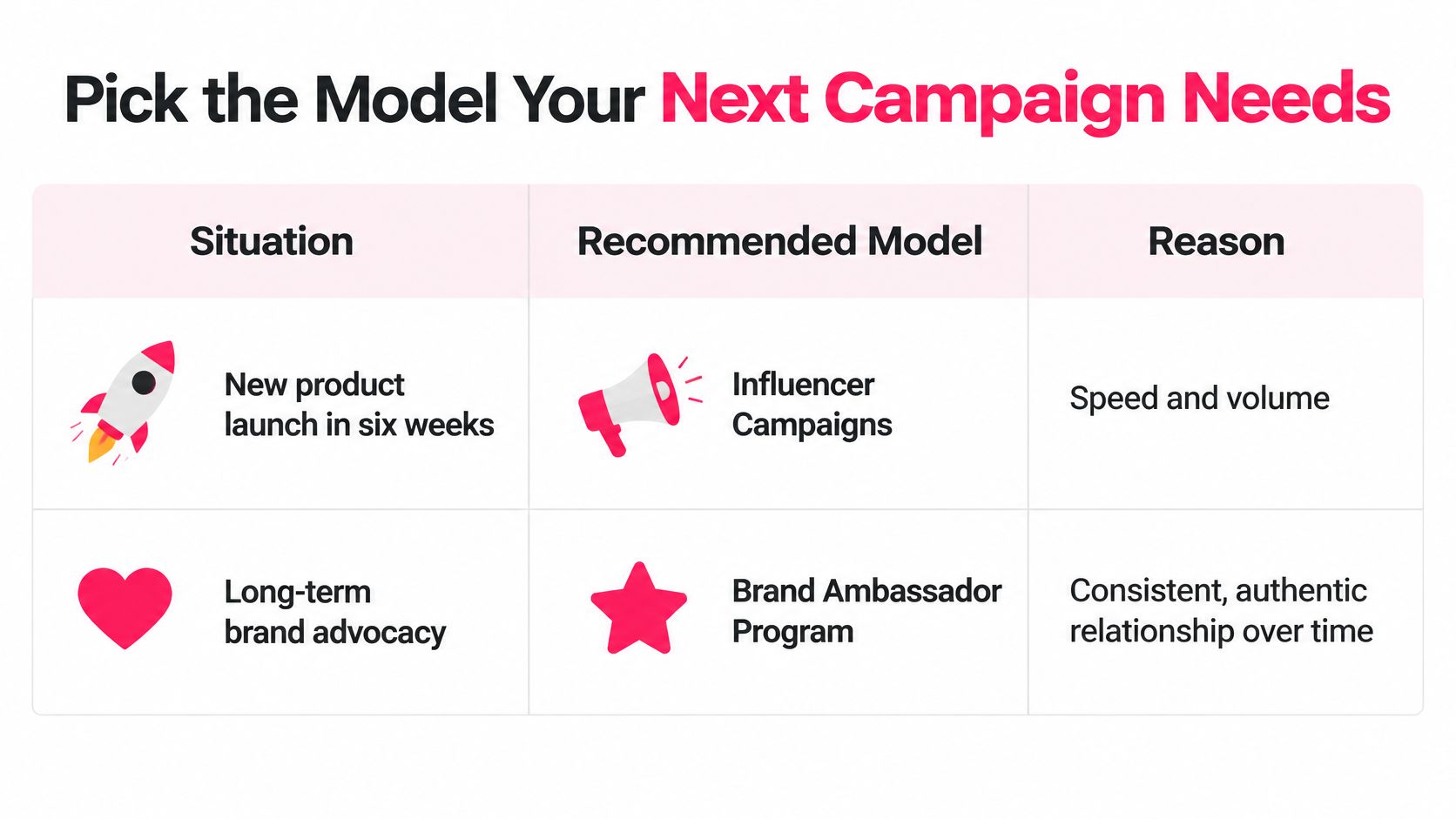
The core decision comes down to governance. An influencer campaign is a bounded commitment: brief, post, pay, measure. An ambassador program is a permanent one, with disclosure checks and cohort-level ROI tests running every month. Match the model to the problem. Speed problems and learning problems point to influencer campaigns. Repetition, education, and retention problems point to ambassadors, provided you've already found people worth repeating.
| Situation | Recommended model | Why it fits |
|---|---|---|
| New product launch in six weeks | Influencer campaign | Speed and volume of creator content |
| Testing five hooks or formats | Influencer campaign with unique codes | Fast, cheap creative signals |
| Seasonal promotion with a deadline | Affiliate-based creator campaign | Pay tied to tracked sales in a short window |
| Product needs repeated demonstration | Ambassador program | Repeat exposure builds trust and product understanding |
| Base of loyal repeat buyers | Product-credit ambassadors | Converts existing advocates at low cash cost |
| Unproven creators and tight budget | Gifted micro-creator test, then ambassadors | Low cash risk before committing to retainers |
| Mature brand with proven creators | Hybrid portfolio | Influencers for launches, ambassadors for always-on content |
The visual below condenses that logic for a quick team discussion.
Two Illustrations of the Same Funnel
Illustration one: A hypothetical skincare brand launches a serum with 40 micro-creators over six weeks. Each creator gets a unique code, the same claim boundaries, and freedom to film either a morning routine or a texture test. Six creators produce the strongest comments, cleanest disclosures, and best first-order economics. The brand promotes those six into ambassador roles with monthly briefs, quarterly product education, and a 90-day review. The other 34 weren't failures. They were paid market research.
Illustration two: A hypothetical supplement brand starts inside its customer base. It invites repeat buyers with public profiles to become product-credit ambassadors, gives each person a tracked link, and judges the cohort on 90-day repeat purchase among referred buyers. Follower count doesn't decide renewal. Reorder behavior, content consistency, and honest routine posts do.
Both illustrations run on the same principle: campaigns discover fit, and ambassador contracts should reward proven fit. Recruiting 50 ambassadors from scratch reverses the funnel. You end up running the highest-overhead model, with its full disclosure load and cohort tracking, before you know who can perform.
Your Next Three Moves
First, audit creators from the last 90 days. Rank them on audience fit, content quality, tracked revenue, comment quality, delivery reliability, and disclosure accuracy. Cut anyone who needed repeated corrections, even if one post sold well. Compliance problems don't get cheaper over a longer contract.
Second, graduate only the strongest creator and product matches. Offer a defined trial term with monthly deliverables, tracked codes, usage rights, and a renewal review tied to cohort results. The renewal test should compare the ambassador cohort's repeat purchase and reorder behavior against the buyers your campaigns acquire, so the retainer has to beat a cheaper alternative. Keep testing new influencers around that core so the program doesn't become dependent on three familiar faces.
Third, put disclosure, claim limits, approval steps, and usage rights in every contract before product ships. That paperwork is what lets you reuse winning content and correct weak posts without renegotiating from zero. JoinBrands users can run creator tests across TikTok Shop, Instagram, YouTube, and Amazon and manage briefs, content approvals, and deadlines in one place. Don't sign a year-long ambassador deal until a creator has passed that test in public, with clean tracking and clean disclosures.
Ready to test creators before you commit to long-term ambassador contracts? JoinBrands helps you discover and hire creators across TikTok, Instagram, YouTube, and Amazon, manage briefs and approvals, and identify the proven performers worth keeping. Start with a campaign, measure who drives qualified buyers, and build your ambassador bench from evidence.