
 Shopify Influencer Marketing: A 2026 Guide to Sales Growth
You're probably doing more than enough already. The posts are going out, the content calendar is full, someone on the team is chasing trends, and the brand feed looks active. But sales don't move much, engagement feels uneven, and social still behaves like a task list instead of a growth channel.
That pattern is common in DTC brands. Teams confuse activity with strategy, and they treat every platform like a distribution pipe instead of a distinct environment with its own audience behavior, creative norms, and conversion role.
That gap matters because the upside is too large to ignore. In 2025, social media advertising spend reached $276.7 billion globally, accounting for 3 in every 10 dollars spent on digital advertising, and social is the top source of brand awareness among 16 to 34-year-olds according to Sprinklr's social media marketing statistics. If your brand is still using social as a loose mix of posting, boosting, and hoping, you're competing in the biggest attention market in digital with no operating system.
The brands that win usually aren't doing one magical thing. They're running a connected system. Clear goals. Platform-native content. A repeatable creator workflow. Paid amplification behind proven assets. Tight measurement. Fast iteration.
That's what social media marketing for brands looks like when it's built to drive revenue instead of just filling a feed.
Table of Contents
Your Guide to Modern Social Media Marketing
A familiar situation looks like this. A skincare brand posts three times a week on Instagram, reuses the same video on TikTok and YouTube Shorts, adds a product offer every few days, and checks performance mostly through likes and follower growth. The team is busy, but the output doesn't compound. A few posts pop. Most disappear.
The problem usually isn't effort. It's the playbook.

Modern social media marketing for brands has to do three jobs at once. It has to earn attention, build trust, and create a path to action. If one of those is missing, the channel stalls. Brand-heavy content gets ignored. Creator content without distribution stays small. Paid ads without social proof feel expensive and fragile.
The shift that matters is simple. Stop thinking in posts. Start thinking in systems.
What actually changes results
Brands get more from social when they connect five moving parts:
- Business objective first: Tie content to awareness, product education, lead generation, or sales.
- Platform behavior second: Build for how people consume content on that channel.
- Creator input third: Add people and proof so the brand doesn't sound like a brochure.
- Paid amplification fourth: Put spend behind assets that already show signs of traction.
- Measurement last: Track what drives the next decision, not just what looks good in a report.
Social should answer one hard question every week: what did this channel help the business do?
A strong social program doesn't feel random from the inside. It feels operational. The team knows what content belongs where, which creators match which product line, what gets boosted, and what gets cut.
That's the difference between content churn and a revenue channel.
Building Your Social Media Strategy Foundation
Most brands start too late in the process. They open Canva, draft a Reel, and only then ask what the post is supposed to accomplish. Strategy has to come first or content turns into noise with branding on top.

Start with the commercial goal
A social plan for a product launch looks different from one built for retention. So does a plan for a high-consideration product versus an impulse purchase. Before you touch formats, define the job social needs to do in the business.
A useful starting split is this:
Awareness goal
You need more qualified people to know the brand exists. In that case, social should prioritize reach, repeated exposure, memorable creative angles, and content that gets shared or saved.Conversion goal
You already have some demand. You need social to shorten the path to purchase. That means stronger product demos, objections handled in content, creator proof, and cleaner traffic paths.Retention or community goal
You need existing customers to buy again, refer others, or stay engaged. Social should lean into education, community interaction, product use cases, and user stories.
Practical rule: If your KPI can't be connected to a business objective, it's probably a vanity metric.
Follower growth can matter. So can views. But neither should sit alone at the top of your reporting.
Build an audience profile people can actually use
“Women 25 to 44 interested in wellness” is not an audience strategy. It's a targeting shell. Your content team, creator manager, and paid buyer need better inputs than that.
A useful audience profile includes:
- Buying trigger: What problem makes them start looking?
- Objection: What slows down the purchase?
- Content appetite: Do they respond to demos, testimonials, tutorials, comparisons, or founder-led content?
- Platform behavior: Where do they browse casually, and where do they research with intent?
- Language cues: What phrases do they use in reviews, comments, and support tickets?
That's also where offline touchpoints can sharpen social execution. If your brand shows up at events, pop-ups, or retail activations, those environments often reveal what customers ask, film, or photograph. Teams working on experiential campaigns can borrow ideas from interactive event branding solutions to turn physical brand moments into social-friendly content prompts.
Define a voice your creators and team can repeat
Brand voice shouldn't live only in a slide deck. It needs to be operational. A good voice guide tells people how to sound in a caption, in a comment reply, in a testimonial ad, and in a creator brief.
Keep it practical:
- Choose three voice traits: For example, clear, confident, and useful.
- State what you won't sound like: Overhyped, clinical, sarcastic, or trend-chasing.
- Write examples: A product hook, a customer reply, a founder post, a UGC intro line.
That last part matters. Teams usually describe voice in abstract terms and then leave creators guessing.
Set metrics that survive scrutiny
The simplest social measurement stack is usually the strongest:
- Awareness metrics: Reach, impressions, profile visits
- Engagement metrics: Shares, comments, saves, completion signals
- Business metrics: Clicks, add-to-carts, lead actions, attributed purchases
Don't report a high-performing post if nobody can explain what kind of performance it created.
If your dashboard is full of surface metrics and nobody can tell which content angle helped sell product, your strategy still isn't finished.
Mastering Platform-Specific Content Formats
Cross-posting the same asset everywhere is one of the fastest ways to flatten performance. It saves time upfront and costs reach later.
That trade-off shows up in the numbers. Brands that adapt content to each platform's format and audience achieve 30% higher engagement rates, while 82% of brands still repurpose without proper adaptation, causing a 20 to 40% drop in engagement according to iPromote's social media marketing statistics.
One message, three executions
The fix isn't creating from scratch every time. It's building one core idea, then changing the packaging.
Say you're launching a hydration supplement. The core message is that it tastes good, travels easily, and solves the midday energy slump.
On Instagram Reels, that idea might become a fast lifestyle edit with polished visuals, product-in-hand shots, text overlays, and a cleaner visual hook in the opening seconds.
On YouTube Shorts, the same product may work better framed as a mini explanation or comparison. Less aesthetic. More utility. “I swapped my afternoon coffee for this for a week” is a stronger Shorts frame than a generic beauty montage.
On Instagram Stories, the same message should feel immediate and informal. Poll sticker. Quick founder clip. Before-and-after routine. Swipe path or link sticker. Stories are less about discoverability and more about moving warm attention.
Reels vs. Shorts vs. Stories At-a-Glance
| Attribute | Instagram Reels | YouTube Shorts | Instagram Stories |
|---|---|---|---|
| Primary role | Discovery with strong visual branding | Discovery through quick utility or entertainment | Nurture, product reminders, and action from warm audiences |
| Best opening | Visual hook and immediate context | Strong verbal premise or direct claim | Casual, in-the-moment prompt |
| Creative style | Polished but native | Straightforward and searchable-feeling | Low-friction, conversational |
| Caption approach | Short support copy with clear angle | Minimal support, let the concept carry | Text overlays and stickers matter more than captioning |
| CTA style | Visit profile, learn more, watch part two | Watch next, comment, visit channel or link path | Tap, reply, vote, click link |
| Good use case | Product reveal, creator demo, lifestyle proof | Testimonial breakdown, problem-solution, mini review | Limited offer, FAQ, community touchpoint |
What adaptation looks like in practice
A customer testimonial can become three different assets without changing the underlying proof.
- For Reels: Lead with the customer's face, then cut quickly into the result and product routine.
- For Shorts: Start with the problem the customer had, then show why the product solved it.
- For Stories: Break the testimonial into frames and add direct prompts like “Want the routine?” or “See ingredients?”
Platform-native content doesn't mean trend-chasing. It means the content feels like it belongs where it appears.
What doesn't work is posting a TikTok-style clip with cluttered captions into Stories, or using a Story sequence as a Reel and hoping the algorithm sorts it out. Each platform rewards different viewer behavior, and your creative has to respect that.
Collaborating with Creators for Authentic Reach
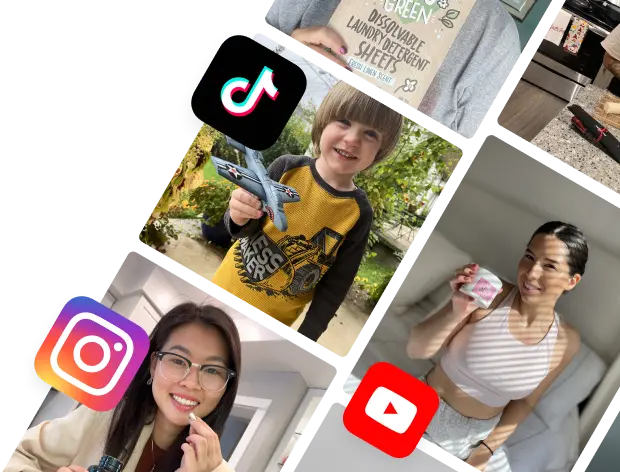
Brand-produced content has limits. It can explain features well, but it often struggles to create trust at scale. Creator content fills that gap because it puts the product in a human context. People see how it looks, how it sounds, how it fits into real use.
That's also why creator content performs beyond awareness. Integrating influencer marketing with paid social delivers strong ROI, and 69% of marketers report direct lead increases. At the same time, micro-influencers with 10k to 100k followers are preferred by 67% of brands and often outperform larger creators on engagement and authenticity according to Marketing LTB's social media marketing statistics.

Choose creators like a media buyer, not a fan
Too many brands still start with follower count. That's usually the wrong first filter.
The better screening order is:
- Audience fit: Does this creator naturally speak to your buyer?
- Content fit: Can they present your product in the style your category needs?
- Trust signals: Do comments look real? Does the creator get actual conversation?
- Usage potential: Can their footage be reused in paid social, email, landing pages, or PDPs?
A creator who shoots clean demos, speaks clearly, and knows how to show a product benefit is often more valuable than a larger creator with broad but shallow attention.
Write briefs that leave room for real content
The worst creator briefs read like legal disclaimers with mood boards attached. They produce stiff content because the creator spends all their energy trying not to be wrong.
A workable brief should include:
The product truth
What the product does, who it's for, and what claim angle matters most.Mandatory elements
Required talking points, prohibited claims, compliance boundaries, usage rights.The creative lane
Testimonial, routine, unboxing, demo, comparison, or problem-solution.The freedom
Let the creator use their own setting, cadence, and phrasing within the guardrails.
Give creators a clear destination, not a line-by-line script.
If you script every sentence, you remove the one thing you hired them for. Their delivery.
Run collaboration like a repeatable process
The brands that scale creator programs don't rely on email threads and scattered spreadsheets. They define a workflow and keep it tight.
A practical creator workflow looks like this:
- Source creators
- Send product and brief
- Confirm timeline and deliverables
- Review first submission against hook, clarity, and brand fit
- Request revisions only when they improve performance or compliance
- Store approved assets with clear naming and rights status
- Route top assets into organic, paid, email, and site use
A platform like this can remove operational drag. JoinBrands is one example of an all-in-one creator marketing platform that lets brands post campaigns, filter creators, manage communication, track product delivery, review content, and activate assets for formats such as Spark Ads from one workflow.
What usually breaks creator programs
Most creator programs fail for ordinary reasons, not dramatic ones.
- Bad briefs: The creator doesn't know the actual angle.
- Slow approvals: Momentum dies while content sits in review.
- Wrong creator mix: The brand hires people who look good on paper but can't sell the product naturally.
- No reuse plan: Content gets posted once and then disappears.
Treat creators as a content engine, not a one-off awareness play. That's when the economics start to work.
Launching Campaigns with Paid Amplification
Organic content tells you what resonates. Paid amplification tells you how far that message can go when you put budget behind it. The strongest social programs use both. They don't separate creator content and media buying into different universes.

Boost what has already earned attention
Paid social works better when you amplify assets that already show signs of traction. A creator video with strong comments, solid hold rate, and clear product understanding usually gives you a better starting point than a polished brand ad built in isolation.
This is why Spark Ads and similar boosted creator formats matter. They preserve the native feel of the content while giving the media team targeting control.
A useful workflow looks like this:
- Test organically first: Publish several creative angles and watch for quality engagement.
- Identify durable hooks: Look for strong openings, clear value communication, and believable delivery.
- Promote the winners: Turn those assets into paid units against a specific objective.
- Refresh quickly: Swap in new creators, new hooks, or new use cases before fatigue sets in.
Match campaign setup to the job
Paid social underperforms when the brief says “drive sales” but the creative is built for awareness. The objective, audience, and asset all have to match.
A simple way to think about it:
Awareness campaigns
Use broad creative that introduces the problem, the category, or the product promise. These campaigns should feel easy to consume. Don't force a hard sell too early.
Consideration campaigns
Use testimonial, routine, comparison, and FAQ-style assets. Creator content often shines in these formats because people want to see product use, not just branding.
Conversion campaigns
Use direct-response creative. Lead with the offer, the objection, the use case, or the urgency trigger. The viewer should know quickly why they should click now.
If you're in print-on-demand or adjacent ecommerce models, campaign structure and offer framing often need special handling because margins, product variation, and creative testing cycles are different. For that use case, Facebook ad strategies for POD businesses can help frame the media side more realistically.
Use creator ads without stripping out authenticity
A lot of teams ruin creator assets in the final edit. They add too much branding, over-design the captions, or cut away the rough edges that made the content believable in the first place.
Keep the native feel intact. Clean up only what improves understanding.
Good paid social often looks less like an ad and more like useful proof shown to the right person at the right time.
This walkthrough is useful if your team needs a practical visual reference for campaign setup and creative thinking:
Common paid mistakes brands keep repeating
- Boosting weak creative: Spend doesn't fix a poor hook.
- Sending cold traffic to vague pages: Your landing experience has to match the ad promise.
- Using one creator angle too long: Freshness matters.
- Judging too early or too late: You need enough signal to make a decision, but not so much delay that weak ads keep spending.
The goal isn't to make paid social separate from organic. The goal is to use organic as your creative lab, then use paid to scale what already proved it can hold attention.
The Modern Workflow Your Brand Needs to Scale
Most social problems aren't creative problems. They're workflow problems.
The team can't find the latest approved file. Creator outreach lives in one tool, shipping updates in another, feedback in email, rights in a spreadsheet, ad codes in a chat thread, and reporting somewhere else entirely. Nothing breaks in a dramatic way. Everything just slows down.
That operational drag hits smaller brands hardest. Industry data shows 70% of small DTC brands struggle with creator vetting and performance tracking, and unified platforms with AI matching and multi-platform tools can improve efficiency by 30 to 50% according to Social Targeter's analysis of digital marketing challenges.
Fragmented systems create silent losses
When workflow is fragmented, teams make predictable mistakes:
- They approve content too slowly
- They lose track of which assets have usable rights
- They forget to connect creator performance to ad performance
- They brief creators inconsistently
- They spend more time organizing work than improving it
That's why social media marketing for brands has become an operations issue as much as a creative one. Speed matters, but controlled speed matters more.
What a scalable workflow should include
A workable system needs a few basics in one place:
| Workflow need | Why it matters |
|---|---|
| Creator discovery and vetting | So the team can find relevant partners without manual research every time |
| Brief management | So every campaign starts with the same standard of clarity |
| Communication history | So feedback doesn't disappear across inboxes |
| Asset approval status | So nobody publishes the wrong version |
| Rights and usage tracking | So the paid team knows what can legally be amplified |
| Performance view | So future creator selection improves over time |
You don't need a giant enterprise stack to do this. You do need one agreed process that marketing, content, and paid can follow.
If your team can't answer “Which creators produced assets we should scale again?” within a few minutes, the workflow is still broken.
Why unified execution wins
Unified systems reduce decision lag. They also make iteration easier because every campaign leaves behind usable data. You can compare creators by deliverable quality, compare hooks by response, and compare content styles by downstream conversion behavior.
That changes how teams work. Instead of debating social in broad terms, they can answer specific questions. Which brief format gets cleaner first drafts? Which creator style generates stronger testimonial ads? Which product category needs more educational framing before conversion creative works?
That's how social starts compounding. Not because the team posts more, but because the operating model gets tighter.
Measuring What Matters and Optimizing for Growth
A social report full of likes can look healthy while the business learns almost nothing from it. Good measurement should help you decide what to make next, who to work with again, and where to put spend.
The cleanest way to do that is a simple funnel.
Track three layers only
Awareness
Start with visibility. Look at reach, impressions, and profile visits. This tells you whether the content is getting distributed and whether people are curious enough to investigate the brand further.
Engagement
Then check response quality. Shares, comments, saves, and replies tell you more than raw likes. These actions usually signal that the content landed well enough for someone to react or return to it.
Conversion
Finally, measure action. Track clicks, add-to-carts, lead actions, and purchases using platform analytics plus UTM parameters. In doing so, social becomes accountable to the business instead of existing as a branding activity only.
Use the data to make sharper creative decisions
A few examples:
- A video gets strong reach but weak clicks. The hook worked, but the value communication or CTA probably didn't.
- A creator's content gets modest reach but excellent add-to-cart behavior. That creator may belong in paid even if their organic metrics aren't flashy.
- Stories drive fewer views than Reels but stronger site visits. That means Stories may be your closer, not your discovery format.
What to optimize every cycle
Keep your optimization loop focused:
- Creative angle: Problem-solution, testimonial, demo, comparison
- Hook: What happens in the first seconds or first frame
- Creator fit: Who can explain or embody the product most credibly
- Platform role: Discovery, nurture, or conversion
- Offer path: Where the click goes and what the visitor sees next
Don't optimize everything at once. Change one meaningful variable, watch the response, then decide the next move.
A strong social program doesn't just produce content. It produces evidence.
If your team needs a cleaner way to manage creator sourcing, briefs, content approvals, and social-ready assets in one place, JoinBrands is worth evaluating as part of your workflow. It fits brands that want less manual coordination and a more structured way to turn creator content into organic posts and paid campaigns.