

 10 Affiliate Marketing Tips for E-Commerce Growth
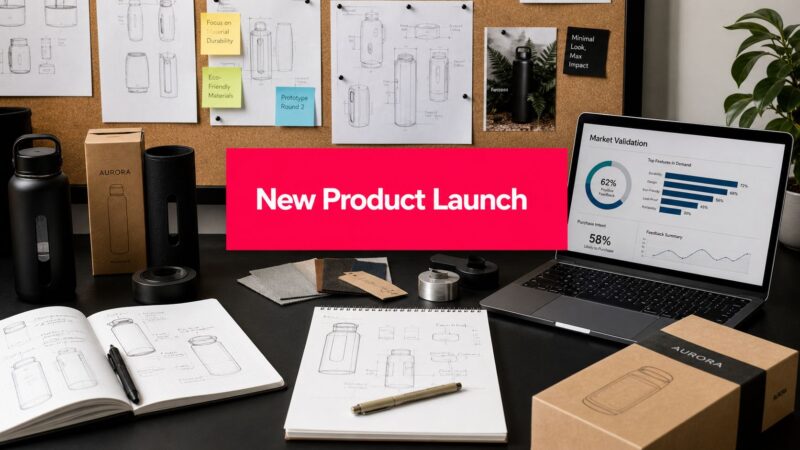
Approximately 30,000 new products are released annually, yet nearly 95% fail. For every successful product, roughly 19 are abandoned. Only 40% of developed products reach the market, and of those, only 60% generate any revenue, according to this product launch statistics roundup citing Clayton Christensen and Forbes.
That should change how you think about new products to launch.
Most brands still treat launch as a campaign that starts after manufacturing. That's backwards. In DTC, the launch starts when you choose the problem, shape the offer, test the message, and put creators in front of the idea before inventory locks you into a bad bet. The brands that de-risk well don't just build a product. They build proof, content, social context, and a repeatable learning loop around it.
A practical launch plan in 2026 looks different from the old retail playbook. You still need product strategy, pricing discipline, and channel planning. But you also need UGC, influencer feedback, creator-led demos, and launch-week content that makes the product understandable fast.
Table of Contents
Why Most New Products Fail and How Yours Can Succeed
The common assumption is that products fail because the product itself wasn't good enough. That's only part of the story. In practice, I see more launches break because teams validate too late, message too vaguely, and expect paid media to rescue weak positioning.

Failure usually starts before launch day
A weak launch often begins with one of three mistakes:
- Teams chase internal excitement: Founders love the concept, but buyers haven't shown clear intent.
- Messaging stays feature-heavy: The page explains what the product is made of, not why someone should care today.
- Content gets bolted on late: The brand finishes production, then scrambles for photos, testimonials, demos, and paid creative.
That sequence creates a familiar funnel. Lots of ideas enter at the top. Most never get real market validation. A smaller group reaches launch with flawed execution. Too many end at the bottom with no sustained demand.
Practical rule: If your product page needs a long paragraph to explain what the item does, your launch risk is already high.
Success comes from process, not luck
The way out isn't magical product intuition. It's a better operating model. Strong teams pressure-test the idea early, look for reasons it might fail, and involve creators before the campaign calendar is locked.
That matters even more for DTC brands, where buyers discover products in-feed, not in a store aisle. If a creator can't explain the product clearly in a short video, your paid ads will probably struggle too. If an early audience doesn't respond to the promise, a bigger spend won't fix the core problem.
A workable launch system has four parts:
- Find sharper opportunities instead of broad, crowded ideas.
- Validate demand before production with offers, prototypes, and feedback loops.
- Build the go-to-market plan early so product, brand, and media work together.
- Launch with creators who generate proof, not just impressions.
The brands that win with new products to launch don't rely on a big reveal. They reduce uncertainty step by step, then show up with assets, clarity, and momentum.
Finding and Prioritizing Winning Product Ideas
Good product ideas rarely come from brainstorming alone. They come from friction. Look at support tickets, return reasons, comment sections, low-rated competitor reviews, product comparison threads, creator complaints, and “how do I use this?” questions on social.
Start with pain that already exists
The most useful shortlist usually includes ideas pulled from places like these:
- Customer support logs: Repeated questions often point to missing accessories, bundle opportunities, or simplified versions of existing products.
- Creator content gaps: If influencers in your category keep hacking together a workaround on camera, there's probably a product opportunity in it.
- Competitor blind spots: Read negative reviews for patterns such as sizing confusion, packaging frustration, setup friction, or unclear instructions.
- Community language: Reddit threads, TikTok comments, and post-purchase surveys reveal the phrases real buyers use. Those phrases often become your headline later.
One of the best filters is whether the problem is annoying enough that people already have a behavior around it. If they've created spreadsheets, DIY fixes, saved videos, or shopping workarounds, the problem is real.
Don't average away niche demand
Many brands miss strong ideas because they study the “average customer.” That approach hides smaller groups with intense needs. Successful launches often target underserved consumers whose pain points are masked by aggregate data. By slicing pilot data by identity and building inclusive build goals, brands can uncover opportunities that broader category players miss, as discussed in this analysis of underserved consumers and product-market fit.
That changes how you prioritize. A niche audience with acute pain can be a better launch wedge than a broad audience with mild interest.
Design for a specific person with a recurring problem. Broad appeal often comes later, after a narrow use case proves itself.
Use a simple scoring matrix
I don't like ideation sessions that end with “we'll know it when we see it.” Score each candidate idea instead. Keep the model simple so the team uses it.
| Criteria | What to ask |
|---|---|
| Customer pain | Is the problem urgent, frequent, or expensive in daily life? |
| Brand fit | Does this feel credible coming from your brand? |
| Message clarity | Can a creator explain the value quickly in a short demo? |
| Margin potential | Can the unit economics support sampling, content, and paid media? |
| Operational complexity | Will packaging, sourcing, compliance, or fulfillment slow the launch? |
| Repeatability | Does this open room for bundles, refills, accessories, or line extensions? |
After scoring, cut aggressively. The goal isn't to pick the most clever concept. It's to identify the product idea you can explain, produce, and sell with the least friction.
For teams shaping visually led consumer products, it also helps to study how content formats are changing. This in-depth analysis of AI video trends is useful because it shows how short-form creative expectations are evolving, which should influence the kinds of products and demos you prioritize.
How to Validate Demand Before You Build Anything
Most brands spend too much money answering the wrong question. They ask, “Can we make this?” before they ask, “Will people buy this from us, with this promise, at this moment?”
That order creates expensive mistakes.

Validate the promise before the product
You don't need final inventory to test demand. You need a believable offer.
Start with a basic landing page, a clear headline, a mockup or prototype, and one core action. That action can be a waitlist join, sample request, consultation booking, or pre-order interest form. The important part is that the page asks for commitment, not passive applause.
Here's a practical sequence that works well for DTC brands:
- Write one sharp problem statement. If you need three angles to make it interesting, you haven't found the angle yet.
- Build a lightweight page. Show the use case, expected outcome, and who it's for.
- Test multiple hooks. One version might lead with convenience, another with comfort, another with status or savings.
- Send traffic from creators and paid social. Different audiences react differently. You want both signal and language.
- Interview the most engaged people. Ask what almost stopped them, what confused them, and what they expected the product to do.
Untapped markets need feedback loops
Validation gets harder when the product is unfamiliar or the category is still emerging. In those cases, poor messaging can kill a good idea early. Seventy percent of new product failures in untapped markets stem from poor communication, not product flaws, and the brands that adapt best create feedback loops to update messaging in real time as confusion appears, according to this analysis of launching in untapped markets.
That means your FAQ, product page, creator brief, and ad hooks should keep evolving during validation. Static messaging is a liability when the audience is still learning the category.
If prospects keep asking the same question, don't just answer it in DMs. Rewrite the offer so the question shows up less often.
Use creators as validators, not just promoters
A prototype in the hands of the right creator can reveal more than a polished internal review. You'll see where setup takes too long, which benefit gets mentioned first, and what wording feels natural when someone explains the product on camera.
A good test group isn't just made of the biggest creators. It should include:
- A category educator: Someone who explains products clearly.
- A niche lifestyle creator: Someone whose audience mirrors your likely first buyers.
- A blunt reviewer: Someone who won't smooth over confusion.
- A conversion-minded UGC creator: Someone who can shoot multiple hooks and CTAs.
If you're organizing prototype testing and early creator feedback, a useful starting point is this creator profile for launch-style content collaboration, which shows the kind of creator-facing setup brands can evaluate when planning pre-launch content.
What good validation actually looks like
Good validation doesn't mean everyone loves the concept. It means you learn exactly where demand is strong, where understanding breaks down, and what language gets people from curiosity to intent.
Use what you learn to answer four questions:
| Question | What you need to know |
|---|---|
| Who wants this most? | Which audience segment responds fastest and understands the value immediately |
| Why do they care? | Which outcome matters most in their words |
| What blocks purchase? | Price resistance, confusion, trust gaps, or timing |
| What content converts? | Demo, testimonial, comparison, unboxing, or explainer |
When brands skip this stage, they usually end up paying to discover basic truths after inventory lands. That's the expensive version of research.
Building Your Unbeatable Go-To-Market Strategy
A validated product idea still fails if the go-to-market plan is loose. DTC brands don't get rewarded for having a good product in isolation. They win when the product, pricing, messaging, operations, and media plan line up tightly enough that the first customer experience feels inevitable.

Four capabilities matter more than budget
The teams that outperform aren't always the ones with the biggest launch spend. Best-performing companies in product innovation achieve a 76% success rate versus the 51% average, and that gap is tied to team collaboration, incorporating market insights, rigorous planning, and talent growth, according to this breakdown of how new products succeed or fail.
That's useful because it points to a concrete operating standard. Your GTM doesn't need more slides. It needs fewer handoff failures.
Build around one core buyer
A lot of launch plans collapse because they're built for multiple audiences at once. One team wants retention. Another wants reach. A retailer wants mass appeal. The founder wants the original niche. The result is usually a blurry product story.
Start narrower.
Create one primary launch persona with five things defined clearly:
- Buying context: What's happening in their life when they decide they need this?
- Current workaround: What are they using today, even if it's clumsy?
- Decision trigger: What makes them act now instead of later?
- Trust requirement: What proof do they need before they buy?
- Preferred content format: Do they respond better to a hands-on demo, a testimonial, a side-by-side comparison, or a creator explanation?
That profile should influence every major decision after it, including packaging copy, pricing architecture, ad hooks, creator selection, and post-purchase education.
Turn the strategy into one-page decisions
The strongest GTM plans I've seen can fit on one page. Not because the work is simple, but because the choices are clear.
Use a framework like this:
| GTM Element | Decision to make |
|---|---|
| ICP | Who is the first buyer, not the eventual broad audience |
| Value proposition | What specific outcome does the product deliver |
| Pricing model | Will you sell it as a hero SKU, bundle, subscription, or add-on |
| Distribution channels | Where will the buyer discover, evaluate, and purchase it |
| Marketing and sales plan | Which assets, offers, and sequences will move them from attention to conversion |
A product that requires education often needs a starter bundle or a demonstration-led landing page. A lower-friction product may work as a hero item with lighter education and heavier social proof.
Align the people doing the work
Most launch problems are cross-functional problems. Product chooses features without hearing sales objections. Performance marketing scales hooks that support can't defend. Creative teams deliver polished assets that don't answer real buyer questions.
That's why I prefer a weekly launch review that includes product, creative, paid media, customer support, and operations. The goal isn't status reporting. It's issue removal.
The best launch meeting is short and uncomfortable. It forces each team to name what buyers still don't understand and what the business still can't support.
If you need a centralized workflow for creator collaboration, content approvals, and launch asset management, JoinBrands is one option teams use to coordinate creator work inside the broader GTM process.
Activating a Creator-Driven Launch Campaign
A creator campaign should do more than “spread the word.” It should teach the market how to understand the product, show proof in different contexts, and produce assets your paid team can keep using after launch week.
That only happens when the brief is specific.

Write briefs that create usable content
Most weak creator campaigns start with lazy instructions. “Make it authentic” isn't a brief. “Show how this solves the getting-ready routine in under a minute, include the setup, mention what surprised you, and end with who it's for” is a brief.
A strong launch brief usually includes:
- The audience context: Who should see themselves in the content.
- The product moment: When the product enters their day or routine.
- The key belief to transfer: The one thing the viewer should understand after watching.
- Mandatory proof points: Setup, texture, result, before/after, portability, ingredients, fit, or durability.
- Content constraints: Duration range, hook style, usage rights, platform format, and delivery deadlines.
Not every creator should get the same angle. Give each one a lane. One handles unboxing. Another does comparison. Another focuses on use-case education. Another shoots clean B-roll your brand can repurpose later.
Build a launch-week content stack
Think in layers, not one-off posts. A product launch needs a stack of creator assets that work at different buyer stages.
Here's a practical mix:
- Teaser assets: Short curiosity clips, packaging glimpses, routine disruption hooks.
- Announcement content: Direct “it's live” posts with clear value and buying context.
- Explainer videos: Why this exists, who it's for, how it works.
- Demo content: Hands using the product in a realistic setting.
- Social proof clips: First impressions, reactions, common objections answered.
- Paid-ready variations: Different hooks, captions, and opening frames for testing.
Creator selection matters. A launch needs both trust and throughput. You want a few people who can explain well and a broader group who can generate asset volume fast.
Coordinate timing like a retailer, not a hobbyist
Brands often underestimate pacing. If every creator posts the same day with the same angle, the content blurs together. If they post too far apart, you lose momentum.
A cleaner rollout looks like this:
| Phase | Creator objective |
|---|---|
| Pre-launch | Build curiosity, collect questions, surface confusion |
| Launch day | Publish clear demos, announce availability, drive clicks |
| First week | Reinforce proof, answer objections, introduce variations in use case |
| Post-launch | Repurpose winners into ads, product pages, email, and retargeting |
Later in the campaign, a walkthrough like the one below can help teams think through creator content execution and launch pacing in a more visual format.
Use creators to find your ad angles
One of the biggest modern advantages of creator-led launches is speed of learning. Your brand no longer has to guess which opening line, objection response, or visual framing will resonate. Creators generate those signals in public.
Look for patterns like these:
- Hooks that stop the scroll: Surprise, frustration, transformation, convenience.
- Natural language: The exact words creators use when they're not reading brand copy.
- Confusion points: Moments where the explanation gets clunky or defensive.
- Demonstration triggers: The visual proof that makes the product click immediately.
A single high-performing creator video often gives you several next moves. It can become a paid ad, a product page embed, an email asset, a retailer pitch visual, and a script template for other creators.
If you're evaluating creator styles for UGC-heavy launch campaigns, this creator example focused on product-style content shows the kind of practical profile review brands should do before assigning deliverables.
Pro tips for launch week
Don't ask creators to sound like your brand. Ask them to sound like themselves while landing one clear buyer takeaway.
A few tactics consistently improve launch execution:
- Front-load product education: Include a one-page cheat sheet with objection handling, setup notes, and claims your team can support.
- Request raw footage when possible: Edited videos are useful, but raw clips give your team more flexibility for paid iterations.
- Approve for clarity, not polish: Slightly imperfect content often feels more believable than studio-clean assets.
- Tag content by use case: Organize assets around routine, audience, objection, and platform so reuse is fast.
- Keep a response loop open: As comments roll in, update talking points and ask later creators to answer emerging objections.
That's how creator marketing stops being a top-of-funnel vanity play and becomes part of product validation, launch execution, and post-launch conversion.
Measuring Your Launch Success with the Right KPIs
A launch can look busy and still be weak. Lots of comments, lots of views, lots of first-week orders. None of that guarantees staying power. Early revenue can hide a message problem, a repeat purchase problem, or a product education problem.
For DTC brands, launch reporting should track the full path from awareness to activation to repeat behavior.
Build a scorecard that ties attention to action
I like a simple KPI scorecard that keeps teams honest. It should include leading indicators, conversion indicators, and post-purchase signals. If you only track sales, you'll miss where the funnel is breaking.
Product Launch KPI Scorecard
| Funnel Stage | KPI | Example Metric | Benchmark (First 30 Days) |
|---|---|---|---|
| Awareness | Reach quality | Are the right audiences seeing the product and understanding it | Establish a baseline and compare by channel |
| Engagement | Content response | Saves, shares, comments, replies, creator content completion | Look for improving engagement on clearer messages |
| Consideration | Product interest | Email signups, waitlist joins, add-to-carts, sample requests | Track steady week-over-week quality, not spikes alone |
| Conversion | First purchase behavior | Orders, landing page conversion patterns, bundle uptake | Compare by message angle and creator asset type |
| Activation | Critical user action | The moment a buyer gets core value from the product | Shorter time to value is stronger than launch-day hype |
| Retention and sentiment | Reviews and repeat signals | Review themes, support questions, repeat orders, organic mentions | Positive trend in clarity and satisfaction over time |
Watch the metrics that explain sustainability
A useful launch dashboard answers practical questions:
- Which creator assets drove qualified traffic?
- Which message angle produced the fewest pre-purchase questions?
- Which audience segment activated fastest after buying?
- Which objections kept showing up in support and comments?
The most important discipline is separating vanity metrics from operating metrics. A video with huge reach may teach you nothing. A smaller asset that drives better add-to-cart behavior or cleaner post-purchase feedback is usually more valuable.
A healthy launch doesn't just attract attention. It reduces friction as the buyer moves from first impression to first successful use.
When teams review KPIs weekly instead of waiting for a postmortem, they can adjust creator briefs, landing page copy, bundle structure, and support scripts while the launch is still alive.
Optimizing and Scaling After Your Launch
Launch day is when the learning gets expensive and useful at the same time. Once customers are buying, commenting, returning, reviewing, and filming their own experiences, you finally get the signal you couldn't fully model in advance.
The first few weeks matter most because early velocity predicts long-term survival. To survive long-term, a new product must reach a peak market share of 4.5% within the fourth week post-launch, according to this 12-year analysis of new product launches.

Days one through thirty
The first month is not the time to chase every possible channel. It's the time to tighten what's already working.
Focus on three things:
- Message refinement: Update PDP copy, FAQs, and creator talking points based on real objections.
- Content reuse: Turn the clearest creator demos into paid variants, email blocks, and review request flows.
- Customer success: Make setup, onboarding, and first use easier than your team thinks is necessary.
A practical example is a product that sells well from a convenience hook but gets support questions after delivery. That usually means the ad was stronger than the onboarding. Fix the unboxing insert, usage instructions, and post-purchase email before scaling spend.
Days thirty through sixty
By this point, patterns start to harden. Some creators will outperform others. Certain use cases will convert better. Some bundles will in fact outperform the hero SKU.
Run a disciplined review:
| Area | What to inspect |
|---|---|
| Customer feedback | Repeated confusion, delight moments, and unexpected use cases |
| Sales behavior | Which variants, bundles, or entry points buyers prefer |
| Paid creative | Which creator hooks still hold up after repeated exposure |
| Operations | Stock risk, packaging issues, shipping friction, return reasons |
This is also when early customers can become your best assets. Ask for reviews, routine videos, comparison content, and “how I use it” clips. A profile like this creator example for collaborative launch content reflects the kind of partnership style brands often need as they move from initial launch into sustained social proof generation.
Days sixty through ninety
By month three, you should know whether the product needs optimization, repositioning, broader distribution, or a slower burn.
The brands that scale well usually do four things:
- Double down on the clearest audience.
- Retire weak messaging angles fast.
- Plan the next asset wave before fatigue sets in.
- Feed product insight back into the roadmap.
If buyers love the outcome but struggle with setup, improve the onboarding. If one niche segment responds much better than the general market, lean into that segment. If creators consistently frame the product differently than your brand does, pay attention. They may have found the sharper story.
A strong launch doesn't end with inventory sold. It creates a repeatable system for deciding which new products to launch next, how to message them faster, and how to bring proof into market before doubt has time to spread.
If you're building a launch plan that depends on UGC, influencer collaboration, and reusable social proof, JoinBrands is worth evaluating as part of your workflow. It gives brands a way to organize creator sourcing, briefs, content delivery, and launch asset production in one place so the campaign doesn't stall between idea validation and post-launch scaling.