
 7 Brand Collaboration Email Templates for 2026 Success
The video is doing numbers. A creator filmed your product on her kitchen counter, posted it, and the comments are full of people asking where to buy it. Your media buyer wants budget behind it by Friday.
You have a signed release from the creator. What you don't have in writing is anything about the song playing under her voice, the friend whose hand reaches into frame at second six, or the fact that she shot the whole thing in a rented apartment whose lease bans commercial filming.
That gap is what UGC usage rights work covers, and it's rarely the creator's own signature that's missing. It's almost everything else inside the frame.
Table of Contents
Who Owns UGC by Default and What Brands Need
A photographer sells you a framed print. You own the paper, the frame and the image on it. You don't own the right to blow that image up across a billboard. Creator video runs on the same logic, and brand teams trip on it constantly, because a delivered file feels like a transferred right.
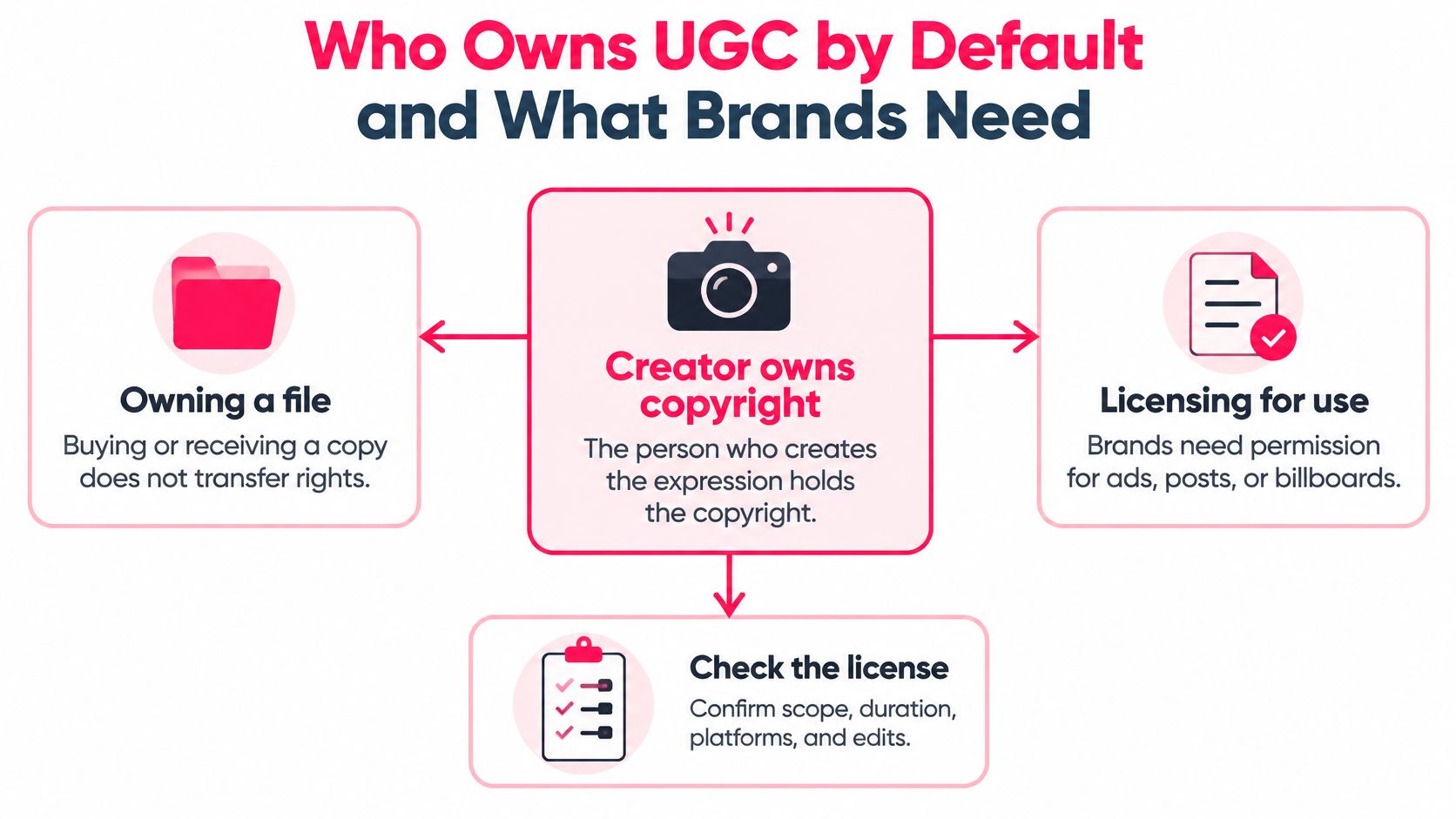
By default, copyright sits with the person who made the expression. A creator who films your product at her own kitchen table owns that footage until she signs something that says otherwise. No registration is needed for that to be true, and no invoice changes it.
The U.S. Copyright Office treats ownership as divisible rather than all or nothing. Copyright may be transferred in whole or in part, and individual exclusive rights, including those under Section 106, can be transferred and owned separately. So you can take a limited license for organic reposting plus paid social while the creator keeps everything else, or you can take an assignment of particular rights. What you can't do is lean on a general ownership phrase and assume it reaches a channel nobody listed.
Here's the distinction in one frame.
The four ways a brand gets rights
Most agreements collapse into one of four models, and each one changes what your team can do without going back to the creator.
| Model | What the brand gets | Typical use | Main risk |
|---|---|---|---|
| Limited license | Permission for listed uses only, creator keeps the copyright | Organic reposting and paid social for 12 months | Permission lapses at term end and must be enforced |
| Exclusive license | Sole permission for listed uses, creator may not license the same uses elsewhere | Category-exclusive campaigns | Higher fee and harder to police |
| Full assignment | Transfer of specific copyright rights to the brand | Long-term brand content library | Creator cannot reuse the work, so price and terms need agreement up front |
| Content-only delivery | Video file delivered, brand posts from its own account | Product pages, ads and social posts | Terms vary by provider, so confirm what ownership means in writing |
The last row deserves scrutiny because it's the one brands misread most often. With Content Only, creators film and deliver the UGC asset directly to the brand, which owns it and can post it wherever it likes. That's a clean arrangement and it's how a lot of marketplace content gets bought. But "owns it" means whatever the provider's terms say it means, so read the language before you build a product page around it. If the creator is an independent freelancer instead of a marketplace seller, the ownership question overlaps with employment and work-for-hire rules, and who owns your freelancer's work walks through how those agreements are structured.
Three questions to settle before anyone films
Every deal has to answer the same three things, in writing, before the camera turns on. Which media will the brand use: organic social, paid social, website, email, retail screens, television? For how long, with a real start and end date rather than "while the campaign runs"? And in which territory, because a license that's silent on geography becomes a fight the moment you launch in a second market.
If the answer to any of those is "we'll sort it out later," you've agreed to negotiate later, after the content has performed and the creator holds full control.
UGC Clauses to Write Down Before Filming
A usage right that lives in a campaign brief or a Slack thread isn't a usage right. It's a hope. Copyright protection attaches to creative expression, but the commercial permissions you need for advertising, reproducing, publicly displaying, distributing, adapting and synchronizing content have to be expressly granted or transferred, and the U.S. Copyright Office guidance on transfers makes that separation plain.
The control that makes this manageable is a rights matrix keyed to an asset ID. Every approved video gets one row: creator identity and their authority to license, delivery date, approved version, permitted placements, expiration date, and evidence of consent from any identifiable person or third-party rights holder. When someone asks in month eight whether you can still run a video, the answer is a lookup, not an email chain.
The clauses, one at a time
| Clause | What to specify | Sample wording |
|---|---|---|
| Assets covered | Asset IDs and the approved final version | Asset 1184, approved final cut only, raw footage excluded |
| Channels | Organic, paid, website, Google listing | Organic social, paid TikTok and Meta ads, brand website |
| Territory | Countries or worldwide | Worldwide |
| Term | Start date, end date and renewal | 12 months from approval, no automatic renewal |
| Paid media | Whether ads are allowed and on which platforms | Paid social only, no TV or programmatic |
| Editing | Cropping, subtitles, captions, derivative cuts | Cropping and subtitles allowed, no voice changes |
| Exclusivity | Whether competitors may use the same content | Non-exclusive |
| Sublicensing | Whether agencies or platforms may use the content | Agency may run the content for the brand only |
| Survival | What happens if the creator ends the relationship | Approved assets may run until the term ends |
Notice how much work Sublicensing and Survival do. Your agency runs the ads from its own ad account. Your media partner uploads to a demand-side platform. Neither is covered unless the clause says so, and neither survives the creator walking away unless you wrote that in.
Take a concrete case. You want a 12-month, non-exclusive paid and organic social license. Write those words. "We can use it for ads" is not the same sentence, because it doesn't fix the duration (ads for how long?), doesn't name the platforms, and doesn't address what happens at month thirteen when the asset is still your best performer.
Practical rule: list every editing change you might want, cropping, subtitles, a new voiceover, a re-cut for a different aspect ratio. A blanket "editing allowed" clause gets disputed the first time the creator sees a version she doesn't recognize as her own work.
Two more clauses belong in the same document, not a side email. A creator warranty of originality, where she confirms the footage is hers and she has the right to license it. And a disclosure schedule listing any embedded third-party material: music, stock elements, logos, other people. Those two sentences are what let you defend a claim later.
The three documents to keep
Store these together, tied to the asset ID, and you're in good shape. The signed license, with the term and permissions spelled out. The approved version, meaning the exact file, because approval of a rough cut isn't approval of anything else. And the consent records, the signed releases from anyone visible and the proof of any third-party rights.
Plenty of platforms now bake that end state into the transaction. On JoinBrands, full content ownership and perpetual usage rights transfer to the brand upon approval, with no additional licensing fees, which is the outcome a well-drafted clause is trying to reproduce. If you're writing your own agreement from scratch, the UGC creator contract breakdown is a useful template to work from before your lawyer sees it.
Clearing the People, Music and Places in a Video
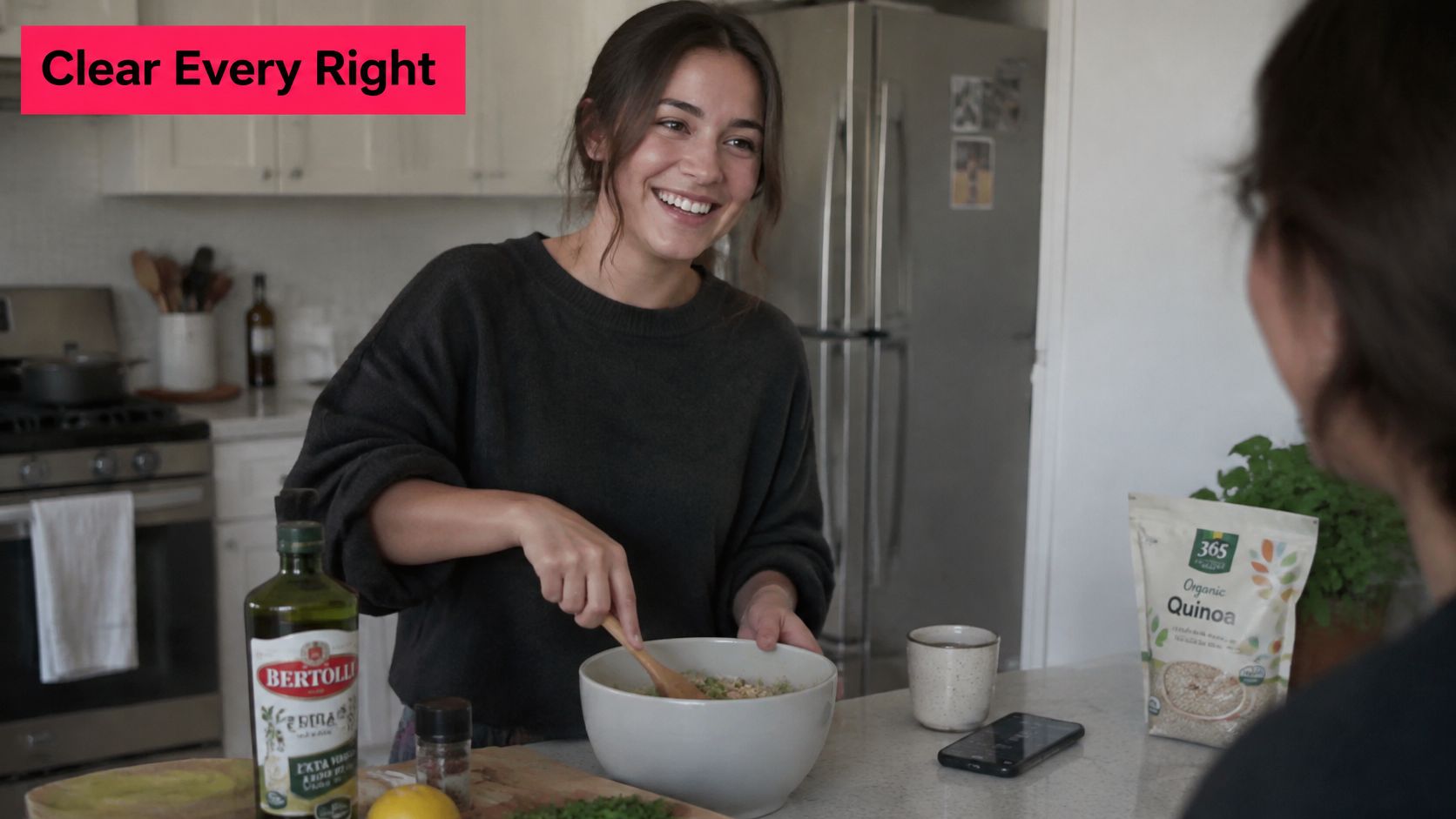
Say a creator films in her kitchen. She's talking to someone off camera, so a friend's voice is on the audio track. A licensed song plays from a speaker behind her. A branded product package sits on the counter, label facing the lens. The flat is rented, and the tenancy agreement prohibits commercial filming.
She signs a release. Now ask what that release covers. Her own performance, and nothing else.
A creator who can license her face and voice often has no authority to commercially exploit a friend, a child, an employee, a customer, a copyrighted music track, a third-party logo, or footage recorded in a privately owned space. Rights clearance is a separate workflow from rights acquisition, and most UGC guidance skips straight past it.
A public post is not a permission slip
The most expensive assumption in creator marketing is that visible means usable. Copyright and privacy interests survive the moment a video goes public. A post being viewable by anyone with a phone doesn't transfer the right to put the same footage behind a paid ad in three markets. This is the part of rights clearance that is underserved in most brand playbooks, and it's the part where a signed creator release stops being enough.
Build a clearance record per creator
Not per campaign. Per creator, per asset. The record needs to answer who appears on screen and on the audio track, who owns the music and the footage, whether minors are present, which territories the consents cover, and whether edits or synthetic alterations are permitted. A global campaign needs a market-by-market check, because publicity and privacy rules differ substantially between countries and a consent valid in one doesn't travel automatically.
Four things worth asking every creator to confirm in writing:
- Everyone visible or audible, by name, including the person holding the camera and the friend laughing off screen.
- Music source and license, whether that's a commercial track, a platform library, or something the creator produced.
- Product packaging and logos, including any competing brand that happened to be on the counter.
- Filming location and consent, particularly for rented property, a workplace, or someone else's home.
Music is its own trap. A track that's fine in an organic post often isn't cleared for paid use, and the platform's licence covers the platform, not your ad account. If the audio matters to the creative, read up on social media music licensing for brands before the ad goes live rather than after.
Plan the exit before you need it
Someone will withdraw consent eventually. A friend gets spooked, a landlord complains, a musician's label sends a notice. The remedy plan is simple and almost nobody writes it down: pause every paid placement on the affected asset within hours, swap in an alternative cut, and notify whoever runs the ad accounts.
The stakes are not theoretical. In 2024, nearly 95% of creators surveyed said brands should ask permission before using their UGC, according to the MASV and Dynata survey reported by AccessNewswire. And 31% of creators surveyed said they eventually received payment after flagging unauthorized use of their content, per Netinfluencer's summary of MASV's report. Creators notice, they speak up, and a portion of the time they get paid for it.
Spark Ads and Branded Content Authorization
A signed contract does not authorize paid media on every platform. Each platform runs its own permission step, and skipping it is the single most common reason a "licensed" creator video gets rejected at ad setup.
Here's the sequence for a TikTok Spark Ad, where the brand promotes a post that lives on the creator's account.
- Agree the specifics. The exact post URL, the ad account that will run it, and the campaign start and end dates.
- The creator generates an authorization code. She picks an authorization period herself.
- The brand applies the code to connect the ad account to her post.
- Store the code and the written permission in the campaign record, not someone's inbox.
- Before the organic video is deleted, remove its Spark Ad authorization first, because TikTok requires that step before deletion.
The authorization period is where campaigns go wrong. The creator chooses 7, 30, 60 or 365 days, according to TikTok's Spark Ads documentation. Match it to the flight, don't guess. A brand running a 30-day campaign should request 30-day authorization and keep the code on file as evidence of the exact scope. A 365-day code on a 30-day campaign is sloppy in the other direction: it leaves authorization live long after anyone is watching.
The deletion trap catches people at the worst possible moment. You can't retire a creator's organic post while it's still authorized as a Spark Ad, so plan replacement content before the campaign ends rather than discovering the constraint on the last afternoon.
Meta runs a different gate. The platform treats content as branded content when the creator receives an exchange of value, including money or free products. That content may only be posted using Meta's branded-content tool, and the creator must tag the featured brand with that brand's prior permission. Meta also states that creators can't accept value for content they didn't create or weren't involved in creating, per Meta's branded content requirements. A usage-rights release doesn't substitute for those steps. The brief should require the creator to use the branded-content label, identify the sponsoring business, and get approval before posting.
Platform mechanics get fiddly fast, which is why it helps to see how Spark Ads work end to end before you brief a creator on deliverables.
Disclosure Rules That Survive Editing and Reposting
A creator's license and a compliant endorsement pass through two separate approval gates. Clearing the first doesn't clear the second. Teams that treat them as one process end up with airtight copyright paperwork on an ad that never disclosed the payment behind it.
The FTC's position is that a material connection, whether that's payment, employment, a family or personal relationship, or free or discounted products, must be disclosed clearly and with the endorsement itself. For video, the disclosure belongs inside the video, not only in the description field. The commission also warns that platform-native disclosure tools may not always be adequate, and its disclosures guidance for social media influencers assigns responsibility across advertisers, endorsers and intermediaries. The practical side of those rules, what counts as clear and conspicuous in a real post, is laid out in how the FTC guidelines apply to influencers.
Follow one asset through four placements, because each handoff can strip the disclosure out.
The organic post. The creator says she was gifted the product in the first four seconds. Fine.
The brand-owned repost. Same file, uploaded natively to the brand's account. The audio and visual disclosure travel with it, so this one usually holds. Owning the file outright doesn't change that obligation. Brands that purchase content with full usage rights, the way JoinBrands transfers 100% ownership of approved content to the seller, own the disclosure problem along with the footage.
The whitelisted or Spark-style ad. Same file, now running as paid media from the creator's handle. Still visible, but the surrounding context changed, and the placement may need its own review because the format differs.
The edited cut. This is the failure. A 15-second cut trims the opening line where she mentioned the gift, the caption gets replaced with brand copy, the audio gets swapped for a licensed track. Every element that carried the disclosure is gone, and the asset now reads as an unprompted endorsement. The new track creates a second problem too: it needs its own clearance, so the cut fixes a runtime problem while introducing a fresh rights question.
What actually works
Encode disclosure status in the asset record, not in the brief document. Then validate it per placement rather than per campaign. A practical setup looks like this:
- A disclosure flag on each asset ID, set at approval, so nobody has to remember.
- Visible or audible disclosure in every derivative, checked at the point of export.
- An audit log linking four things: the paid brief, the creator's compensation or product seeding, the approval record, and the final rendered file. When a regulator or a platform asks, that chain is your answer.
There's a regulatory backdrop brands forget until a platform asks for paperwork. The EU's Directive (EU) 2019/790, adopted on 17 April 2019, requires online content-sharing service providers to obtain authorization from copyright holders, typically through licensing agreements, when protected works uploaded by users are made available to the public. That's one reason platforms ask for licence evidence before hosting content, so check how your campaign reaches EU audiences even when you're based elsewhere.
AI Edits, Dubbing and Digital Likeness Rights
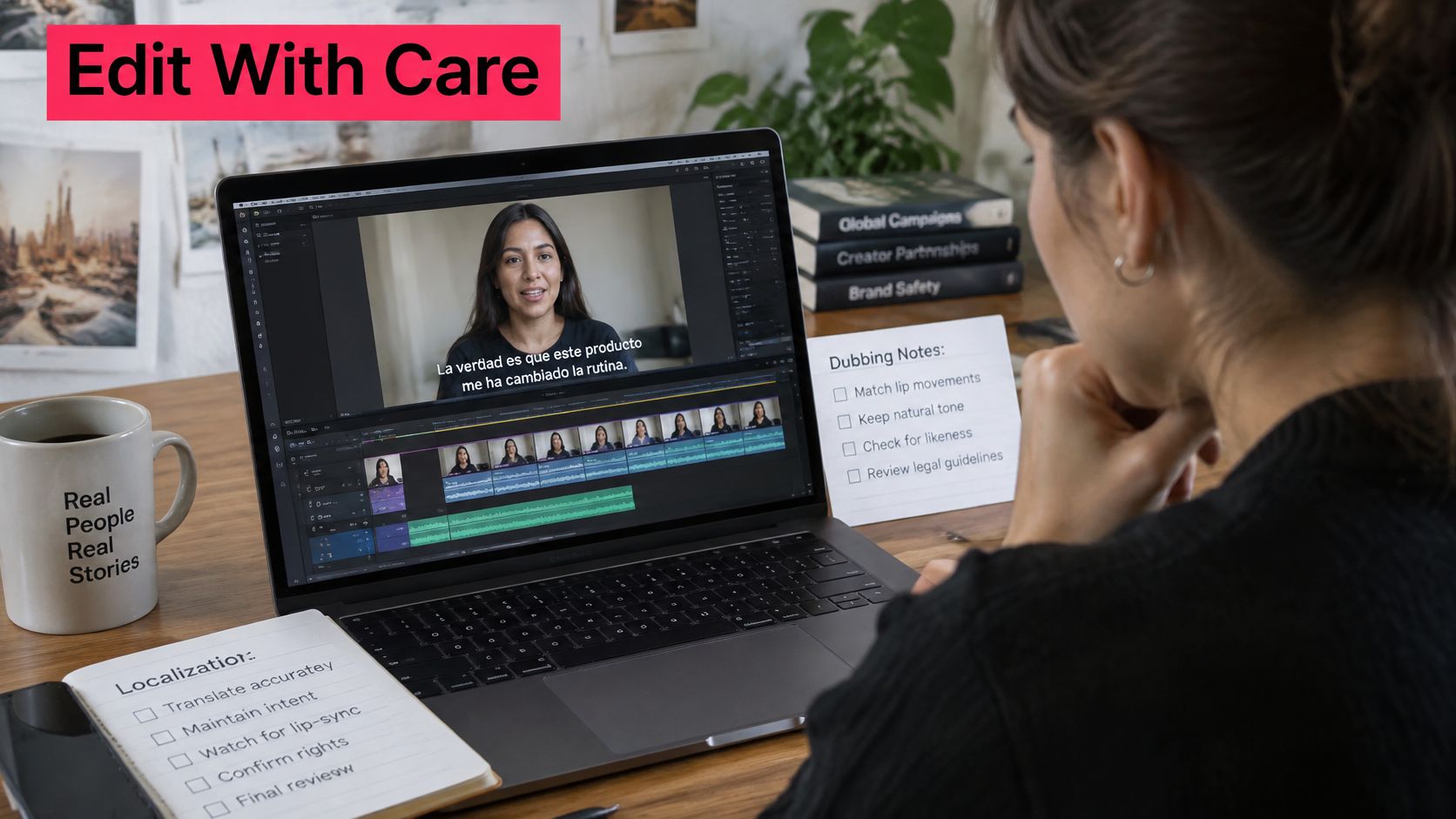
A creator's English testimonial performs well and your team wants a Spanish version with her lips matching the new audio. The footage is licensed. The dubbing request lands with localization as if it were a caption pass.
A license to edit does not automatically include a license to replicate an identity. Cropping the frame, adding subtitles, changing the grade and cutting a 9:16 version sit in ordinary production. Voice cloning, lip-sync, face animation and any reusable model of the creator's features sit in a different category because they create an asset built from a person. Price and approve that category separately.
The clearance gap usually sits one layer past the signature: the cloned voice, the synthetic lip-sync, the reusable face file. Those are the elements a standard UGC release often leaves implied, and implied permission is where localized versions get risky.
What the contract has to say
A line that reads "AI rights included" leaves the argument for later. Write the controls into the order instead:
- Permitted tools, named, so the edit cannot drift into whatever plugin a vendor installed.
- Prohibited transformations, stated plainly, if the creator will not accept synthesized face or voice output.
- Consent scope per output, covering language versions, cutdowns, paid placements and any reuse of the trained file.
- Disclosure placement, meaning where the synthetic label appears and how long it stays on screen.
- Provenance records, so you can show which source file generated which derivative, on which date, with which tool.
- Takedown and withdrawal rights, with a defined route if consent is revoked after delivery.
- Separate compensation for a reusable digital likeness, priced as its own line rather than folded into the video fee.
The disclosure obligation does not disappear because the face or voice is generated. The FTC's endorsement guidance applies across social and influencer marketing, and its material-connection principles still govern a synthetic cut that reads as authentic creator content. If a viewer cannot tell whether the creator said it or a model said it in her voice, that confusion is the problem the rules are aimed at.
The deadline worth diarising
The EU AI Act sets Article 50 transparency obligations that apply from 2 August 2026 and require clear disclosure for deepfakes and certain AI-generated or manipulated content. If that Spanish testimonial is aimed at EU viewers, put the label and provenance fields into the export spec now rather than leaving them to the localization team.
Add the AI clause to the template before the campaign that needs it. Decide in advance whether voice cloning is allowed at all, and treat a reusable likeness as a separate product with term, territory, revocation and fee. I would rather lose a clever localized edit than discover after launch that the only permission held covers cutting the video shorter.
Clearing a UGC video means clearing more than a signature, and the brands that get it right treat rights, platform permissions and disclosure as one workflow rather than three. JoinBrands gives you full ownership and perpetual usage rights on approved content, so you can run it across Meta, Google, TikTok, your website and other brand channels without a renewal conversation, while the review flow lets you approve every asset before anything ships. Browse the JoinBrands platform to see how content-only and content-plus-posting campaigns are set up, and get the rights question settled before the video starts performing.