





 Content Creators on Instagram: Your 2026 DTC Guide
Your DTC campaign is live. Creators are posting, attributed orders are appearing, and the percentage you negotiated looks affordable. Then finance checks the numbers. Refunds are rising, discount-heavy partners are taking credit for customers who were already close to buying, and the margin left after commissions is thinner than expected.
That failure usually isn't caused by choosing the “wrong” percentage. It comes from choosing a payout structure before deciding which behavior the partnership should reward. Revenue sharing models shape creator decisions, attribution disputes, fraud exposure, and accounting workload long before the first payout reaches a partner.
Table of Contents
Why Your Revenue Share Number Is the Wrong Place to Start
A brand manager once launched a creator program with a flat 15% commission because it sounded competitive without appearing reckless. The offer attracted plenty of partners. Sales volume increased, but the dashboard soon showed a less useful pattern: creators optimized for coupon distribution, last-click capture, and fast transactions rather than qualified demand.
The percentage had looked reasonable in negotiation. The structure wasn't. A generous rate on poorly defined revenue can cost more than a smaller rate attached to cleaner attribution and better customer quality. A 15% share with a disciplined attribution rule may outperform a 30% share that pays multiple partners for the same order or rewards traffic that converts only after heavy discounting.
Start with four decisions:
- Behavior: Do you want reach, qualified clicks, first purchases, renewals, or profitable revenue?
- Measurement: Can your team identify the partner, customer, order, refund, and renewal reliably?
- Economics: Which revenue base can support the payout after discounts, refunds, payment costs, and fulfillment?
- Control: How much influence should the partner have over pricing, brand usage, and customer ownership?
Revenue sharing has moved far beyond informal commissions. Historical evidence traces profit-sharing arrangements to Venice's commercial expansion around 810 BCE, while an early French workforce-compensation experiment appeared in 1820. In the United States, the State and Local Fiscal Assistance Act created General Revenue Sharing in 1972, and the program ultimately expired on September 30, 1986, after distributing billions through a large institutional system, as documented by this history of revenue sharing.
The practical lesson is simple: choose the incentive first, then set the number.
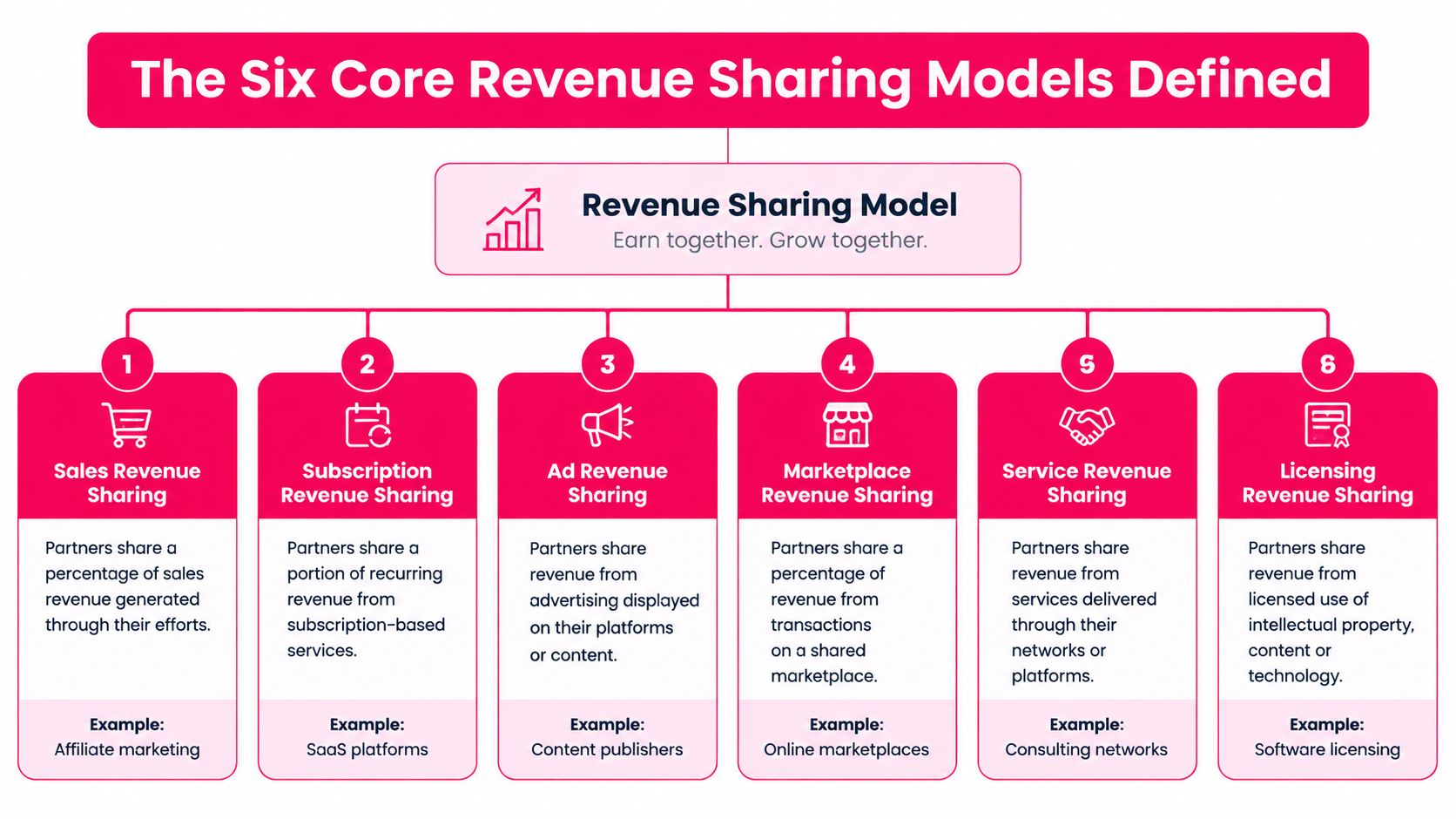
The Six Core Revenue Sharing Models Defined
The easiest way to classify an offer is to identify what gets measured and what event triggers payment. The six models below cover most brand, creator, platform, and commercial partnership arrangements.
Affiliate commissions
An affiliate commission pays a partner a percentage of attributed sales. The formula is:
Payout = eligible revenue × commission rate
For example, a creator earning 15% of $1,000 in monthly course sales receives $150, as shown in Intuit's revenue-sharing example. The contract must define eligible revenue, attribution, refunds, and the payment schedule.
CPA arrangements
Cost per acquisition, or CPA, pays a fixed amount for a defined conversion, such as a completed order, qualified lead, or activated account. The formula is:
Payout = approved conversions × fixed acquisition fee
A partner might receive a set fee for each validated new customer rather than a percentage of the order value. The business measures completed, eligible actions, not the total revenue generated by each action.
Profit-sharing agreements
Profit sharing distributes an agreed portion of profit rather than top-line sales. The formula is:
Payout = defined profit base × partner share
The contract needs a precise profit definition. If one party includes fulfillment and support costs while the other excludes them, the model becomes an accounting dispute disguised as a partnership.
Licensing revenue share
Licensing pays the rights holder a percentage of revenue generated from licensed intellectual property, a product design, content library, formula, or brand asset. The formula is:
Payout = licensed-product revenue × royalty rate
A beauty brand could license a creator's content or product concept and pay royalties on the resulting sales. The agreement should specify permitted uses, territory, channels, reporting, and approval rights.
Equity-linked participation
An equity structure gives a contributor ownership or ownership-like participation instead of, or alongside, cash compensation. The financial outcome depends on the value and terms of the equity rather than a routine sales calculation.
This model fits strategic contributors who create durable enterprise value, not short campaigns where a brand needs a clean monthly payout. It also requires legal and tax review because ownership rights, vesting, dilution, and exit conditions matter more than a simple commission rate.
Hybrid structures
A hybrid combines a fixed fee with variable compensation. A documented example uses a US$2,000 base fee, 12% commission on attributed sales within a 30-day window, and milestone bonuses of US$500 above US$10,000 in attributed revenue and US$1,000 above US$25,000, according to this hybrid compensation example.
Comparing the Models Side by Side
The right model depends on the business event you can measure without argument. Affiliate commissions and CPA arrangements work well when the brand can validate conversions. Profit sharing becomes harder when cost allocation changes. Licensing and equity can create durable alignment, but they demand stronger legal, financial, and governance processes.
| Model | Payout Logic | KPI Rewarded | Fraud Risk | Best Fit |
|---|---|---|---|---|
| Affiliate commission | Percentage of attributed sales | Revenue and conversion quality | Medium | E-commerce and creator sales |
| CPA | Fixed payment per approved action | Valid acquisitions | Medium to high | Lead generation and defined conversions |
| Profit sharing | Percentage of defined profit | Contribution to profitable growth | Medium | Joint ventures and shared operations |
| Licensing | Royalty on licensed-asset revenue | Product sales using the asset | Low to medium | Brand, content, design, or IP partnerships |
| Equity | Ownership or value participation | Long-term enterprise value | Low in transaction terms, high in governance complexity | Strategic company-building relationships |
| Hybrid | Base fee plus variable payout | Delivery plus revenue performance | Medium | Creator campaigns and uncertain demand |
Predictability versus alignment
Fixed CPA payments are easier to forecast than open-ended revenue shares, but they can encourage partners to prioritize conversion count over order quality. Affiliate commissions align payment with realized sales, yet the brand still carries attribution and refund risk.
Profit sharing appears highly aligned, but it often creates the most room for disagreement because “profit” depends on the accounting rules in the contract. Licensing is more predictable when product sales are cleanly separated. Equity postpones cash cost, but it doesn't eliminate economic cost.
Where scale changes the answer
Pure revenue share makes sense when demand is uncertain and the partner creates incremental sales. It becomes less attractive when the brand can predict demand, conversion, and partner output. At that point, the percentage can operate like a tax on scale, while the partner may prefer a flat fee that reflects known delivery requirements.
The creator economy is also moving toward subscriptions and direct payments alongside advertising, as discussed in this 2026 creator-economy analysis. The commercial implication is clear: alignment is valuable, but it isn't automatically worth giving away an uncapped percentage forever.
The Incentive Each Model Actually Creates
Payment logic is behavior design. Pay for clicks and you'll get clicks. Pay for total content volume and you'll get more content, even when much of it produces weak buying intent. Pay only on downstream revenue and you'll attract quality-focused partners, but slower conversion paths may become unattractive to creators.
Academic work on platform allocation highlights the difference between pro rata and user-centric systems in music streaming. The distinction matters for brand partnerships because a pooled payout can distribute money according to total output, while a user-level system attempts to connect value to the behavior of individual users, as explored in the Management Science research on platform payout logic.
What each structure pushes partners to do
- Affiliate sales: Partners seek purchases, but may focus on last-click tactics unless the contract recognizes assisted influence.
- CPA: Partners pursue approved conversions and may avoid audiences that require education or multiple interactions.
- Profit sharing: Partners care about profitable outcomes, although they may challenge the brand's cost allocations.
- Licensing: Rights holders prioritize asset usage and product performance rather than daily promotional activity.
- Equity: Contributors think about durable company value, not just campaign-level output.
- Hybrid: The base fee supports delivery, while variable pay directs attention toward the commercial outcome.
Engagement-based systems create a different problem. A creator can generate comments, views, or clicks without producing buyers. If the brand pays from a single engagement pool, high-volume, low-intent activity can absorb budget while a smaller creator with stronger purchase intent receives too little.
Design rule: Tie every payout event to the KPI your finance team would defend in a board meeting.
A DTC team should therefore separate attention metrics from commercial metrics. Use engagement to assess creative health and audience fit. Use validated revenue, contribution margin, or approved acquisitions to release variable compensation. Don't let an easy-to-count metric become the default measure of value.
Setting Up the Contract, Tracking, and Payouts
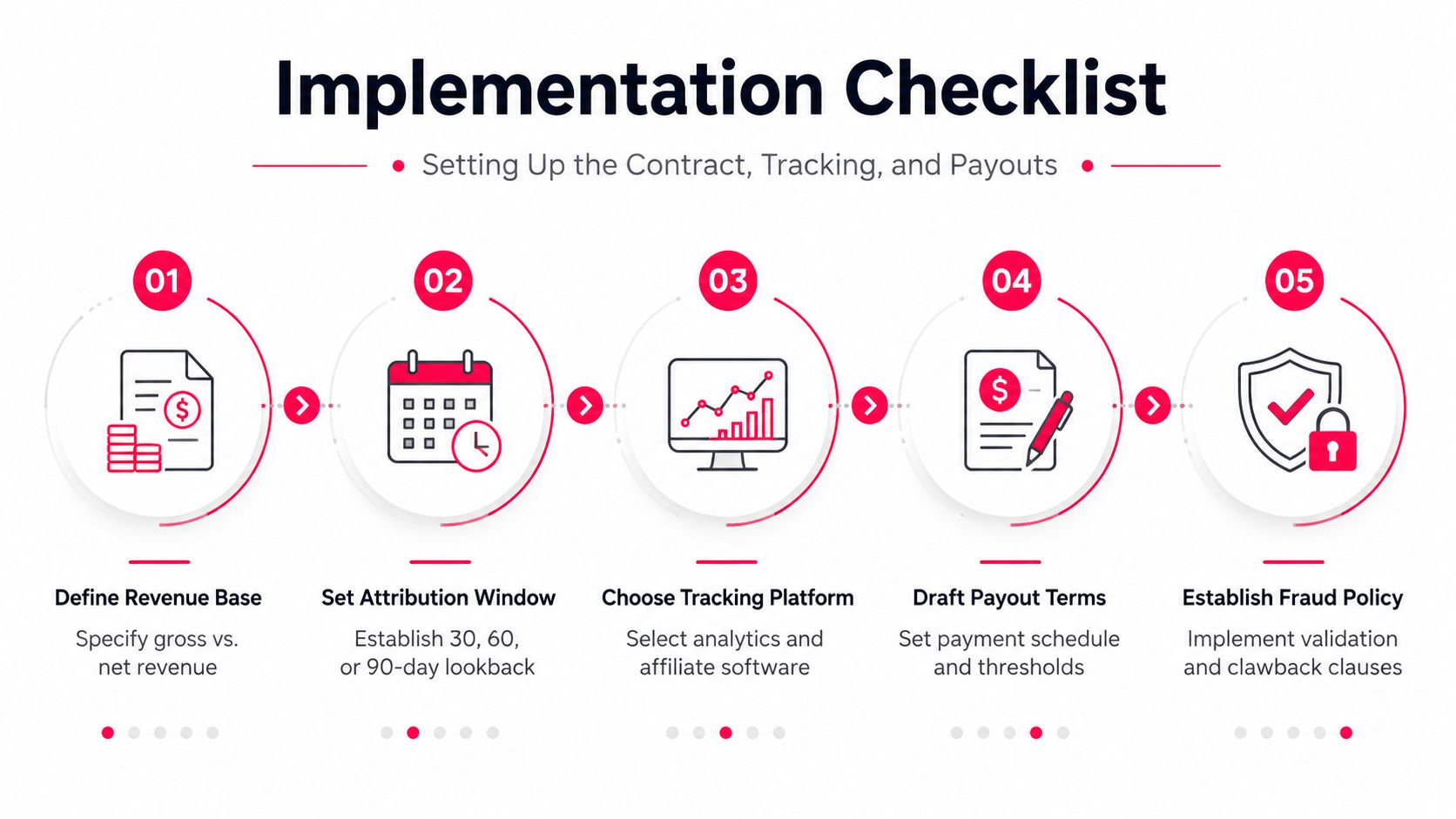
A rev-share deal fails in operations before it fails in strategy. Put the following terms in writing before a creator publishes anything.
Define the revenue base
State whether the percentage applies to gross sales, net sales, collected revenue, or contribution profit. Deductible items should be named, not implied. Include discounts, refunds, chargebacks, taxes, shipping, payment processing, and returned products where relevant.
Contract language to settle early: “Eligible revenue” should be a defined term with an example calculation, not a phrase left for finance and the partner to interpret later.
Set attribution and validation rules
Choose the tracking method, such as unique links, codes, platform reporting, or a combined system. Establish the attribution window and say whether the rule is first touch, last touch, or another documented approach. The implementation checklist used for affiliate operations commonly calls for a 30, 60, or 90-day lookback, so select the window that matches the buying cycle rather than copying a competitor.
Refunds need their own clause. Hold commissions until the refund period passes, or reserve the right to claw back commissions on returned, canceled, fraudulent, or unpaid orders.
Choose cadence and thresholds
Monthly payments are practical for recurring programs, provided the brand supplies a statement showing orders, exclusions, refunds, and the resulting payout. Set a minimum payment threshold, a dispute period, and the records each party must retain.
Tiered structures can reward scale without raising the starting rate for every order. One example uses a 60/40 split up to $1 million, then shifts to 70/30 above that level. Another applies 60/40 to the first $50,000 of monthly revenue, 70/30 from $50,000 to $150,000, and 75/25 above $150,000, as outlined in these tiered revenue-sharing examples.
Fraud guardrail: Ban self-referrals, unauthorized coupon sites, trademark bidding, incentivized traffic, bot activity, and any channel your brand can't audit. Add validation rights and clawback terms.
Operationally, a creator platform can reduce manual coordination by combining creator matching, filters, project tracking, predictive analytics, content approvals, and multi-brand workflows. JoinBrands offers those functions alongside campaign management and creator collaboration, so teams can manage the operating layer without building every workflow internally.
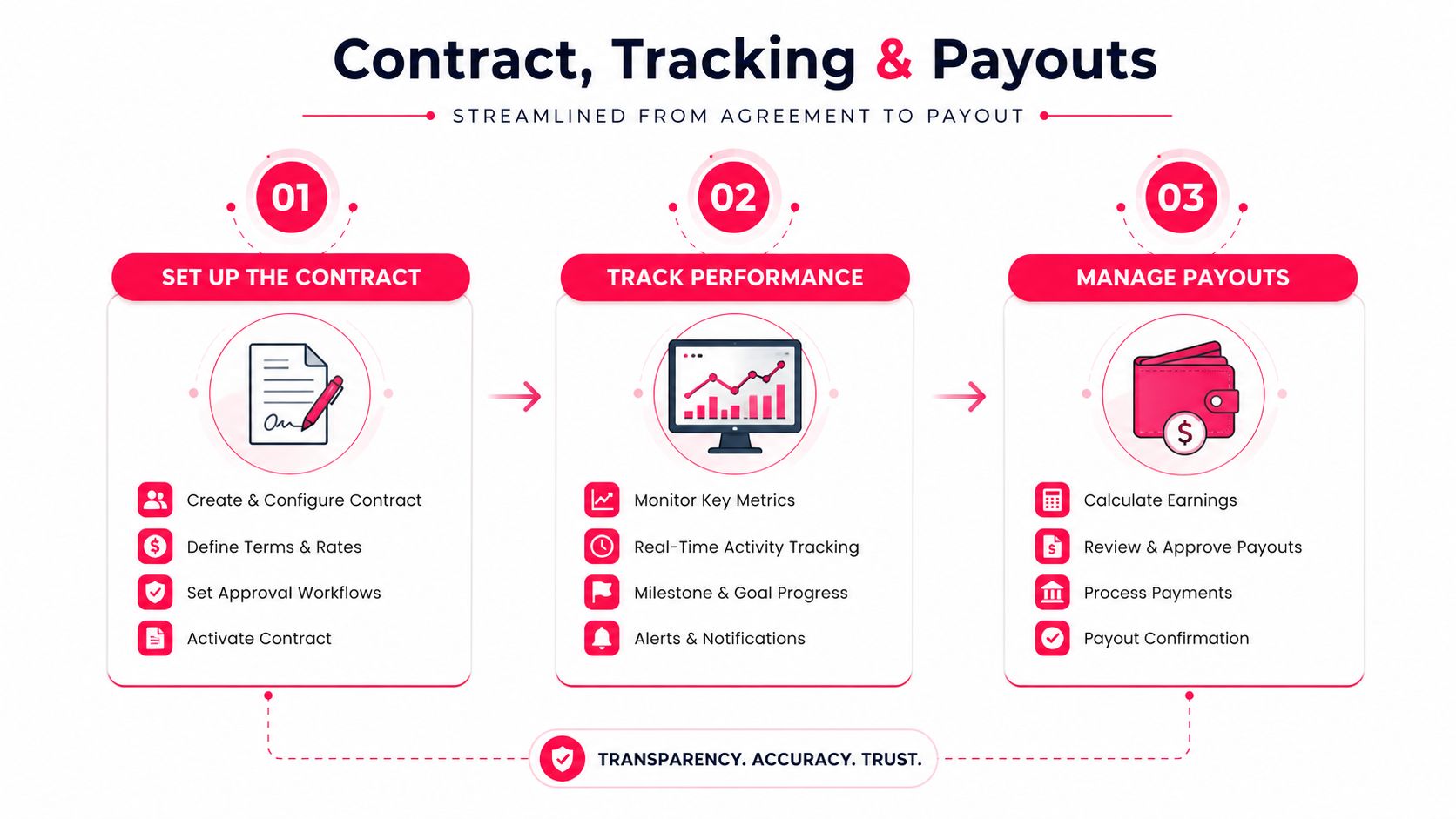
The commercial workflow also benefits from a clear separation between briefing, tracking, approval, and settlement. Use the following walkthrough as a practical reference for mapping those stages.
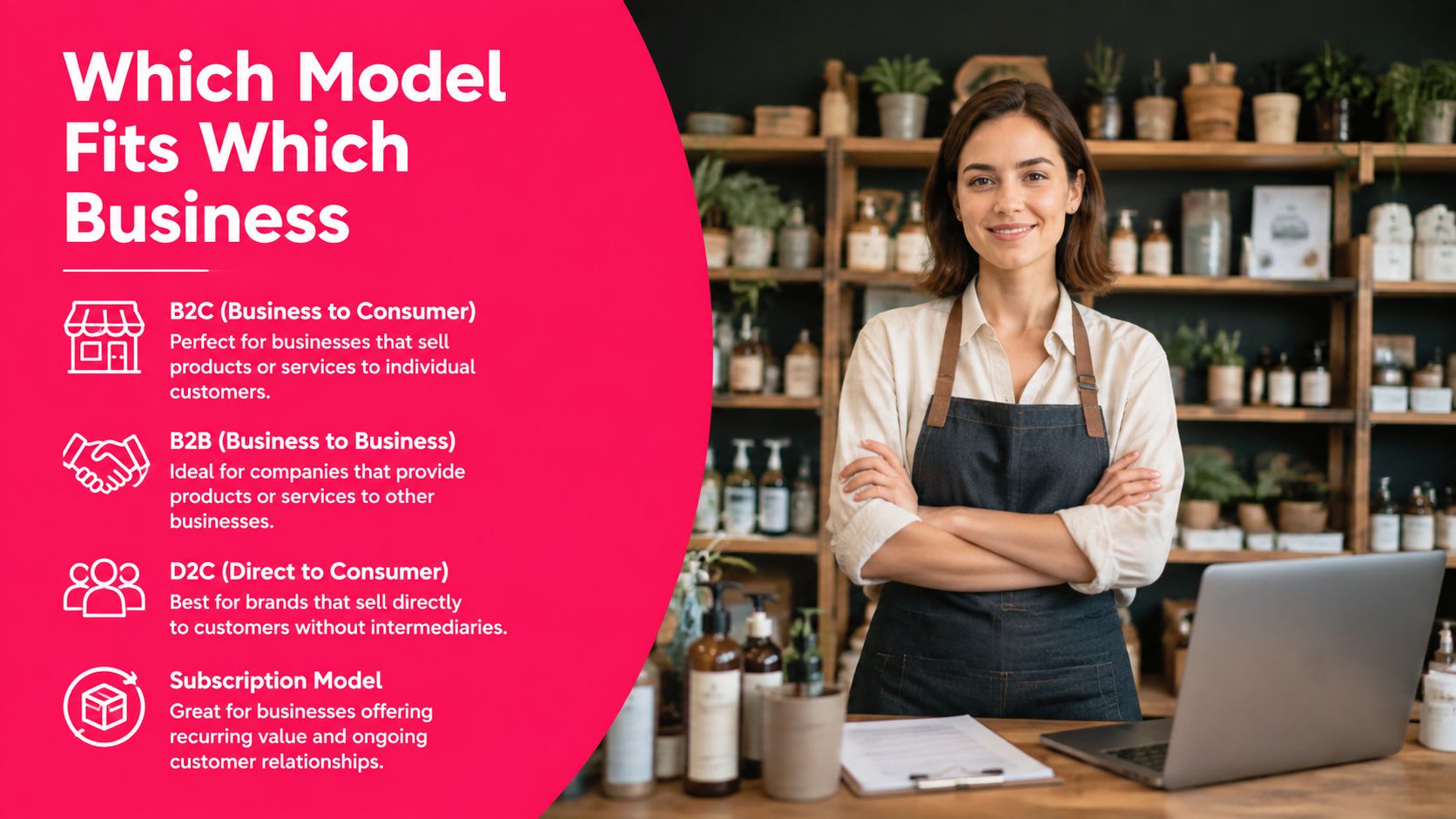
Which Model Fits Which Business
DTC physical products
Choose an affiliate commission with a tight attribution window and tiered bonuses. Physical-product brands with thin margins shouldn't promise an uncapped recurring share when the partner influences one purchase. Pay on validated orders, exclude refunded revenue, and use volume milestones to reward scale without compromising baseline margin.
Subscription and SaaS
Use a hybrid structure with a strong first-year commission and a smaller recurring share. SaaS and membership products commonly use commissions between 5% and 20% of monthly revenue, while software subscription programs may cite 20% to 40% of first-year revenue, according to these performance-based influencer benchmarks. The exact offer should reflect churn, payback, support cost, and how much education the partner provides.
High-margin goods
For luxury, beauty, and premium supplements, licensing or profit sharing can be stronger than a basic affiliate deal when brand control matters more than raw volume. Licensing protects the value of distinctive intellectual property. Profit sharing can work when the partner contributes meaningfully to product development, distribution, or a shared operating function.
A Rev Share Deal That Broke and How It Got Fixed
A mid-market DTC brand launched with a flat 15% revenue share. The offer was easy to explain, and creators quickly produced a large flow of attributed orders. The dashboard looked healthy until the team compared revenue quality across partners.
Several creators relied on discount codes that captured shoppers already familiar with the brand. Others generated bursts of low-intent traffic, while refunds and suspicious transactions increased. The program rewarded order volume, not incremental contribution, so the brand paid for activity that didn't justify the margin sacrifice.
The team changed three things. First, it narrowed attribution to a stricter, documented window and excluded refunded or invalid orders. Second, it introduced tiers so stronger volume earned better economics only after reaching defined thresholds. Third, it moved to a hybrid structure with a base fee, a lower commission, and milestone bonuses tied to validated attributed revenue.
The revised structure changed the conversation with creators. Partners still had a path to upside, but they couldn't earn more by generating noisy traffic. The brand reviewed conversion quality, refund patterns, discount dependence, and contribution economics together rather than treating attributed sales as the only success metric.
The important outcome wasn't a particular lift or a dramatic dashboard percentage. The improvement was control. Finance could reconcile payouts, creators could understand how to earn more, and the partnership team could identify which content produced durable demand.
The warning signal: If attributed revenue rises while refunds, coupon dependence, or invalid traffic rise with it, your model is paying for volume instead of value.
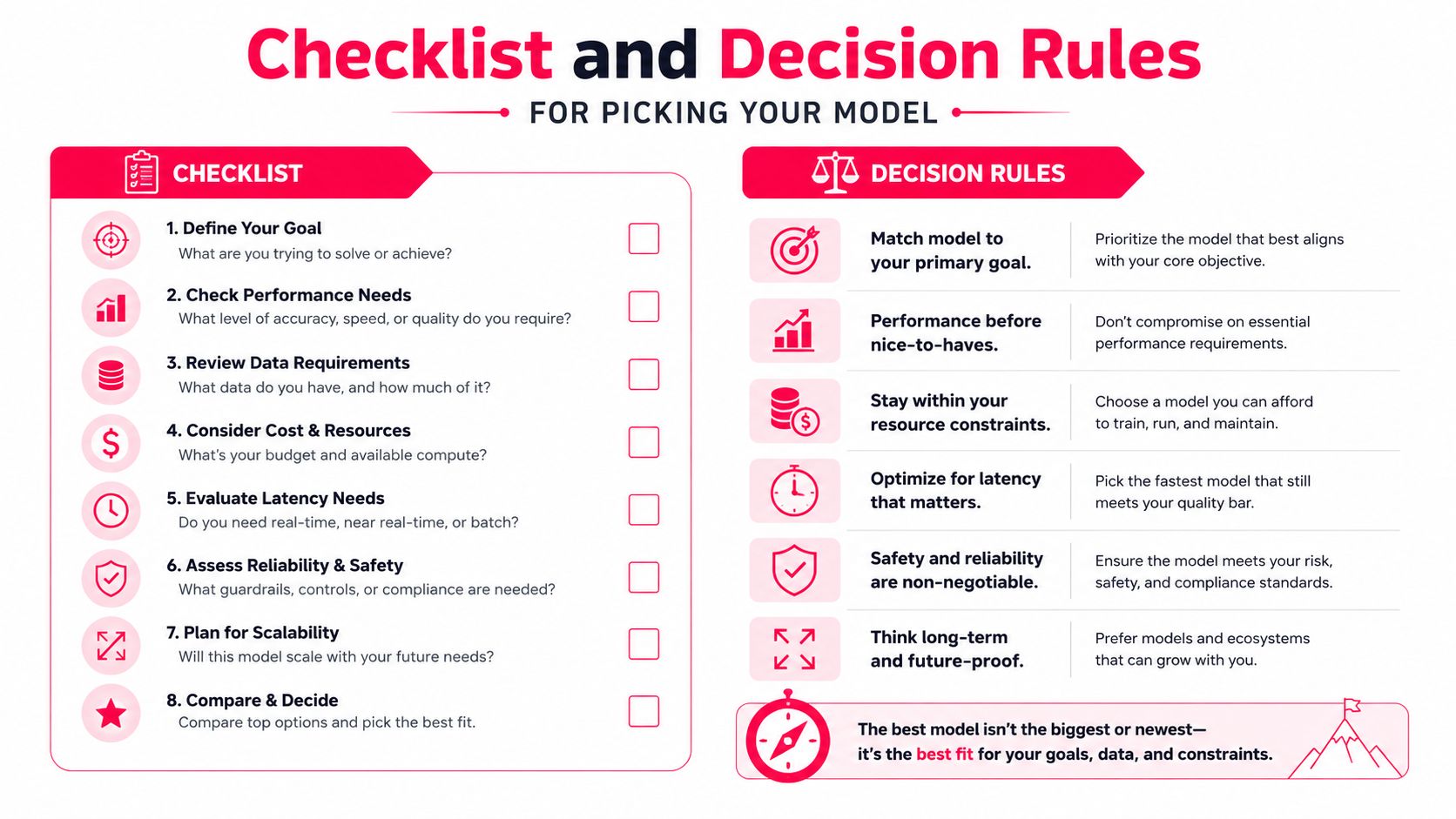
Checklist and Decision Rules for Picking Your Model
Before launch, make the deal auditable:
- Revenue base: Define gross, net, collected, or profit revenue and list every deduction.
- Attribution window: State the lookback period, tracking method, and ownership rule.
- Payout cadence: Set the payment date, reporting format, minimum threshold, and dispute process.
- Refund policy: Delay or reverse commissions for returns, chargebacks, cancellations, and fraud.
- Traffic rules: Prohibit unauthorized incentives, self-referrals, bots, trademark abuse, and unapproved channels.
- Scale logic: Add tiers or bonuses only when the partner reaches commercially meaningful milestones.
Use these decision rules
Start with pure revenue share when demand is uncertain, the partner has genuine access to incremental customers, and your attribution is reliable. Move to tiers when the partner proves they can drive profitable volume and the business wants to share more upside without overpaying from the first sale.
Choose a hybrid when the creator must produce substantial content or ongoing support regardless of sales. Walk away from pure rev-share when demand is predictable, delivery requirements are fixed, accounting disputes consume team time, or the partner's audience already has strong purchase intent that the brand could buy through a flat agreement.
A practical creator workflow should connect the commercial brief to the operational record. Brief the campaign, use AI matching and filters to find suitable creators, track deadlines, review content for paid-media readiness, and use predictive analytics to flag campaigns that generate attention without enough revenue quality.
The best revenue sharing models aren't the ones with the most attractive headline percentage. They're the ones that make valuable behavior profitable, make invalid behavior expensive, and give both parties a calculation they can verify.
JoinBrands connects brands with a network of over 500,000 creators across channels including TikTok Shop, Instagram, Amazon, and YouTube, with campaign management, creator matching, tracking, approvals, and analytics in one workflow. Visit JoinBrands to operationalize the revenue-sharing structure that fits your margins, attribution model, and growth targets.