
 Creator Marketing Platform: The Complete 2026 Guide
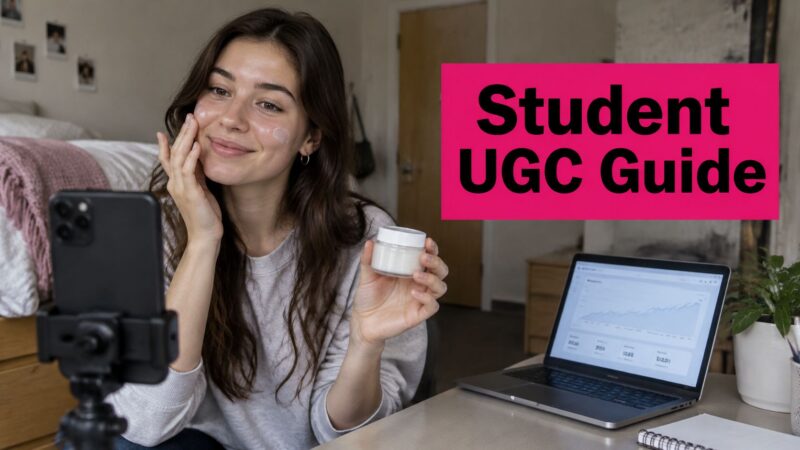
The most popular advice on hiring a college UGC creator is to find a student with a phone, ship a free product, and treat the views as proof the campaign worked. That advice is cheap to follow and expensive to live with. A gifted item still costs the student an evening they could have spent on paid work, exams, or an internship, and a brand that never prices that time ends up with rushed clips, unclear ownership, and no way to tell a save from a sale.
Treat the hire as a campaign evaluation problem. Compare a cash fee with product value, write down paid-media rights before anything ships, and judge the work on incremental conversion or qualified traffic, not on how many people watched the first three seconds.
Table of Contents
Why Student Creators Matter for Brands
A college UGC creator gives a brand peer credibility, a lower cost per usable asset, and a low-risk place to test angles before a bigger media buy. Students already talk the way their classmates buy. That match is the asset, not the follower count.
The habit is older than brand deals. In a Pew Internet & American Life Project survey fielded from March 12 to May 20, 2003, 44% of U.S. adult internet users, more than 53 million people then, had contributed material online, and 20% of those contributors were full-time or part-time students, against 14% of the U.S. population. Among contributors, 46% held at least a college degree, versus 26% of all Americans. Student publishing started in blogs, forums, and personal sharing, long before sponsored posts, and those same habits later became short-form video and product reviews.
Say a skincare brand sends one bottle to a nursing student who films a 40-second routine between shifts. Classmates who recognize the dorm lighting and the tired voice treat that clip as a recommendation, not a studio ad. Brands that also need polished product motion, separate from that student voice, can pair the test with an ai video generator for clothing brand when the brief calls for consistent garment shots rather than a campus story.
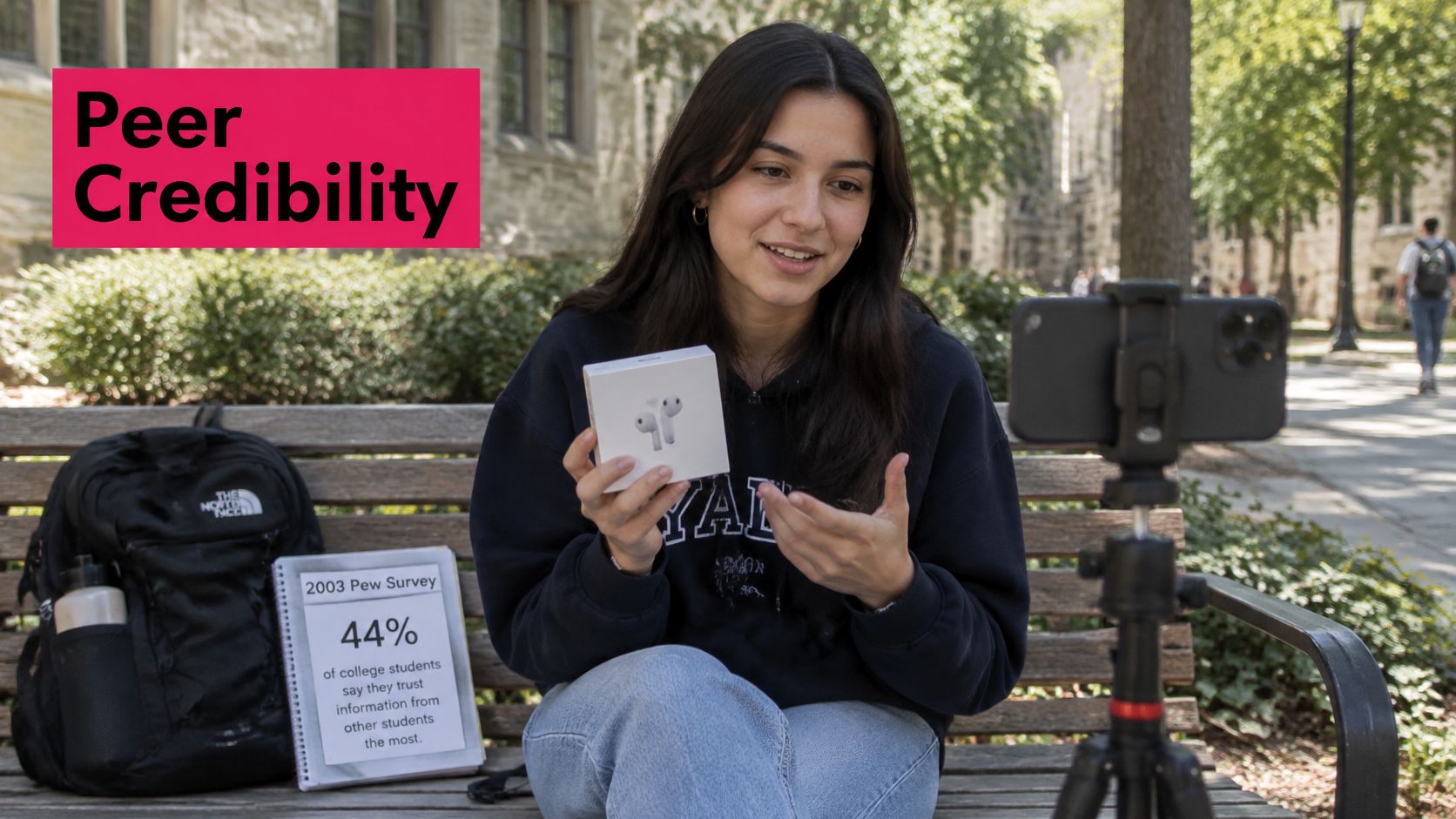
The trade-offs are real. Students post around classes, often don't know usage terms, and may have little legal familiarity. Screen for those gaps before you fall for the clip. If you want a wider read on how this generation buys from people their own age, start with how Gen Z influencers shape trust.
How to Screen Students for Trust, Not Reach
Follower count is a poor filter for student work. A 2025 NeoReach survey of more than 3,000 creators, representing over 1.1 billion total followers, found that more than half earned less than $15,000 a year from content, while 43.8% had fewer than 100,000 followers across their accounts. More than 77% reported attendance at a college or other higher-education institution. Many of the people you want are small, educated, and not living on creator income. Scale will not tell you whether their audience is on your campus or whether they disclose a gift.
Creator screening scorecard
Score each applicant 1 to 5 on every row. Weight process transparency and disclosure habit highest, because those two predict whether the file survives legal and brand review. A charming hook with no label is a rewrite, not a win.
| Criterion | What to check | Red flag |
|---|---|---|
| Process transparency | Shows the full product-use process, not only the final shot | Only polished, ad-style clips |
| Subject relevance | Major, coursework or certification tied to the product | Claims expertise it cannot show |
| Disclosure habit | Past brand posts carry a commercial-content label | Undisclosed brand mentions |
| Production quality | Clear audio, readable captions, vertical video | Unusable audio or cropped frames |
| Audience fit | Followers who share the campus or buyer profile | Audience from unrelated regions or markets |
| Responsiveness | Replies and delivers within the brief timeline | Missed deadlines on earlier work |
Drop anyone under 3 on disclosure, even if the other scores look strong. A nursing student reviewing a first-aid kit should show the steps, name the course or job that taught them, and already label older brand posts. A film major with a huge following and a history of silent product plugs fails the same card.
Practical rule: Ask for a 60-second sample of the full product-use process, not a highlight reel, and open two older posts to see whether a paid-partnership label is already there.
The same survey reported that 15.9% of creators had dropped out of or postponed higher education for content work, and 57% of full-time creators earned below its benchmark for a U.S. living wage. Ask about exam weeks and internship dates before you lock a deadline. A student who needs the fee to cover rent will say yes to a Friday delivery they can't hit. Build the calendar around the semester, not around your media flight alone.
Run a Student Pilot Step by Step
A pilot is a controlled test of one product with one audience, not a casting call. In a survey of 505 Gen Z college students, 58% said they trusted creators more when they showed the full process, cited research, or actively worked in the field, and 56% reported higher trust when the creator held a relevant degree or certification. Use that as a creative screen, not as a promise of sales lift. The survey measures trust, not checkout.
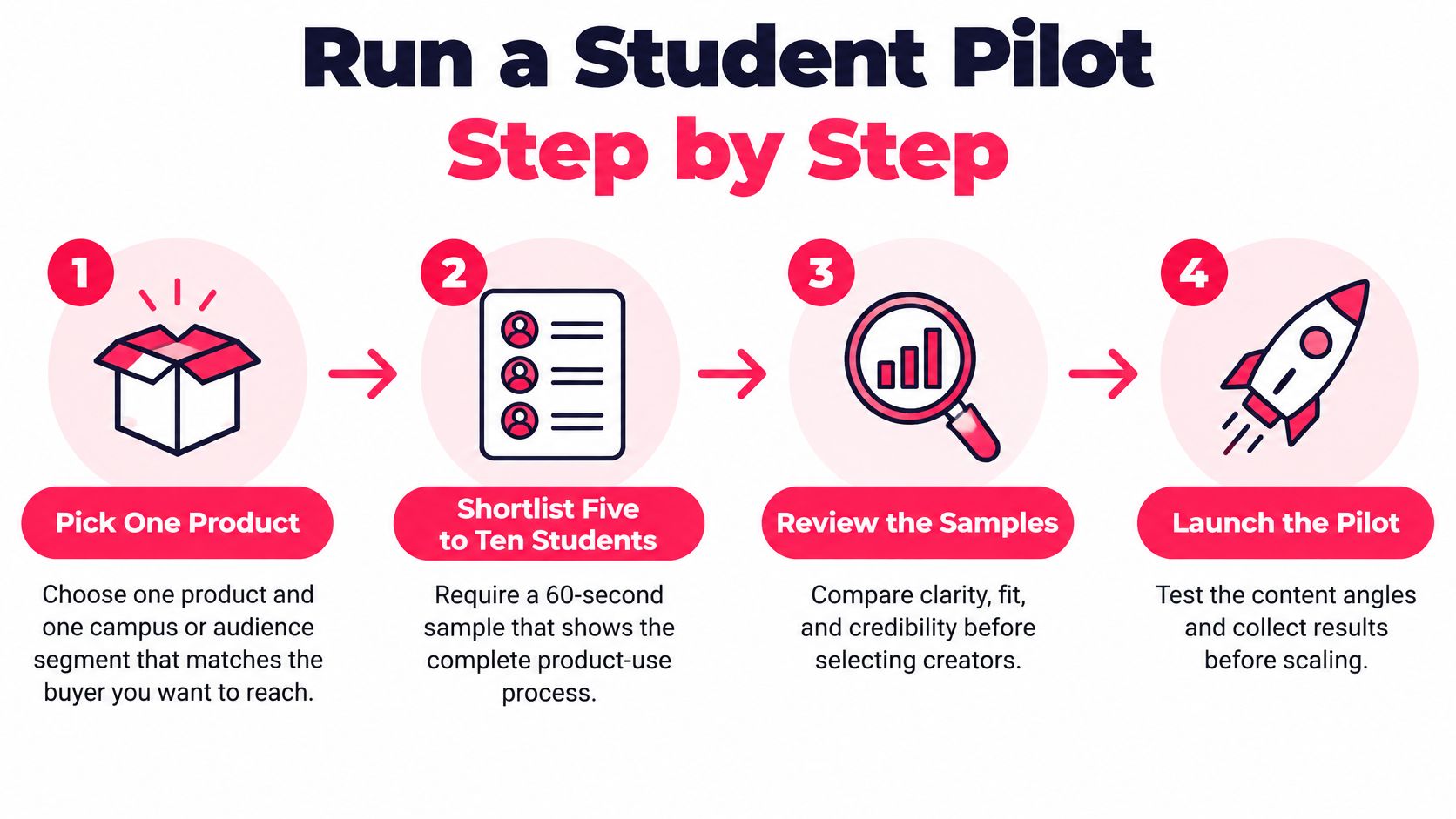
- Pick one product and one segment. Match a campus, city, or buyer profile to the person who purchases. One serum for commuter students beats five SKUs for "college" in general. The slip is launching a catalog and then blaming the creators when nothing converts.
- Shortlist five to ten students. Require the 60-second sample with the complete use process and a source for every claim. Reject highlight reels. Creator profiles can be created for free, and brands can browse verified portfolios, ratings, and past work, or let top creators apply. The slip is choosing the biggest account in the stack.
- Score the card and cut disclosure failures. Use process transparency, subject relevance, disclosure, production quality, and audience fit. Anyone under 3 on disclosure is out before product leaves the warehouse.
- Send a one-page brief. List allowed facts, banned claims, required shots, 9:16 vertical, burned-in captions, and licensed audio. A usable UGC brief template keeps that page short enough that a student reads it between classes. The slip is a 12-page brand book nobody opens.
- Agree terms in writing before anything ships. Fee or product, revision count, usage, paid-media permission, disclosure setting, and what happens if exams collide with the due date. Once a creator is approved, the brand ships the product for free and the creator uploads the video for review.
- Approve against a checklist. Disclosure label, factual claims, usage rights, captions, and audio. Send one round of notes that protect accuracy, not a request to sound like a commercial.
- Lock the control, the codes, and the scale rule now. Each creator gets a unique link or code. Decide the window and the go or no-go before the first post. Scale only if the cohort beats the control on incremental conversion or on efficient qualified traffic.
Don't ask for an overpolished advertisement. That request erases the student voice you paid for.
A healthy pilot ends with complete product-use videos, a commercial-content label on every post, and a pre-agreed review. Reach-only casting is the common failure. The audience looks large and doesn't contain your buyer.
Disclosure, Usage Rights and Fair Terms
A free product is not a casual favor. The student is trading hours, and the FTC's Disclosures 101 for social media influencers says a creator may need to disclose a relationship even when compensation is non-cash, including free or discounted products. An endorser also cannot call a product excellent when they thought it was terrible. Pay does not buy a fake opinion. If you need a plain-language walkthrough of those rules for ongoing partners, pair the worksheet below with this guide to compliant affiliate partnerships and with the FTC guidelines for influencers.
Campaign evaluation worksheet
Settle every row before the parcel goes out. Students in a tight community also carry reputational risk a professional influencer can walk away from.
| Term | What to settle | Why it matters |
|---|---|---|
| Cash fee vs gifted product | Whether the student gets money, product, or both | Product-only deals still trigger disclosure |
| Deliverables and revisions | Number of videos, cuts and rounds of edits | Stops open-ended revision requests |
| Usage duration | Months the brand may post or run the video | Defines how long the asset stays live |
| Paid-media rights | Whether the video can run as a Meta, Google or TikTok ad | Organic posting rights do not cover paid ads |
| Exclusivity | Competing products the creator may not promote in the window | Protects both sides from conflicts |
| Disclosure | Commercial content setting, label and partner name on every post | Required for free product and for paid work |
| Cancellation | Notice period and payment if the project ends early | Avoids disputes around exam and internship weeks |
On TikTok, the practical path is inside the post, not a hashtag. TikTok's commercial content disclosure help tells creators to open Content disclosure and ads, turn on Disclose commercial content, choose Branded content for a partner deal, and name the brand. That adds a Commercial content label. Skipping it can get the post removed or restricted. A dorm-organization video paid in product still needs Branded content, not only #ad in the caption.
Paid flights and who owns the file
Tagging a brand partner starts a default 60-day authorization, so confirm the window covers the planned ad flight and renew it if the ads run longer. TikTok's content-sharing guidelines also require apps that post for users to offer the same commercial-content control, and to disable publish if the toggle is on without a required choice. If the student posts through a third-party tool, open the live TikTok post and check the label yourself.
With a content-only model, creators film and deliver the asset to the brand, which owns it and can post it wherever it likes. Agree separately, in the paid-media row, whether that file may run as a Meta, Google, or TikTok ad. Organic rights on the student's account do not cover your ad account.
Price paid-media usage per month, separate from the base fee, and write exam and internship dates into the cancellation clause.
Measure Student Content Against a Control
Views are a delivery signal, not a sales result. Before launch, choose one primary outcome, such as qualified landing-page visits, add-to-cart rate, or purchases. Track watch time, saves, and comments separately as diagnostics.
A systematic review of 59 scholarly studies found that published research focused heavily on image and text content, with less attention to short-form video such as Reels. Don't apply a static-post benchmark to TikTok. A separate experiment with 175 participants found consumer-generated advertising improved ad attitudes and interactive behavior after exposure, depending on source credibility and product involvement. That kind of response can build interest without producing a purchase.
How to run the comparison
Give comparable creative or audiences either the student treatment or a control. Keep the offer and landing page identical, then assign each creator a unique link or promo code. This makes it easier to connect a sales change to a creator rather than to the channel as a whole.
UGC does not reliably lift purchase intent in every product category. A high save count on a snack video, for example, is not proof that people bought the snack. For guidance on choosing and interpreting metrics, see this guide to measuring content performance.
| Metric | Role | What it tells you |
|---|---|---|
| Qualified landing-page visits | Primary outcome | Whether the video sent potential buyers to the page |
| Add-to-cart rate | Primary outcome | Whether interest continued after the click |
| Purchases on unique code | Primary outcome | Revenue tied to one creator or cohort |
| Thumb-stop rate | Diagnostic | Whether the opening seconds hold attention |
| Average watch time and completion rate | Diagnostic | Whether viewers stayed with the product message |
| Saves and comments | Diagnostic | Whether the content seems useful or prompts discussion |
| Cost per acquired customer | Outcome | Whether the cohort beats the control on spend |
Set the test window before the first post. Scale when the student cohort beats the control on incremental conversion or efficient qualified traffic. If the diagnostic signals are strong but the primary outcome is not, keep the creator for organic tests and hold off on paid media.
Request Customer Reviews at the Right Moment
Creator content and customer reviews answer different questions. A creator pilot tests whether a message earns qualified attention and contributes to sales. A review request asks buyers to describe their experience after they have used the product. Keep those requests separate, and ask all buyers rather than only customers likely to leave positive feedback.
For a review prompt, match the timing to the customer's opportunity to use the product:
| Channel | Timing | Template angle |
|---|---|---|
| Post-purchase email | After the customer has had time to use the product | Ask how the product is working |
| In-app prompt | After a later session, not during checkout or an error | Offer a simple star-rating card |
| Reminder email | One follow-up after the first request | Keep the reminder brief |
| Social reply | After a customer posts and has opted in | Thank them and offer a direct review link |
Ask for a photo separately and make it optional, so customers can submit a rating without extra steps. Avoid filtering requests based on whether someone seems satisfied; that can undermine trust in the reviews.
The creator test and the review request have different audiences and goals. Keep them out of the same message.
JoinBrands connects brands with UGC creators for content-only videos. The brand owns the delivered asset and can post it on its own accounts or use it as Meta, Google, or programmatic ad creative. Brands can set a brief, arrange product shipping, and review submitted content through the platform. Visit JoinBrands to set up your next creator campaign.