


 College UGC Creator Guide: Hire, Brief and Measure Students
The founder is staring at a Trello board full of half-finished creator briefs. A growth lead is digging through screenshot folders that nobody organized. The paid-media team is waiting for UGC assets that won't arrive before the Q4 launch, while the partnerships manager is still negotiating usage rights in direct messages.
That situation usually starts innocently. An e-commerce brand tests a few creator partnerships, finds some promising content, and assumes the next step is to do more. Then outreach expands, approvals become harder to track, reporting fragments across platform dashboards, and the internal team discovers that organic creator content isn't automatically ready for paid distribution.
The creator marketing industry has moved well beyond experimental endorsements. The worldwide market was estimated at $16.4 billion in 2022 and $32.55 billion in 2025, with some 2026 projections above $40 billion, according to Influencer Marketing Hub's industry statistics. That scale creates a practical problem for brands. More budget means more creators, more assets, more rights negotiations, and more pressure to prove commercial results.
Hiring an agency isn't just a vendor decision. It's a decision about your operating model. The right partner should reduce the workload between brief and live ad, not merely add another presentation layer. You shouldn't judge an agency by its creator count. Judge it by whether it can turn creator output into measurable paid-media results.
Table of Contents
The Moment Brands Realize They Need a Creator Marketing Agency
The search usually begins when the brand's experiment stops being manageable. A founder or growth lead may have personally recruited creators, approved videos, and tracked coupon codes. That works while the program involves a handful of relationships. It breaks when the brand needs a steady supply of platform-native assets for product launches, paid social, and seasonal campaigns.
The warning signs are operational:
- Briefs stay unfinished: Different creators receive different instructions, so the team can't compare the resulting assets cleanly.
- Reporting lives in screenshots: Engagement, clicks, sales, and creator payments sit in separate folders or message threads.
- Rights remain unclear: A creator delivers a strong video, but the brand can't confidently use it in Meta or TikTok ads.
- Paid teams wait on creative: Media buyers have budget available, yet approved UGC arrives too late to test properly.
- The internal team becomes the bottleneck: One person owns sourcing, negotiations, reviews, invoices, revisions, and reporting.
The creator market's expansion makes this pressure more common. Aspire's 2026 industry guide reports that 74% of marketers planned to increase influencer marketing budgets. It also describes a split operating model, with 66.33% of respondents managing influencer marketing entirely in-house and 10.71% using an agency partner. Brands are spending more, but many still haven't decided which work should stay internal.
The operating question
Don't ask, “Can this agency find creators?” Your team can find creators through platforms, referrals, search, and existing communities. Ask whether the agency can run the full workflow without losing commercial discipline.
A useful agency should connect creator selection to the intended use of the asset. A creator chosen for an organic product review may not be the right creator for a direct-response ad. A video that earns comments may still lack a clear hook, product demonstration, call to action, or licensing permission for paid amplification.
Practical rule: If the agency's strongest proof is a list of famous creators, but it can't show how those creators' assets performed in paid media, keep looking.
What a Creator Marketing Agency Actually Does
A creator marketing agency should turn creator output into usable, measurable media. It owns the workflow from strategy and sourcing through approval, licensing, activation, and reporting. A large network matters only if the agency can convert that access into assets your paid team can test and scale.
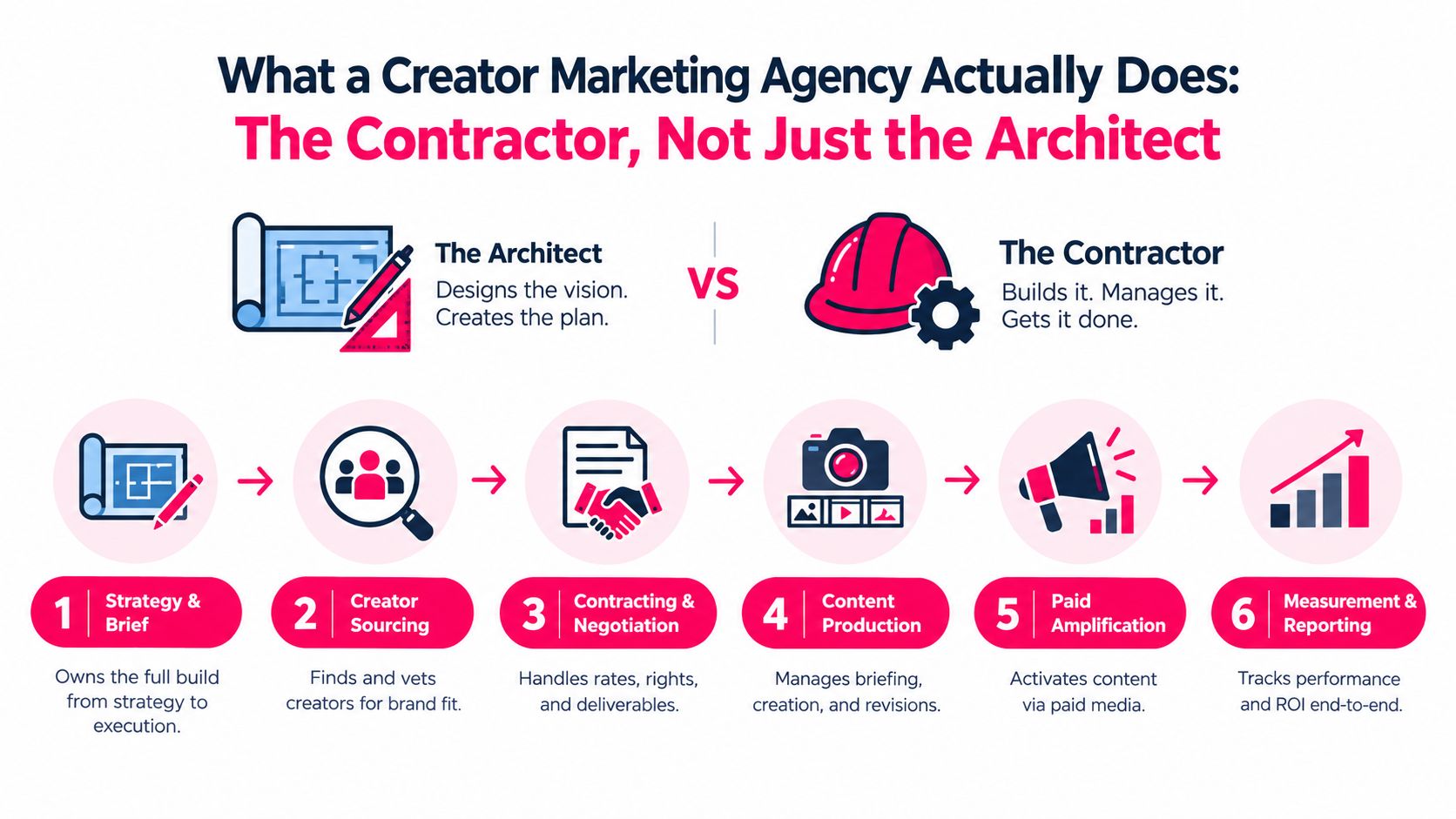
A capable agency controls the handoffs that create delays:
- Strategy and briefing: It connects the business objective to creator profiles, formats, mandatory and prohibited claims, disclosure requirements, and intended usage.
- Sourcing and vetting: It evaluates audience fit, content quality, brand suitability, platform behavior, and commercial history, rather than relying on follower count.
- Outreach and negotiation: It manages rates, deadlines, deliverables, exclusivity, revisions, and communication.
- Contracting and licensing: It defines ownership, usage channels, duration, paid-media permissions, and whitelisting or dark-posting rights.
- Production and review: It gives creators a usable brief, checks drafts against it, consolidates feedback, and manages revisions.
- Activation and measurement: It delivers approved files to organic or paid teams, tracks usage, and reports on business outcomes.
A talent marketplace may introduce a brand to creators. A SaaS platform may provide search, messaging, or workflow tools. Neither automatically owns the strategy or commercial result. A full-service agency should take responsibility when a creator misses a deadline, a deliverable fails compliance review, or attractive engagement does not translate into paid performance.
That accountability should appear in the contract and the reporting, not just the pitch deck.
The distinction matters because brands often outsource individual tasks instead of full program ownership. Influencer Marketing Hub's benchmark report found that creator discovery and vetting accounted for 19.44% of commonly outsourced functions, followed by content production at 15.28%. Reporting and analytics accounted for 6.9%, showing where agency involvement often ends. During vetting, ask for paid-media results, testing processes, usage-rights examples, and reporting samples. A list of recognizable creators is not proof of commercial capability.
Service Models and How They Differ
The cheapest option isn't always the least expensive. A self-serve platform can reduce fees, but your team still pays in management time, revision cycles, and rights administration. A managed agency can remove execution work, yet some partners optimize for reach because it's easier to present than incremental revenue.
| Model | Fee Structure | Pros | Cons | Best Fit |
|---|---|---|---|---|
| Self-serve creator marketplace | Platform or project fees, with internal team managing execution | Fast sourcing, cost control, direct access to creators | Strategy, licensing, reviews, and reporting remain with the brand | Seed-stage brands with a capable operator and a narrow asset need |
| Managed-service creator agency | Retainer, campaign fee, or percentage-based management fee | Handles outreach, production, approvals, and creator relationships | May prioritize reach and engagement over paid performance | Series A brands that need execution capacity without building a large team |
| Performance-led creator agency | Higher management fee or retainer, often combined with media-management costs | Connects creator production to paid amplification, testing, usage rights, and commercial reporting | Higher minimums, more complex measurement, and a longer ramp | Growth brands running always-on paid social and multi-platform creative testing |
A self-serve model makes sense when your internal team knows exactly what it needs. For example, a brand launching a product may need a batch of short-form demonstrations and already have a media buyer, editor, and legal process. The platform handles access, while the brand retains control.
A managed-service agency earns its fee by removing coordination. It can be the right choice when the main problem is volume, creator communication, or production scheduling. The risk is that the agency delivers a polished campaign report dominated by impressions, views, and engagement, while the paid team still has to figure out which assets deserve budget.
The performance-led model suits brands that expect creator content to work beyond the creator's own audience. The agency should understand paid social creative, define usage rights before production, and collaborate with media buyers on hooks, formats, testing, and budget allocation. That integration costs more because you're buying operating judgment, not just introductions.
Decision cue: Choose the model that owns the bottleneck you can't solve internally. Don't pay a performance-led fee for simple asset generation, and don't hire an outreach shop to manage a serious paid-media pipeline.
ROI Metrics That Matter in Creator Marketing
A single engagement target is a reporting shortcut, not a measurement strategy. Creator performance changes by platform and creator tier, so agencies should benchmark within comparable groups and keep the denominator consistent. InfluenceFlow's 2026 benchmark data places typical engagement at 1.5% to 3% on Instagram, 4% to 8% on TikTok, and 0.5% to 2% on YouTube. It also reports 4% to 8% for nano creators, while macro and mega creators can fall toward 1% or below.
Those figures are useful for context, not as universal targets. A nano creator may generate dense interaction with a focused audience. A macro creator may deliver broader awareness with lower engagement efficiency. Compare like with like, then connect the comparison to the job the asset needs to do.
Use the metric that matches the decision
- CPM: Useful for comparing media efficiency when creator assets run in paid placements. It doesn't tell you whether the impressions reached buyers or produced profitable action.
- EMV: Helpful for estimating exposure value in an organic program, but it shouldn't substitute for revenue measurement.
- ROAS: Relevant when creator assets are part of a paid campaign. Require clear attribution rules and separate creator production costs from media spend.
- CPA: A board-level metric when the objective is customer acquisition. Track it for creator-assisted paid spend rather than only for creator-posted links.
- View-through rate: Useful for judging whether the opening and pacing hold attention, especially on short-form video. It isn't a purchase metric by itself.
Once an asset is whitelisted or used in a dark post, its organic engagement rate becomes less important than its paid creative behavior. The media team should test hooks, openings, demonstrations, calls to action, and audience segments. For serious budget allocation, use holdouts or geo-lift where the measurement design supports it. Otherwise, attributed ROAS can overstate the creator's incremental contribution.
A CMO usually needs three numbers in the board update: cost per acquired customer from creator-assisted paid spend, attributed incremental revenue, and creator-asset production cost amortized across the usage period. The last figure matters because a video licensed for multiple placements can create more value than one used once.
Don't let an agency improve one target while damaging the funnel. Lower CPM can come from cheap inventory. Higher engagement can come from content that entertains without selling. The agency earns trust when it explains those trade-offs in commercial terms.
The Standard Content Production Pipeline
A creator project can lose its budget before the first ad runs. The usual causes are predictable: an incomplete brief, a poor creator fit, unclear usage rights, or files the media team cannot deploy. A mature pipeline addresses each risk in sequence.
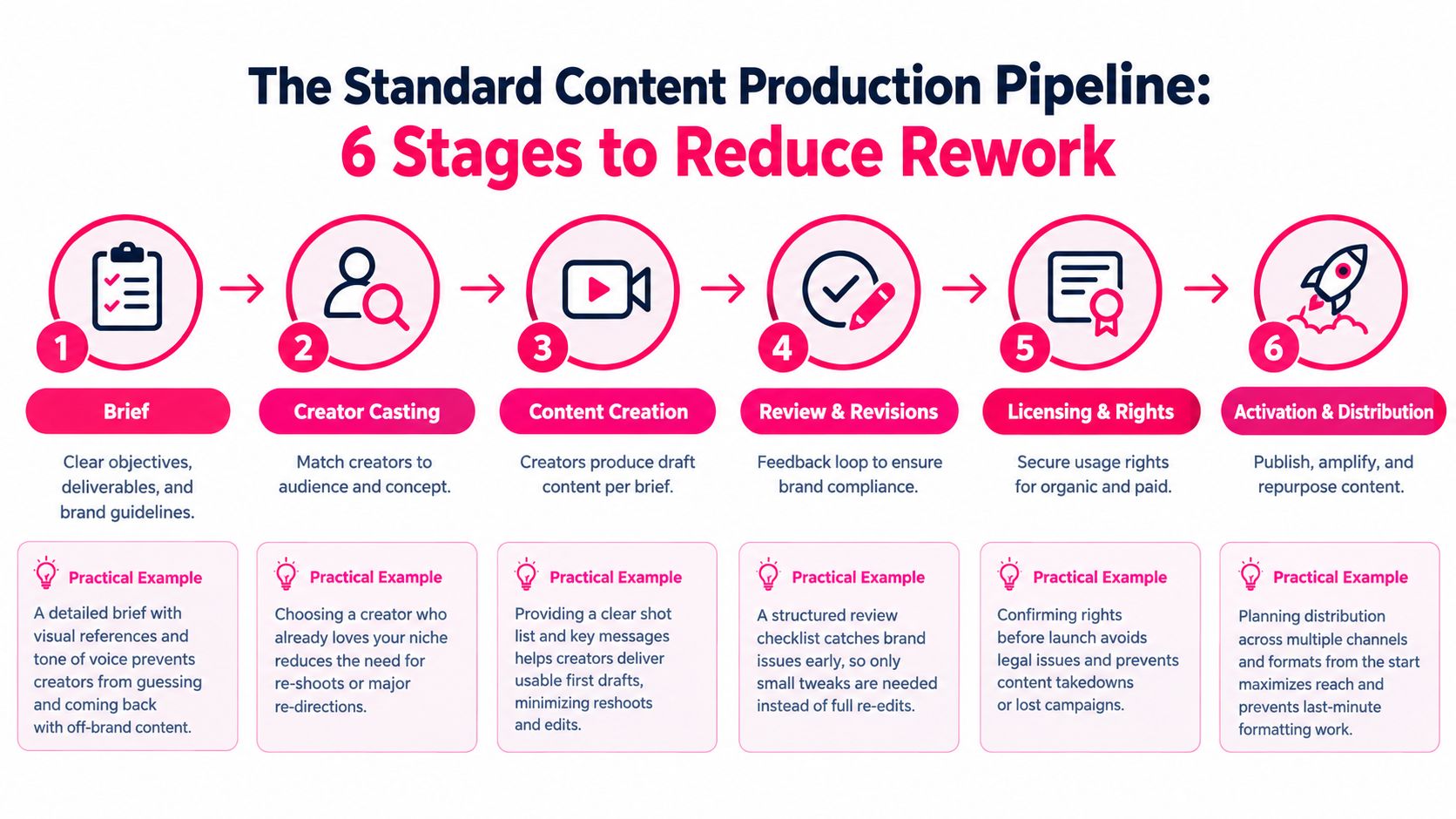
Six stages that protect the budget
Brief the creative job. Define the platform, hook, video length, aspect ratio, product and prohibited claims, disclosure language, call to action, and intended use. A Reels brief cannot be copied directly into a paid UGC assignment.
Cast against the audience and concept. Check the creator's style, audience relevance, previous brand work, and ability to demonstrate the product. Pre-qualification catches fit problems before filming and delivery.
Contract before production. State the deliverables, revision terms, ownership, paid usage, whitelisting, channels, and licensing duration. The agreement must specify where and how the brand can reuse the content, rather than leaving those rights in vague, open-ended language.
Review against the checklist. Consolidate feedback, define turnaround windows, and separate legal or brief requirements from personal preferences. Creators should know which changes are mandatory.
Deliver platform-native files. Request the required aspect ratios, captions, clean versions, thumbnails, and naming conventions. The paid team should receive assets it can deploy without an avoidable editing queue.
Activate and track. Record the asset, placement, rights window, and result. That record turns production into a repeatable learning system and helps the team identify which creative can support paid performance.
Consider a $15,000 DTC shoe project. If paid usage is absent from the brief, the strongest video may be unusable in advertising. If the licensing window is missing from the contract, the brand may have to renegotiate before reusing a winning hook. A generic brief can also produce a video without the demonstration or claim the media buyer needs, forcing a second shoot.
A clearly defined 90-day usage window across organic and paid channels can allow reuse during the approved period, provided the contract covers that scope. Agencies that handle licensing late create avoidable cost and delay.
Use format-specific templates, approval checklists, and a rights register. RZLT's UGC paid-media playbook outlines a workflow of briefing, sourcing, review, approval or licensing, and activation. The brief carries the constraints that make the asset ready for advertising.
Why the Biggest Creator Network Is Not the Best Agency
A large creator database is useful. It isn't a performance strategy.
An agency can claim access to hundreds of thousands of creators and still struggle to identify the small group that fits your product, audience, creative brief, legal requirements, and paid-media objective. A network number often describes CRM capacity. It doesn't prove active relationships, responsive talent, quality control, or the ability to turn a delivered video into an efficient ad.
The stronger question is whether the agency can connect creator work to the media plan. That means the creative team understands why a hook matters, the media buyer can test the asset, the analyst can interpret the result, and the account team can negotiate the rights needed to continue using it.
Three questions that expose the difference
Show me the path from creator selection to paid activation. Ask which audience signal, content behavior, or commercial reason led to the selection. Then ask how the agency prepared the asset for Meta, TikTok, or YouTube placements.
What happens when the content underperforms? A real operator can explain the next move, such as changing the opening, testing a different audience, adjusting the offer, or replacing the asset. A network pitch usually returns to creator reach.
Who owns measurement after launch? Ask to see the reporting logic, not just the final slide. The agency should distinguish organic outcomes, paid outcomes, attributed revenue, and incremental evidence.
The New Engen analysis of creator marketing agencies for consumer brands identifies paid-social integration, production infrastructure, measurement philosophy, creator network quality and category fit, and full-funnel integration as important evaluation criteria. That list is more useful than a network badge because it describes the capabilities that affect commercial output.
The agency that can make today's asset work in paid media is more valuable than the agency that tells you which creator it sourced years ago.
How to Vet a Creator Marketing Agency
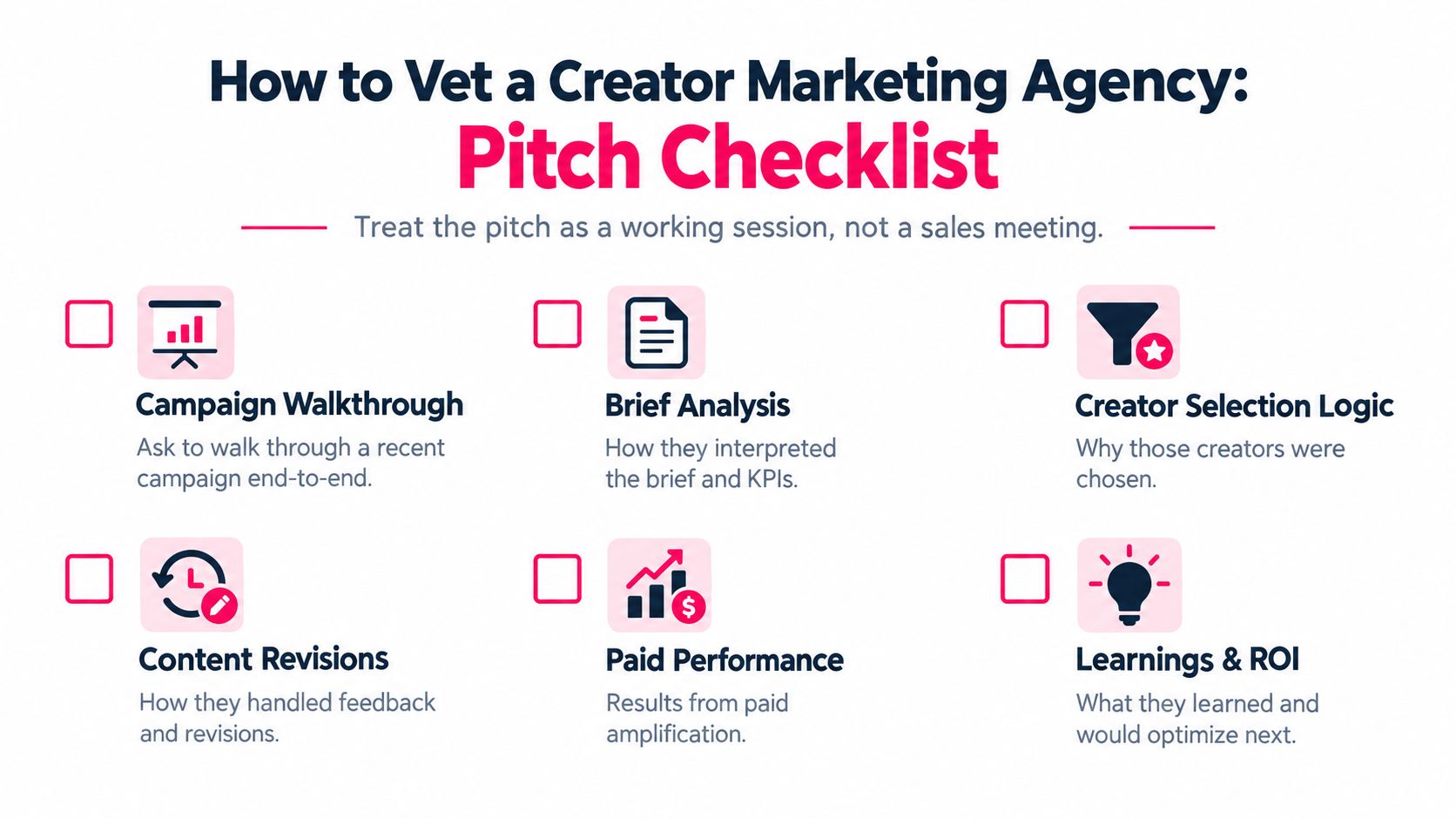
Treat the pitch as a working session, not a sales meeting. Ask the agency to walk through a recent campaign from the original brief to creator selection, revisions, launch, and the optimization decisions made after the first performance read.
You aren't looking for a perfect campaign. You're looking for evidence that the team can see problems, make decisions, and explain trade-offs.
Ask for operating evidence
- Campaign walkthrough: Who wrote the brief, and what changed before production?
- Creator selection logic: Why did the team choose those creators instead of similar alternatives?
- Revision history: What did the creator submit first, what feedback did the agency give, and who approved the final asset?
- Paid performance: Which assets entered paid media, with what spend, audience, placement, and outcome?
- Underperformance response: What did the team change when a creator or asset missed the objective?
- Reporting ownership: Does the agency connect spend to revenue, or does it stop at impressions and engagement?
Request raw performance screenshots with media-buyer-level breakdowns where confidentiality allows. Sanitized case studies often hide the variables that matter, including whether the result came from organic distribution, paid amplification, a discount code, or an existing high-intent audience.
Watch for red flags:
- Guaranteed follower counts: Follower delivery isn't a reliable proxy for commercial performance.
- Vague CPM promises: Ask which platform, placement, audience, and spend level the figure represents.
- Contract reluctance: If the agency can't explain ownership and usage rights before production, expect friction later.
- Vanity-led case studies: Reach can support awareness, but it doesn't prove sales efficiency.
- No week-two plan: A launch without an optimization process is just a delivery date.
Score finalists on creator quality, paid-media fluency, measurement rigor, and cultural fit. Then give the same one-page brief to your top two agencies. Compare the creator shortlist, proposed hooks, rights assumptions, KPI definitions, and reporting sample side by side.
A useful working session reveals how an agency thinks before you give it budget. It also shows whether the team asks commercially relevant questions or repeats your brief in prettier language.
Choosing the Right Path for Your Brand
Your decision comes down to three inputs: budget, internal capability, and how you plan to use creator content. Don't hire a full-service relationship-management partner if your real need is a reliable batch of ad assets. Don't choose a low-touch marketplace if your team expects an agency to own attribution, whitelisting, and ongoing optimization.
| Annual Budget | Best Fit | Primary Strength | Watch Out For |
|---|---|---|---|
| Under $50K | Self-serve platform or UGC-focused boutique | Efficient asset generation and direct control | Internal workload for briefs, reviews, contracts, and reporting |
| $50K to $500K | Mid-market agency with creator and paid-media capability | Coordinated sourcing, production, and amplification | A partner may still optimize for reach instead of revenue |
| Above $500K | Full-service performance-led partner | Multi-platform operations, whitelisting, attribution, and ongoing testing | Higher complexity, longer ramp, and the need for strong internal governance |
These thresholds are decision guides, not laws. A small brand with an experienced media buyer may extract more value from a self-serve model than a larger company with no creator operations. Conversely, a brand running always-on campaigns across Meta, TikTok, and YouTube needs a partner that understands creative iteration and media measurement, not only talent relationships.
For pure content generation, keep the scope narrow. Define formats, usage, revisions, deadlines, and delivery standards. For ongoing creator partnerships, add relationship management, exclusivity, affiliate operations, and recurring performance reviews.
The broader market supports a serious approach. CreatorIQ's 2024 Influencer Marketing Trends Report says 55% of organizations increased influencer investment year over year, and one in four invested more than $1 million annually. That level of spend demands governance, rights discipline, and reporting that leadership can understand.
Choose the agency whose dashboard you could defend in a board meeting. If you can't explain the output, costs, rights, and revenue contribution to leadership, you can't scale the program responsibly.
JoinBrands offers brands and agencies a platform for sourcing creators, managing briefs, reviewing content, handling approvals, and activating formats such as Reels, Shorts, B-Roll, and Spark Ads, with agency tools for managing multiple client accounts. Visit JoinBrands to evaluate whether its workflow fits your creator production and paid-media operating model.