
 Affiliate Outreach Playbook: How to Scale Your Program
A DTC brand launches an influencer push with a polished product, a strong offer, and a carefully chosen creator list. The first videos arrive, but the results are uneven. One creator focuses on features, another improvises a different offer, and a third misses the required disclosure. The team spends more time requesting revisions than analyzing performance.
The problem usually isn't creator talent. It's an influencer marketing campaign brief that leaves too many important decisions unresolved. A useful brief gives creators enough context to make the content feel native while giving the brand enough structure to protect the message, timeline, compliance, and measurement plan.
The need for that structure has grown with the channel itself. The industry expanded from about $1.7 billion in 2016 to a projected $32.55 billion in 2025, nearly a twenty-fold increase, while 86% of U.S. marketers partnered with influencers by 2025, according to Sprout Social's influencer marketing statistics. This guide focuses on the decisions that prevent weak campaigns: audience fit, creative latitude, and measurable outcomes.
Table of Contents
Introduction to Campaign Briefs
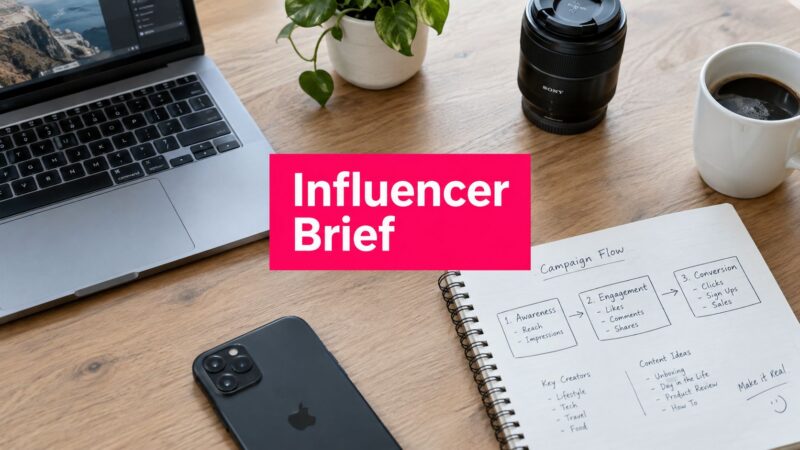
An influencer brief is the operating document for a creator partnership. It should explain what the campaign needs to accomplish, who it must reach, what the creator needs to produce, how the content will be reviewed, and how the team will judge the result.
A short document can work better than a long one if it answers the right questions. The brief should help a creator understand the product and audience without forcing them to sound like a brand spokesperson. It should also help internal teams agree on the campaign before content production begins.
A practical influencer marketing campaign brief normally includes:
- Campaign purpose: The business outcome, such as awareness, launch education, or purchases.
- Audience definition: The people the content needs to reach and the problem they're trying to solve.
- Message hierarchy: The primary claim, supporting reasons, and approved offer.
- Deliverables: Platforms, formats, quantity, required assets, and posting instructions.
- Measurement: The primary KPI, supporting metrics, tracking links, and reporting expectations.
- Operations: Dates, compensation, usage rights, disclosures, contacts, and approvals.
The strongest briefs prioritize decisions rather than merely filling fields. If the audience is wrong, excellent creative won't rescue the campaign. If the objective is unclear, the team may approve attractive content that can't be evaluated. If the brief dictates every line, the creator may lose the voice that made the partnership valuable.
Clarify Purpose Audience and Messaging
Start with one sentence that describes the campaign's job. “Promote our new product” isn't specific enough because it doesn't tell the creator whether the content should create curiosity, explain a benefit, or drive an immediate purchase.
Use a structure such as:
Campaign purpose: Introduce [product] to [audience] so they understand [main benefit] and take [desired action].
A DTC skincare launch might become: “Introduce the new barrier cream to people with dry, sensitive skin so they understand how it fits into a simple evening routine and visit the product page.” That sentence gives the creator a useful direction without prescribing the entire story.
The business context matters too. Note whether the product is entering a crowded category, replacing an older product, supporting a seasonal offer, or addressing a customer objection. A creator can make a more relevant video when they know the market tension behind the campaign.

Build a usable audience persona
Avoid demographic labels that don't change the creative. “Women interested in beauty” gives little practical guidance. Describe the audience through context, motivation, barriers, and language.
Persona Template
- Who they are: Life stage, relevant location, and category familiarity.
- Current problem: What frustrates them or takes too much effort.
- Desired outcome: What would make the purchase feel worthwhile.
- Objection: Price, complexity, trust, ingredients, fit, or switching costs.
- Content behavior: What they watch, save, share, or search for.
- Proof needed: Demonstration, review, comparison, tutorial, or social validation.
- Action: The one next step the campaign should encourage.
The persona should influence creator selection. A creator can have a large audience but still be a poor fit if their viewers don't share the product problem or buying context. Review audience geography, interests, prior brand collaborations, comment quality, and the creator's natural relationship with the category.
Create a message hierarchy
Give creators a message ladder, not a paragraph of brand language.
- Primary message: The one idea viewers should remember.
- Supporting proof: Product details, demonstration points, or customer benefits that support it.
- Required action: Visit a page, use a code, save the tutorial, or learn more.
- Approved language: Claims and descriptions the brand can stand behind.
- Avoid list: Unsupported promises, competitor attacks, sensitive claims, or misleading demonstrations.
This order directly addresses the documented failure pattern. Analysis attributes 30% of brief failures to wrong influencer selection, 21% to poor creative quality, and 21% to unclear campaign objectives, as reported in the Influencer Strategists performance report. The practical implication is clear: choose for audience fit first, give useful creative direction second, and define measurement before production begins.
Practical rule: If a sentence in the brief could apply to every audience and every product, rewrite it until it changes the creator's decision.
Set Goals KPIs and Creative Deliverables
A campaign goal describes the business outcome. A KPI tells the team how it will recognize progress. Keep the distinction visible so creators understand what the content needs to do.
For an awareness campaign, the brief might prioritize qualified reach, video views, or watch time. For engagement, it might emphasize comments, saves, or engagement rate. For conversion, it could focus on tracked purchases, CPA, or CTR. Practitioner guidance recommends pairing the goal with precise KPIs such as CPA, CTR, or watch time, as explained in Modash's influencer briefing guidance.
Don't give every metric equal status. Choose one primary KPI and identify supporting indicators. A sales campaign could use CPA as the primary measure, with CTR and landing-page sessions as diagnostic metrics. A tutorial campaign could use watch time as the main signal, with saves and comments helping the team understand whether the content was useful.

Turn the objective into deliverables
Write deliverables so a creator can tell exactly what must be submitted. Include:
- Platform and format: TikTok video, Instagram Reel, Story sequence, carousel, or YouTube Short.
- Content requirements: Product appearance, demonstration, spoken message, caption elements, and call to action.
- Submission materials: Draft file, caption copy, thumbnail, raw footage, or alternate hooks.
- Posting conditions: Account, tag, link, code, disclosure, and publishing window.
- Reporting: Metrics required, reporting deadline, and screenshot or platform-export expectations.
A useful deliverable line might read: “Create one TikTok product demonstration showing the setup process, explain the primary benefit in your own words, include the approved offer, and submit the draft for review before publishing.” It sets a boundary while leaving room for the creator to choose the opening, setting, pacing, and visual style.
Protect creator interpretation
The brief should define the problem and the essential requirements, not dictate every movement. Scripts can help when legal wording or technical accuracy matters, but rigid scripts often flatten the creator's voice. Instead, provide two or three possible angles, examples of content the brand likes, and a short list of prohibited claims.
For example, a meal-planning app might allow a “busy weekday,” “budget reset,” or “first-time user” angle. The creator chooses the scenario that fits their audience. The brand controls the product truth, required disclosure, and offer, while the creator controls the performance.
Give creators references with an explanation of what works. “Use this style” is weak. “We like the direct opening, real screen demonstration, and clear final action” gives the creator something they can interpret.
The brief should function as a guide for interpretation, not a production script.
Plan Timeline Compensation Legal and Approval
Operational details determine whether a promising collaboration moves smoothly or becomes a chain of unanswered messages. Put the calendar in the brief before the creator starts work, and separate production deadlines from publication deadlines.
A basic campaign calendar can include:
| Milestone | What the creator submits or receives |
|---|---|
| Product and brief delivery | Product information, links, requirements, and contact details |
| Concept confirmation | Proposed angle or short creative outline |
| Draft review | Video, caption, and required supporting assets |
| Feedback window | Consolidated brand comments |
| Final approval | Approved content and publishing confirmation |
| Live post | Published URL, code, and reporting instructions |
| Performance report | Agreed platform metrics and submission format |
Industry guidance recommends specifying timelines, payment terms, and review windows, while sharing examples of successful past content to clarify expectations. Meltwater's influencer marketing brief template guidance supports treating these details as core brief fields rather than administrative notes.

Make compensation unambiguous
State the compensation model, amount or agreed consideration, payment trigger, invoice process, and responsibility for transaction fees. Depending on the partnership, compensation may involve a fixed fee, product, affiliate commission, or a combination. Don't leave the creator to infer whether payment follows approval, publication, or reporting.
For product-only collaborations, clarify what the creator receives and whether the product must be returned. For affiliate partnerships, specify the tracking link or code, commission terms, attribution window if applicable, and reporting owner. For fixed-fee work, explain whether paid usage, raw footage, exclusivity, or additional revisions are included.
Compensation and rights should appear together because a request for paid media usage changes the value of the deliverable. A creator shouldn't discover after approval that the brand expects to run the video as an advertisement.
Write legal requirements into the creative instructions
Disclosure isn't a footnote. The Federal Trade Commission's social media disclosure guidance says disclosures should be clear, hard to miss, and placed with the endorsement message itself. Tell creators what disclosure language or platform label to use, where it must appear, and whether it needs to be spoken, shown on screen, included in the caption, or applied through the platform's paid partnership tool.
Document usage rights in plain language:
- Channels: Organic social, website, email, retail pages, or paid media.
- Duration: How long the brand can use the content.
- Edits: Whether cropping, subtitles, resizing, or cutdowns are allowed.
- Territory: Where the brand can publish the asset.
- Exclusivity: Categories or competitors the creator must avoid for an agreed period.
- Ownership: Whether the brand receives a license or full asset ownership.
Design an approval process people can follow
Name one brand reviewer and one backup contact. Require consolidated feedback instead of comments from several stakeholders arriving separately. Define what counts as a required revision, what the brand won't change, and how emergency corrections will be handled if a product detail or disclosure is wrong.
A practical workflow might allow concept approval before filming, one structured draft review, and final sign-off before publication. That process protects the brand without turning every creator decision into a committee vote.
Build Distribution Amplification Strategy
The media role changes the brief. Organic content needs to feel native to the creator's feed. Paid amplification needs a strong opening, clean rights, and an asset that can work outside the creator's immediate audience. Affiliate content needs an unmistakable path from recommendation to tracked action.
Label the intended role beside every deliverable:
| Media role | Brief emphasis |
|---|---|
| Organic reach | Native voice, audience conversation, saves, shares, and platform behavior |
| Paid amplification | Hook options, clear product framing, usage rights, cutdowns, and ad-account permissions |
| Affiliate conversion | Offer, tracking link or code, product proof, buying objections, and reporting |
| Cross-funnel asset | Variants that can support discovery, consideration, and action |
Short-form content must earn attention quickly. The brief can require an opening problem, visible product context, or immediate outcome without forcing a scripted first sentence. Specify pacing expectations, on-screen text, caption structure, landing page, and attribution method.

By 2026, 98% of brand respondents repurposed creator content across other channels, and 74% of marketers used AI to generate ideas and briefs or streamline workflows, according to Aspire's influencer marketing statistics. That makes usage rights, aspect ratios, raw files, captions, and alternate edits planning fields, not post-campaign conveniences.
Creator size can also affect distribution economics. A 2026 benchmark reported a 40% cost-per-engagement gap, with median engagement rates of 3–8% for micro-creators versus 1–3% for macro-creators, as reported by NewEngen's influencer marketing trends analysis. Use that benchmark as a decision input, not a universal rule. Micro-creators may suit targeted product education and community trust, while macro-creators may provide broader awareness or stronger production scale.
For paid use, specify whether the brand needs Spark Ads or whitelisting access, which account will run the promotion, the approved duration, and whether edits are permitted. For affiliate use, provide the exact destination, code, commission terms, and customer support route. A distribution-ready brief prevents the common mistake of producing an attractive post that the media or commerce team can't legally or technically reuse.
Provide Sample Templates Examples and Checklist
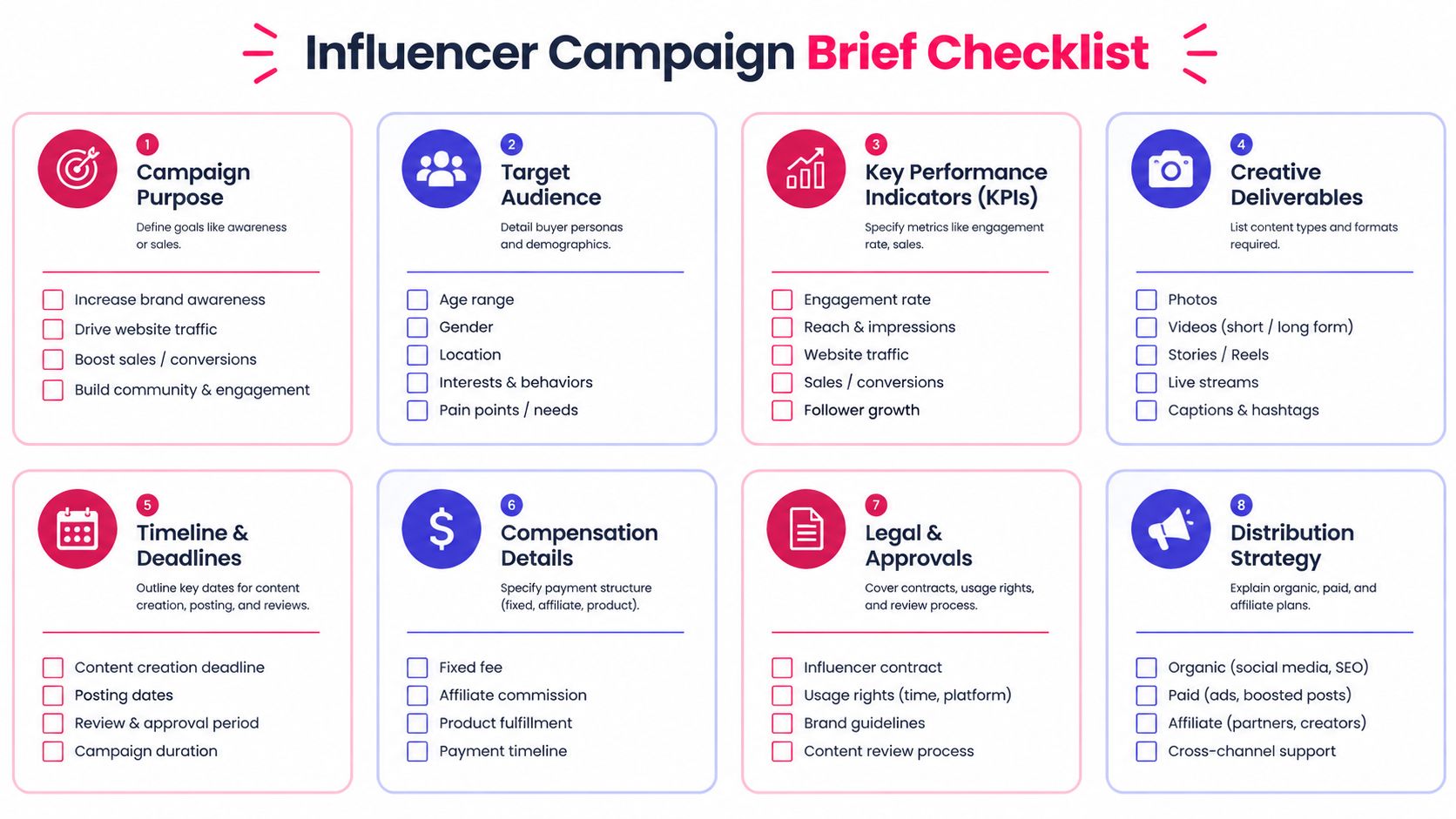
A useful template should be fillable without becoming a strategy document that creators won't read. Keep the opening page focused on decisions, then attach deeper product, legal, and brand resources only when necessary.
Fillable campaign brief template
Campaign overview
- Brand and product: What is being promoted, and what customer problem does it address?
- Purpose: Awareness, launch education, engagement, conversion, or another defined outcome.
- Market context: Why this campaign is happening now and what audience tension matters.
- Primary action: The one action viewers should take.
Audience and positioning
- Audience persona: Who they are, what they want, and what may stop them from buying.
- Creator fit: Audience characteristics, category relevance, content style, and exclusions.
- Primary message: The idea viewers should remember.
- Supporting proof: Demonstrations, product facts, reviews, or approved claims.
- Avoid: Unsupported claims, competitor references, prohibited visuals, or sensitive language.
Measurement
- Primary KPI: The single metric that determines success.
- Supporting KPIs: Diagnostic measures that help explain performance.
- Tracking method: Link, code, platform analytics, affiliate dashboard, or reporting form.
- Reporting requirement: What the creator submits and when.
Deliverables and creative direction
- Platform and format: Specify each asset separately.
- Quantity: State the required posts, stories, videos, or raw files.
- Creative latitude: List what the creator chooses and what the brand requires.
- References: Include examples and explain the useful elements.
- Mandatory details: Product appearance, offer, disclosure, tags, hook type, and call to action.
Operations and rights
- Timeline: Product delivery, concept, draft, review, approval, publication, and reporting.
- Compensation: Fixed fee, product, affiliate, or combination, with payment terms.
- Usage rights: Channels, duration, territory, editing, paid media, and ownership.
- Approval process: Reviewer, feedback format, revision expectations, and sign-off.
- Contacts: Day-to-day manager, legal contact, and escalation route.
Example one TikTok launch brief
Purpose: Introduce a new kitchen organization product to renters who want a more functional space without a major renovation.
Audience: People who regularly watch small-space organization content and need simple, visible improvements. Focus on the problem of cluttered counters rather than broad lifestyle language.
Primary message: The product creates a practical storage improvement without requiring permanent installation.
Deliverable: One TikTok demonstration using the creator's own kitchen or an authentic home setting. Show the starting problem, the setup, the finished result, and one limitation or consideration that helps the review feel credible.
Creative latitude: Choose the opening and presentation style. The brand requires a clear product demonstration, approved product description, disclosure, and tracked destination. Avoid claiming that the product works for every surface or household.
Distribution: Organic TikTok publication, with separate approval for paid amplification. Request the final video file and caption so the brand can evaluate reuse rights before activation.
Example two Instagram micro-influencer partnership
Purpose: Help a niche fitness creator explain how a recovery product fits into an existing routine and drive qualified visits through an affiliate link.
Audience: Followers already interested in practical recovery habits, who may need evidence of ease of use and a reason to try the product now.
Deliverables: One Instagram Reel and supporting Story content with the affiliate link. The Reel should show the routine context and personal product experience. The Stories should make the offer and next action easy to find.
Measurement: Use affiliate purchases as the commercial KPI, with CTR and replies as supporting signals. Give the creator the exact link, code rules, commission terms, and reporting instructions.
Creative latitude: The creator chooses the routine and tone. The brand supplies approved claims, disclosure requirements, product handling instructions, and the review process.
Final send checklist
- Purpose: Can the creator state the campaign's job in one sentence?
- Audience: Does the persona describe a real problem and buying context?
- Creator fit: Have audience relevance and content style been checked?
- Message: Is there one primary message rather than a collection of slogans?
- Claims: Are approved product facts separated from prohibited claims?
- KPI: Is one primary success metric clearly identified?
- Deliverables: Are platform, format, quantity, and submission materials explicit?
- Creative freedom: Does the creator know what they can interpret?
- Timeline: Are product delivery, draft, review, approval, posting, and reporting dates visible?
- Compensation: Are payment, commission, product, invoice, and trigger terms clear?
- Disclosure: Are placement and wording requirements included?
- Rights: Are organic, paid, website, email, editing, duration, and ownership terms documented?
- Distribution: Is the asset intended for organic, paid, affiliate, or cross-channel use?
- Approval: Is there one decision-maker and a defined feedback process?
- Tracking: Are links, codes, tags, and reporting destinations ready?
- References: Do examples show the desired principle rather than invite imitation?
Conclusion and Next Steps
A strong influencer marketing campaign brief connects purpose, audience fit, messaging, creative freedom, measurement, operations, compliance, and distribution. That connection prevents the most expensive upstream mistakes, including choosing the wrong creator, producing weak creative, or judging the campaign against an unclear objective.
Download or copy the template, run it through a small pilot, and ask creators which fields helped or restricted them. Archive the final brief beside the content, rights terms, and performance data so future teams can improve the next campaign instead of rebuilding the workflow from memory.
JoinBrands helps brands create campaign briefs, match with creators, review content, manage deadlines, and activate formats such as Reels, Shorts, UGC, and Spark Ads in one workflow. Visit JoinBrands to build your next creator campaign around clearer deliverables and measurable outcomes.