
 Pixel Size for YouTube Video: A 2026 Guide for Creators
In a Twitter dataset of 773,393 disclosed sponsored posts, researchers estimated that 96% of sponsored posts were undisclosed, with roughly 18.97 million undisclosed sponsored posts in the examined data the Twitter sponsorship disclosure study. That is the situation you are buying into with paid social media influencers. The channel works because it does not look like advertising, and that exact quality creates your compliance risk, your measurement problem, and most of your wasted spend if you do not run it tightly.
Table of Contents
What Paid Social Media Influencers Are
This isn't casual posting anymore. The global influencer-marketing industry was valued at approximately RMB 126.4 billion in 2020 and reached RMB 176.3 billion by 2024, a compound annual growth rate of 8.7%, while a separate estimate placed the broader influencer-advertising segment at US$35.1 billion in 2024, projected to reach US$52 billion by 2028 the HKEX filing on influencer marketing market size. Treat it as a media channel with dedicated budgets, creator fees, and performance expectations, not as free reach.
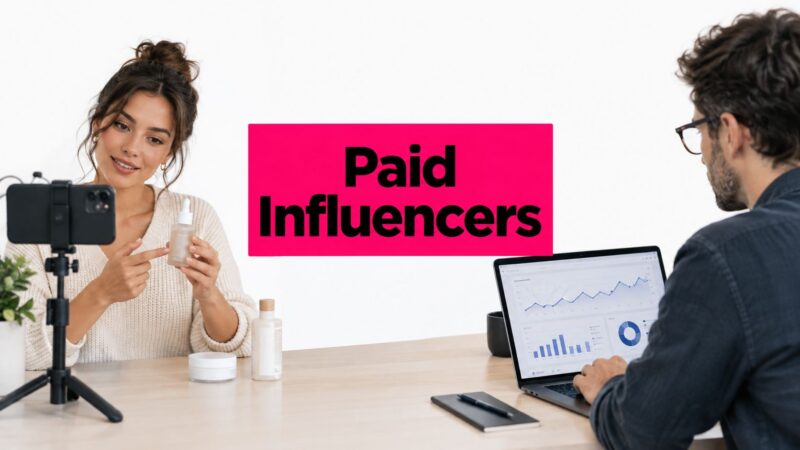
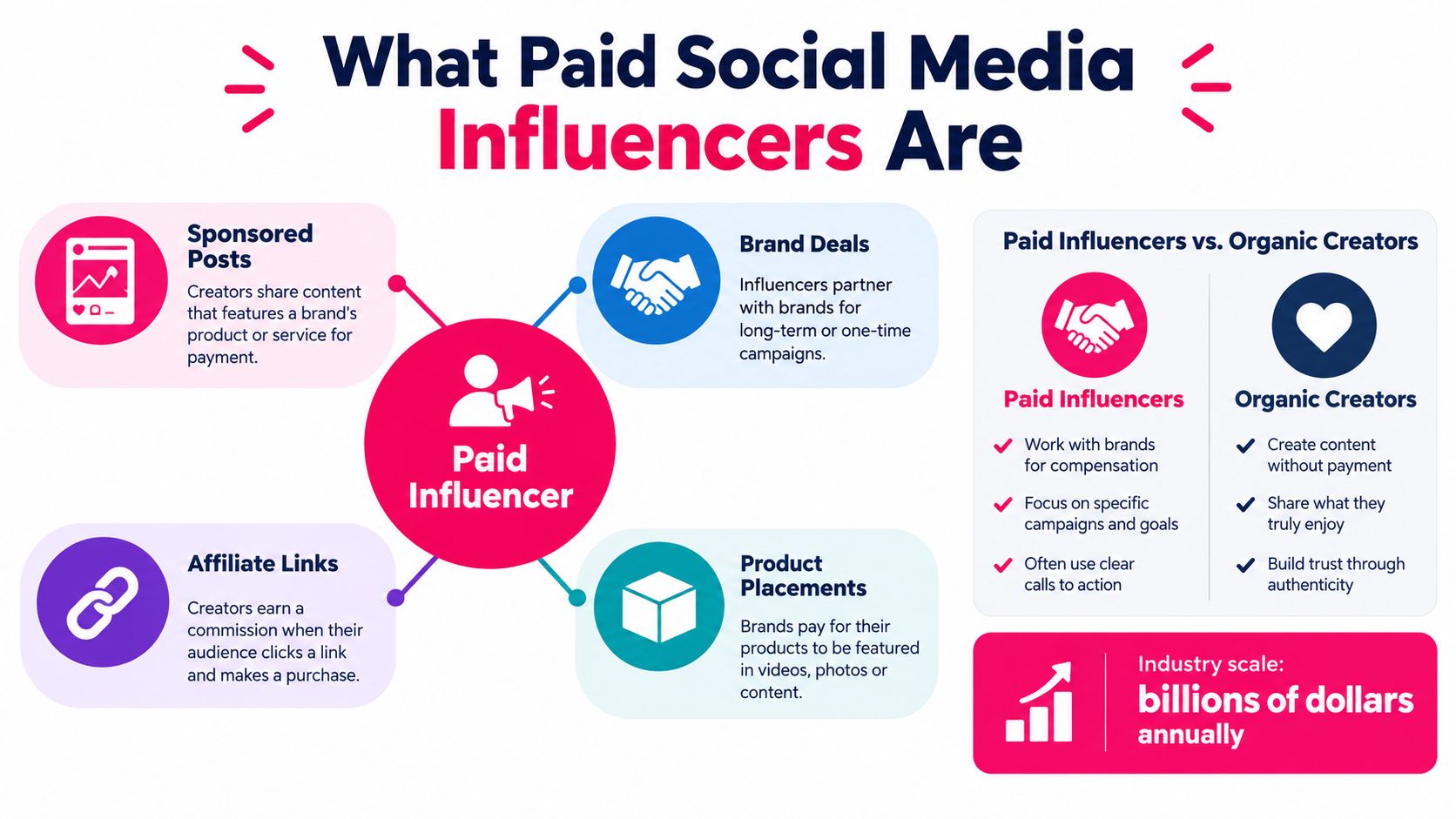
A paid social media influencer is a creator who promotes a product because of a material connection to a brand. That connection includes cash, affiliate commissions, free or discounted products, employment, or other benefits that could change how an audience interprets a recommendation. You don't need a wire transfer for it to count as paid.
Why Brands Pay Instead of Hoping for Organic Mentions
You're paying for three separate things, and you should know which one you're buying before you approve a rate. First, you're borrowing trust a creator built with a specific audience. Second, you're buying distribution into segments your own account can't reach. Third, you're buying an ad-ready asset you can license, whitelist, or turn into a Spark Ad or Partnership Ad.
Those are different jobs with different prices. A creator who's brilliant at making a 20-second product demo for paid media may be mediocre at driving organic comments. A lifestyle creator with loyal followers may produce content that won't survive as a cold ad. Mixing up the job is how brands overpay.
Pro tip: Write one sentence before outreach that says, “This creator is being hired primarily for trust, distribution, or ad creative.” If you can't pick one, your brief and your KPI choice will drift.
Formats now include sponsored short-form video, affiliate promotions, livestream commerce, branded content, and creator-authorized advertising. By the end of this guide you'll be able to choose a model, price it fairly, set KPIs, run a compliant workflow, and test whether a creator caused incremental sales or just touched buyers who were already coming.
Paid vs Organic vs Affiliate vs Ambassador Models
Most programs fail at model selection, not creator selection. Brands ask an affiliate creator to deliver controlled launch messaging, or they pay a flat fee and then judge the post only on last-click sales. Each model shifts risk and control differently.
Paid campaigns give you guaranteed deliverables, deadlines, and approval rights. You carry the risk because you pay whether or not it sells, so they're best for launches, claims-sensitive products, and content you need on a specific date. Organic partnerships usually involve gifting or light-touch collaboration without guaranteed posting. They cost less control, but you can't build a launch calendar on hope.
Affiliate programs flip the risk to the creator, who earns commission on tracked sales. That works when your product page converts, your margins support commission, and creators can post shoppable links without friction. It fails when your offer is weak, because good creators won't keep promoting something that doesn't pay them.
Ambassador models trade short-term control for repeated exposure over months. They're useful when trust builds through repeated use, like supplements, skincare routines, or apps. They're a poor fit if you need fresh creative angles every week, because the same face can wear out an audience.
Creator Partnership Models Compared
| Model | Payment | Content Ownership | Risk | Best For |
|---|---|---|---|---|
| Paid campaign | Flat fee per deliverable | Licensed if contracted | Brand pays upfront | Launches, controlled messaging |
| Organic or gifted | Product or no fee | Usually creator-owned | No guaranteed post | Seeding, relationship building |
| Affiliate | Commission on sales | Creator-owned unless licensed | Creator carries performance risk | Proven offers, shoppable content |
| Ambassador | Retainer plus possible commission | Negotiated long-term license | Shared over time | Repeat-use products, loyalty |
Combining Models Without Creating a Mess
A practical sequence is paid first, affiliate second, ambassador third. Pay a small cohort for launch content and usage rights, identify who drives qualified traffic and usable creative, then move winners into affiliate so they keep posting without a new negotiation each time. Promote only the most consistent performers to ambassador deals.
Don't run all four models with the same creator at once unless the contract separates them clearly. Disputes often start when a brand assumes an ambassador retainer covers paid ad usage, while the creator assumes affiliate commission is on top. Put deliverables, posting obligations, commission, exclusivity, and licensing in separate line items. That paperwork feels slow. It's cheaper than renegotiating after content goes live.
Pricing Models and Typical Rates by Platform
A creator's rate is only the start of the negotiation. Two identical fees can produce different economics once revisions, usage, exclusivity, and attribution are priced in. Standardize the payment structure first, then compare creators on equal terms.
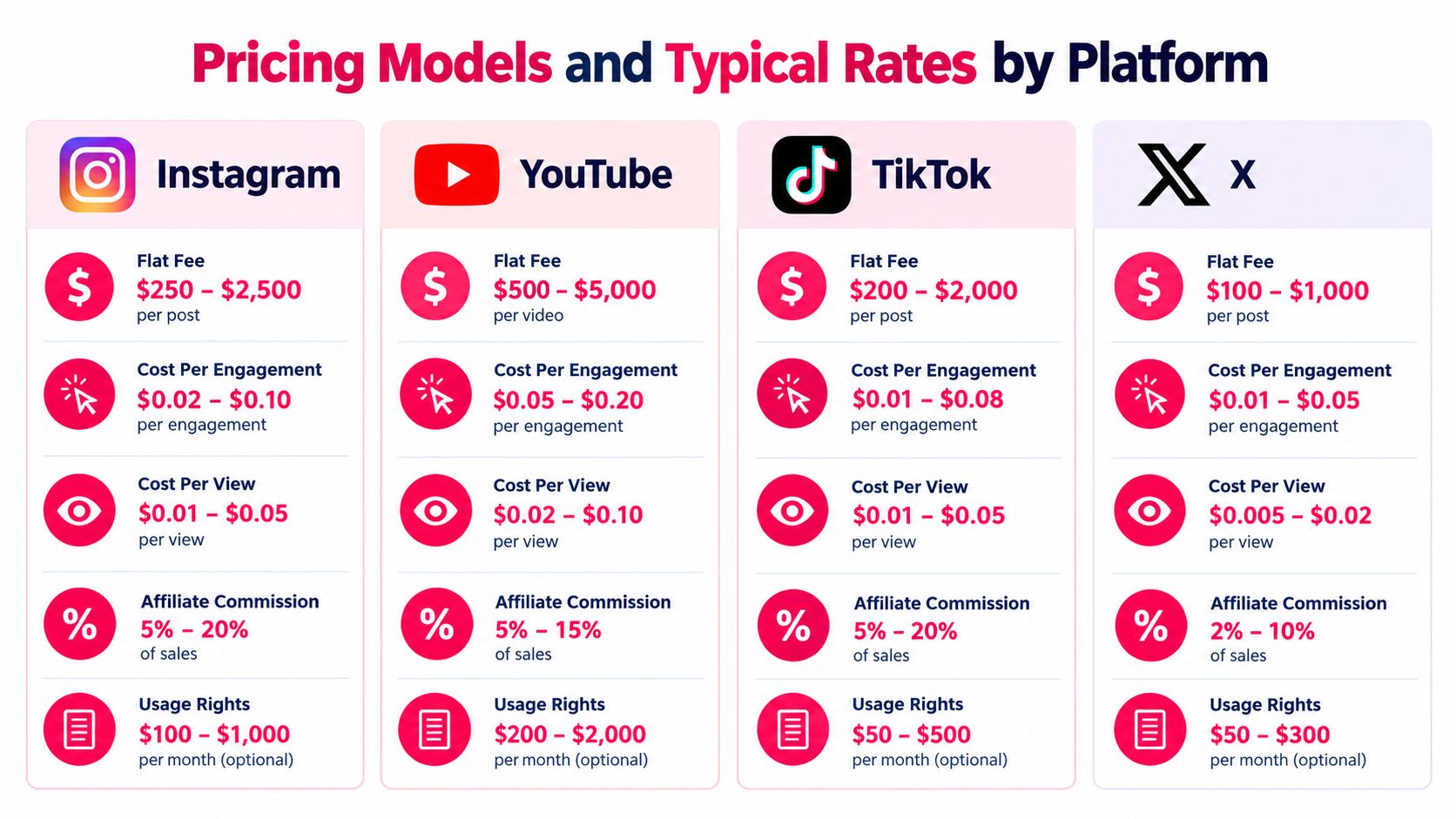
The pricing visual below breaks the common structures by platform so you can see them side by side before you negotiate.
The Structures You're Choosing Between
- Flat fee per post: Predictable and best for guaranteed deliverables. Define format, length, posting window, revisions, and whether the post stays live.
- Cost per engagement or view: Ties pay to distribution, but it can reward low-intent views. Use it only with clear counting rules and caps.
- Affiliate commission: Works when tracking is clean and the creator can use direct product links. In Southeast Asia, direct product links influenced 31% of consumers, outperforming non-shoppable influencer posts the CreatorIQ State of Creator Marketing report.
- Usage rights fee: Separate from the posting fee. Duration, paid media use, whitelisting, and territory change the value.
- Hybrid base plus bonus: A modest base covers production time, with bonuses tied to tracked sales, qualified clicks, or approved ad performance. This is usually the fairest structure for smaller creators.
Price the Increment, Not the Audience
Follower count is a weak pricing input. The same CreatorIQ dataset points to slipping reliance on very large accounts as feeds reward watch time, saves, shares, and comment quality. The cleaner buying question is whether the creator can reach buyers you would not have reached anyway.
Don't ask, “What do you charge per post?” Ask, “What does your fee include for posting, revisions, raw files, paid usage, and exclusivity?” You'll learn more in one reply than in a rate sheet.
Budget for hidden costs before you agree. Whitelisting access, extra revision rounds, product shipping, paid amplification, music licensing, and exclusivity all change the cost. A low flat fee that excludes ad usage can become the expensive option if the organic post works and you can't legally scale it.
A fair hybrid protects both sides: base pays for controlled labor like scripts, revisions, deadlines, and raw files; bonus pays only on tracked outcomes that survive a holdout, exclude existing customers, or use a matched-market comparison. That keeps a creator from carrying all performance risk while stopping a brand from paying commission on demand that was already coming.
Pro tip for fairness: Don't use affiliate-only deals to shift all risk onto emerging creators while still demanding scripts, revisions, and deadlines. If you control the work like a paid job, pay a base fee like a paid job.
How to Set Objectives, Budget, and KPIs
Pick one primary objective per campaign. Awareness, traffic, and conversion campaigns need different creators, different briefs, and different success thresholds. When everything is the goal, weak results get defended with whichever metric happens to look good.
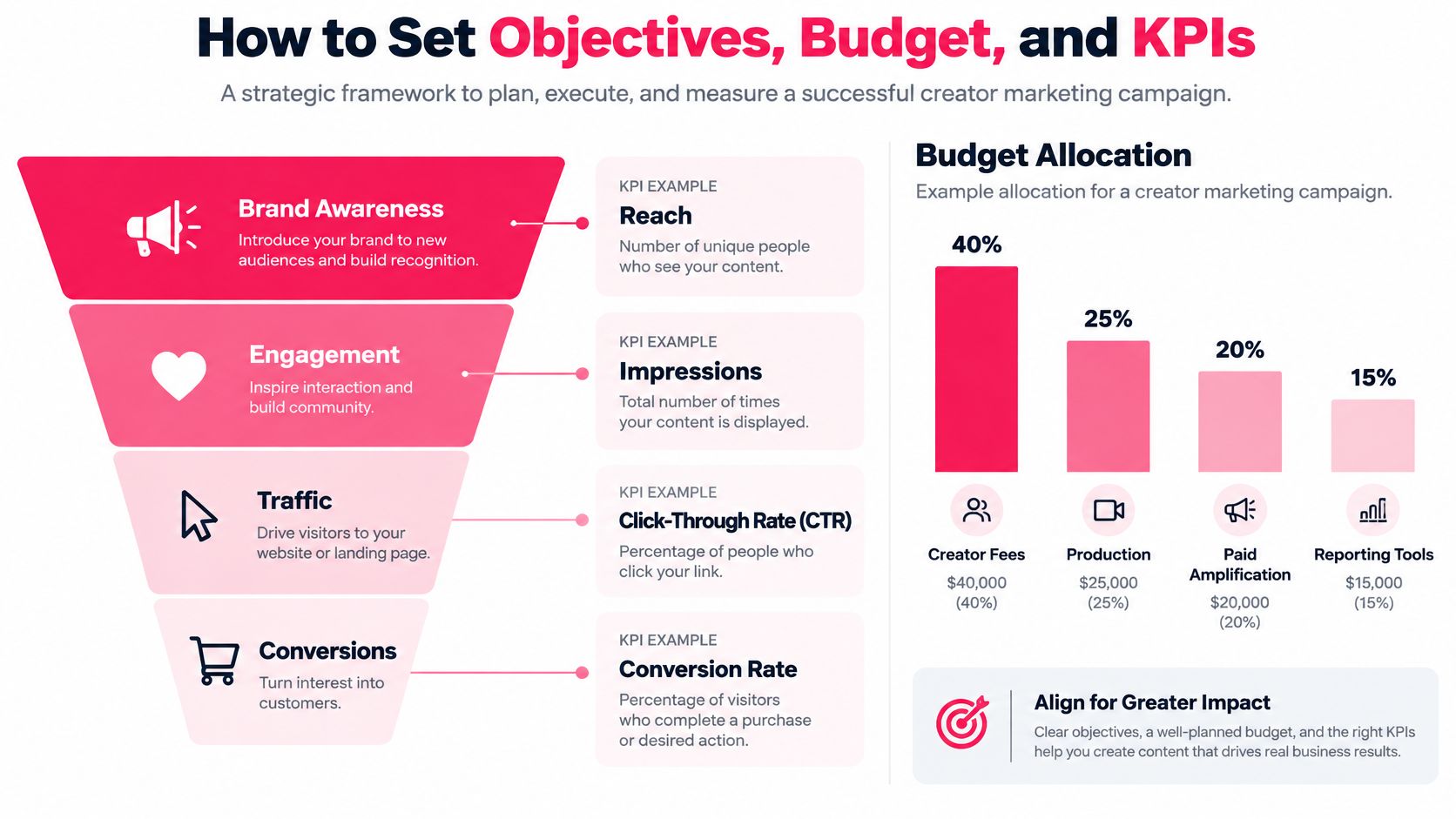
The funnel below maps objectives to budget and KPI choices in the order you should make them.
Match the KPI to the Job
- Awareness: Use reach, impressions, video completion, and brand recall. Don't punish an awareness creator for low discount-code sales.
- Engagement quality: Use saves, shares, substantive comments, and profile taps. Raw likes tell you very little about purchase intent.
- Traffic: Use click-through rate, landing page sessions, and product-page view rate with UTMs or platform links.
- Conversions: Use cost per acquisition, attributable revenue, conversion rate, and blended CAC. Separate organic posting results from paid amplification results.
Agree these definitions before launch, in writing. Creators, media buyers, and finance teams often use the same words for different calculations. One team counts a view at two seconds, another counts a completed video, and reporting turns into an argument.
A Simple Budget Build
Start with this formula: number of creators × fee per creator, plus usage rights, plus product and shipping, plus paid amplification, plus tracking and management time. Build amplification into the first budget, not as an afterthought. Under-budgeting amplification is a common planning mistake, because teams spend everything on content creation and then can't put spend behind the two or three posts that work.
Reserve budget for iteration too. Your first cohort is a test of creator fit, hook style, and offer. If you spend the full budget on untested creators, you've bought a very expensive first draft.
Pro tip: Set a kill rule and a scale rule before launch. For example, decide in advance what product-page rate earns paid amplification and what cost per acquisition stops it. You'll make faster, less emotional calls when results arrive.
The Campaign Workflow From Brief to Reporting
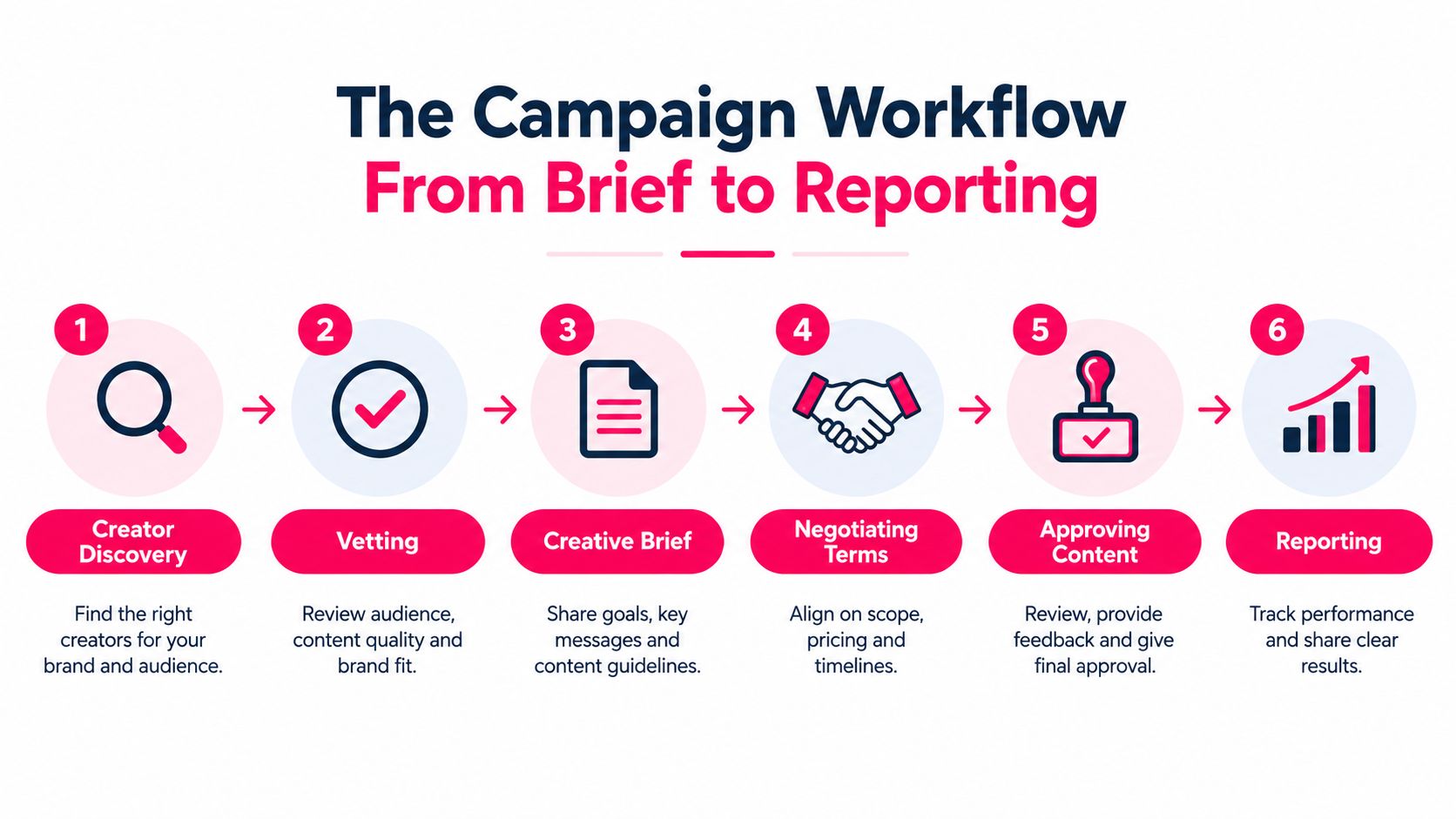
Good workflows protect creative freedom by making the commercial parts explicit. Creators don't usually resist structure. They resist vague briefs, late feedback, and surprise usage demands after they've filmed.
Start with discovery and vetting before you talk rates. Review recent sponsored posts, comment quality, audience fit, claim discipline, and whether the creator already promotes competitors. Platforms such as JoinBrands let brands discover creators, review applications and portfolios, manage deliverables and approvals, handle payments, and activate Spark Ads or Partnership Ad codes in one workflow, which is one option alongside direct outreach and agency management.
The six-step flow below shows where compliance and approval checkpoints belong.
Brief, Contract, and Approval
Your brief needs the campaign goal, audience, key messages, claims the creator can and can't make, deliverables, deadlines, disclosure wording and placement, link requirements, and revision limits. Your contract needs payment terms, usage rights, exclusivity, content ownership, takedown terms, and who is responsible for platform labels. Don't bury disclosure in a general compliance line. Show the exact placement.
Give feedback on accuracy, claims, and clarity first. If you rewrite the creator's opening line, pacing, and personality, you've paid for an influencer and produced a stiff ad. Ask for a hook check before full filming on higher-fee work. It's much cheaper to fix an angle early than to reshoot a finished video.
This walkthrough shows the operational rhythm from setup through live campaign management, which is useful when you're assigning owners to each step.
Close every campaign with reporting against the KPIs you set, plus a decision for each creator. Scale, retest with a new angle, move to affiliate, or stop. Store raw files, final links, disclosure screenshots, usage terms, and Spark or Partnership Ad codes together. You'll need them when a post wins weeks later.
FTC Disclosure Rules and Compliance Best Practices
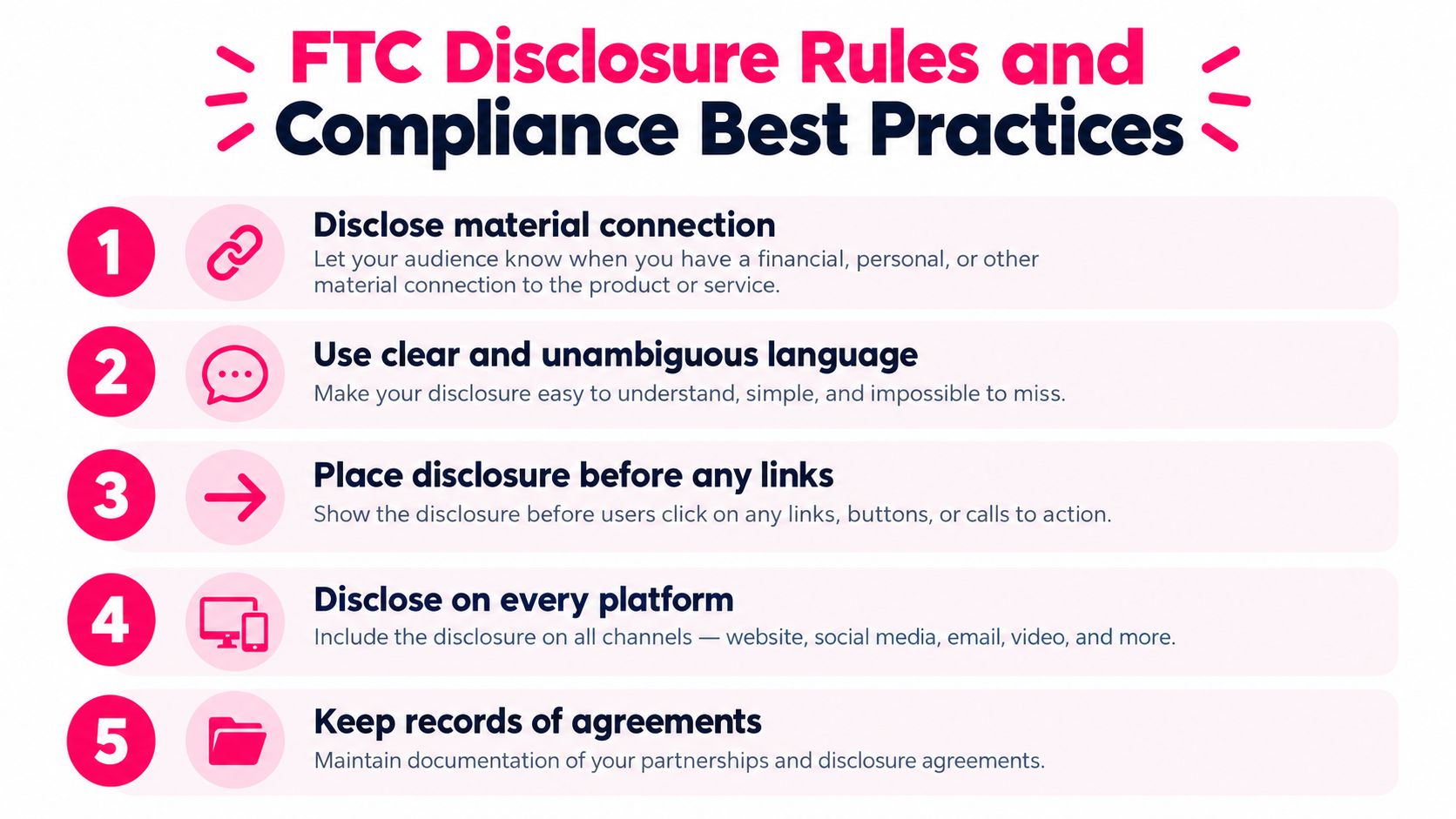
In the United States, a paid influencer must disclose any material connection, including money, free or discounted products, employment, family relationships, or other benefits, and the disclosure belongs with the endorsement itself the FTC guide Disclosures 101 for Social Media Influencers. Hidden on a profile page isn't good enough. Vague labels like “collab” are weaker than clear language such as ad, advertisement, or sponsored.
The checklist below turns the core duties into a pre-publish review you can run quickly.
What Clear and Conspicuous Means in Practice
The FTC's updated Endorsement Guides became effective July 26, 2023, broadened what can count as an endorsement to include compensated tags, hashtags, likes, and virtual influencers, and define a clear disclosure as difficult to miss, understandable, and unavoidable the FTC announcement of the updated Endorsement Guides. Match the medium. A visual endorsement needs a visual disclosure, and an audio endorsement needs an audible one. Don't rely only on an optional platform paid-partnership label.
Claims matter as much as labels. Endorsements must reflect honest opinions or experience, creators shouldn't claim they used a product they haven't tried, and they can't make claims you couldn't legally make yourself the FTC guidance on advertisement endorsements. A skincare creator can say a product felt moisturizing after personal use. They shouldn't promise it permanently cures a condition without substantiation.
Disclosure Is Also a Creative Variable
A meta-analysis of 288 effect sizes from 37 studies and 12,721 participants found disclosures increase persuasion knowledge and brand recall, reduce perceived creator credibility, and had statistically insignificant overall effects on brand attitudes and behavioral intentions the 2024 meta-analysis of sponsorship disclosure effects. That's not a reason to hide disclosure. It's a reason to design it well, place #ad or #sponsored early, and measure recall, clicks, and conversions instead of guessing.
Pre-publish check: Is the disclosure visible without tapping more, spoken or shown in video where needed, repeated on each platform version, and supported by a saved contract and screenshot? If any answer is no, don't publish yet.
Measuring Success and Optimizing Performance
Measuring creator performance was identified as the top barrier to influencer-marketing success by 32% of brand marketers worldwide, and the channel still lacks standardized metrics comparable to CPM or CPC eMarketer coverage of creator measurement barriers. Discount codes and last-click links don't solve that. They undercount view-through demand, cross-device journeys, organic reposts, and buyers who search later.
Follower count misleads in the other direction. Performance is increasingly driven by engagement and content quality rather than audience size, so a big account can look efficient on reach while producing no incremental buyers. You need to separate outcomes instead of forcing everything into one ROAS number.
Use Four Buckets, Not One Score
- Incremental reach: How many qualified people saw this who wouldn't have seen your own ads or account?
- Content efficiency: What did a usable, licensed asset cost after fees, revisions, and usage?
- Assisted demand: Did branded search, product-page visits, email signups, or retargeting pool quality rise after exposure?
- Directly attributable conversions: What can codes, affiliate links, UTMs, and platform tracking credibly connect to the post?
Then test incrementality. Run geographic or audience holdouts where you amplify creator content to one group and withhold it from a matched group. Add post-purchase surveys that ask how buyers first heard about you, and compare blended CAC before, during, and after flights. No single method is perfect, but agreement across methods beats a precise-looking dashboard that's wrong.
Segment results by country too. A longitudinal analysis of more than one million Instagram posts from 400 creators found sponsored posts generally received lower engagement than organic posts, adding disclosure didn't reduce engagement further overall, and disclosed posts performed better in Brazil while the reverse appeared in Germany and the United States the longitudinal Instagram sponsored post analysis. Pooling markets hides that.
Practical rule: Judge a creator ad as an ad asset and a creator post as a placement. They can both win, but they rarely win on the same metric at the same time.
Optimize in small loops. Test disclosure placement while staying compliant, compare hooks and formats, move budget across creator tiers based on qualified actions, and keep a control variant running long enough to learn something real.
Templates for Outreach, Briefs, and Rate Negotiation
Use short outreach that proves you've watched the creator's work. Generic mass messages get ignored or priced defensively.
Copy-Ready Outreach
“Hi [Name], I'm [Your Name] at [Brand]. Your [specific video] worked because [specific detail]. We're launching [product] for [audience] and want [number and format] for [platform] during [window]. Paid partnership, product provided, disclosure required, and we're also interested in paid usage if the post performs. Can I send the brief and your rate options for posting only versus posting plus usage?”
Brief Checklist and Negotiation Points
- Brief essentials: Goal, audience, deliverables, deadline, product facts, prohibited claims, disclosure placement, link or code, revision rounds, approval contact.
- Rate questions: What's included for posting, raw files, paid usage duration, whitelisting, exclusivity, extra revisions, and affiliate commission?
- Fair structure: If you require scripts, deadlines, and revisions, offer a base fee. Use bonuses to reward performance, not to replace payment for labor.
What if a creator publishes without proper disclosure? Ask them to correct it immediately, pause amplification, and save screenshots of the fix. If they refuse, enforce the contract and don't rehire them. Your responsibility doesn't end because the creator pressed publish.
Micro or mega? Choose by qualified reach, conversion intent, production quality, and licensing value. Start with a test cohort, scale the creators who create buyers and reusable assets, and let follower count be a screening detail rather than the decision.
Ready to run paid social media influencers with cleaner pricing, approvals, disclosure checks, and reporting instead of scattered DMs and spreadsheets? JoinBrands connects you with creators across TikTok, Instagram, YouTube, and Amazon, and helps you manage briefs, content approval, payments, and Spark Ads activation from one place. Visit JoinBrands to launch your first campaign and test which creators drive measurable, incremental growth for your brand.