
 Influencer Marketing vs Brand Ambassador: Which Model Fits
You've just had a creator post land that looks perfect. Strong opening, real voice, the product shown in use, a comment section filling up with people asking where to buy it. Your brand account reposts it, likes climb, and someone on Slack asks whether this should become an ad. That question is where many teams stall for a week, because posting a video and paying to distribute it are two different processes with different paperwork, and nobody agreed in advance who owns the authorization code, how long the brand can use the footage, or which number would tell you whether the post sold anything.
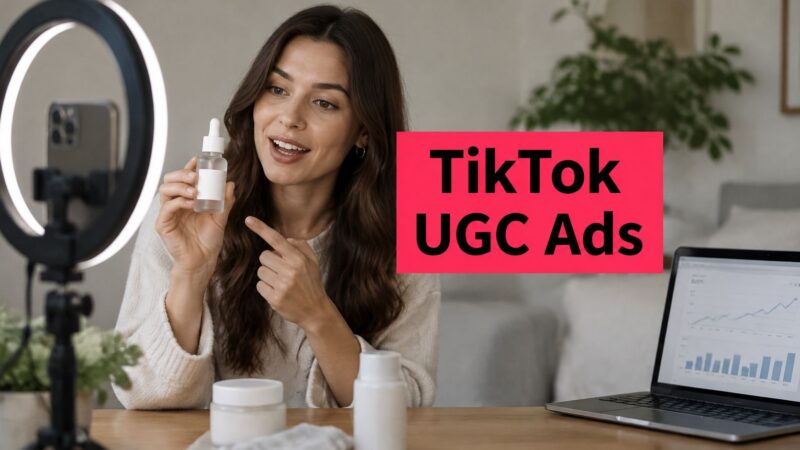
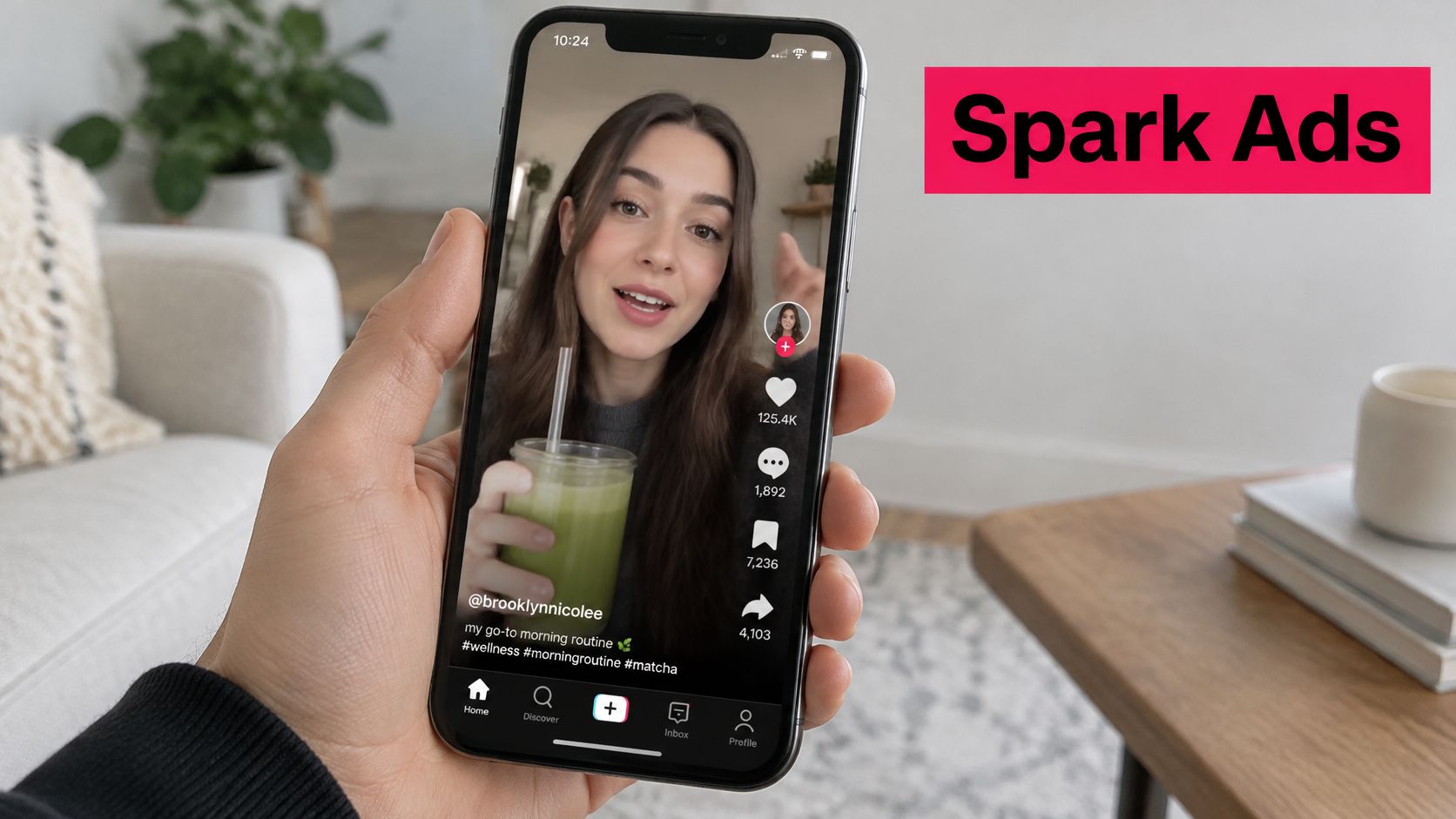
TikTok UGC ads are creator-made, sound-on, vertical videos that a brand pays to promote. The strongest version runs as a Spark Ads campaign, so the paid post keeps the creator's handle, likes, comments and profile, rather than being republished as a brand asset that looks like an ad.
That distinction matters because it changes what you're buying. You aren't buying a video file. You're buying distribution attached to a creator's identity and an engagement history.
Table of Contents
The TikTok UGC Ad Workflow at a Glance
A TikTok UGC ad is a creator-made vertical video, filmed the way a customer would film it, that a brand pays to put in front of an audience. Many brands run it through Spark Ads, which launched globally in July 2021 and lets a brand promote an existing organic post while preserving its social signals, including likes, comments, shares, follows and profile visits, as TikTok's Spark Ads overview explains.
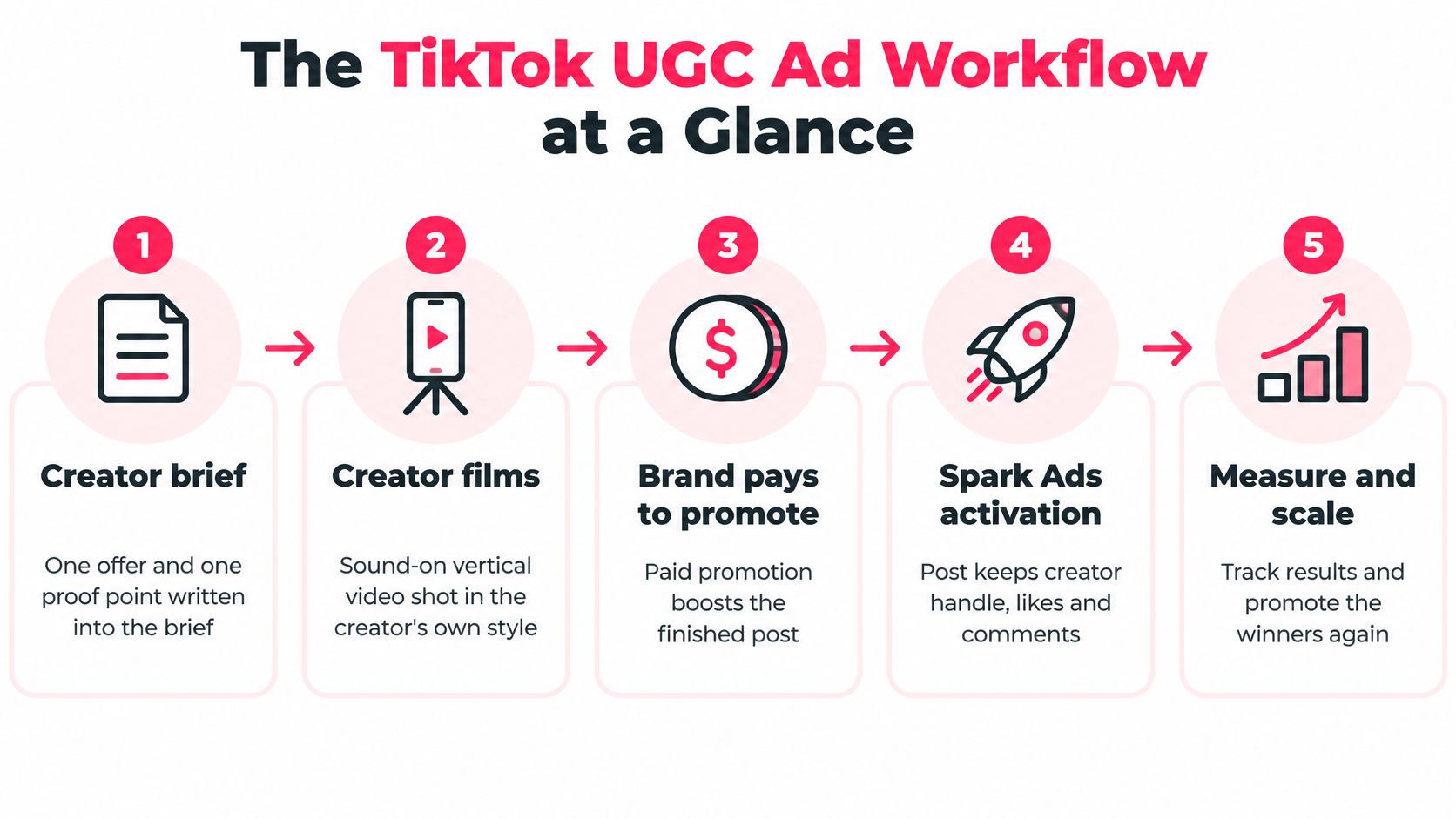
The workflow has seven stages, and each one produces something the next stage needs. Skipping a stage doesn't save time, it moves the delay further downstream where it's more expensive.
| Stage | Output | Usual Owner | Check Before Moving On |
|---|---|---|---|
| 1. Brief | One offer, one proof point and a three-part script | Brand marketer | Brief approved and approval timeline set before filming |
| 2. Creator sourcing | Three to five creators matched to the target audience | Brand or agency | Portfolio shows native, sound-on vertical video |
| 3. Production | Several hooks and creator variants at 720p or higher | Creator | Product or problem visible in the first two seconds |
| 4. Permissions | Signed usage scope and branded-content setting | Brand and creator | Rights, duration and disclosure recorded in writing |
| 5. Authorization | Spark code generated from the approved organic post | Creator and brand | Authorization duration matches the planned paid window |
| 6. Testing | Creatives and ad groups run under identical conditions | Media buyer | Same audience, budget, bid and attribution window for each test |
| 7. Measurement | Incremental conversions, CAC and retention by creative | Analyst | Holdout or geo test in place before reading results |
Read that table as a gating sequence, not a checklist. Stages one and four cause most of the delay. A brief that wanders across three messages forces reshoots, and a permissions conversation that happens after filming turns a two-week campaign into a five-week one. Put the earliest deadlines on those two rows and the rest of the timeline takes care of itself.
The format earns its reputation on numbers TikTok publishes about itself. The platform reports that Spark Ads achieved a 134% higher video-completion rate and a 157% higher six-second view-through rate than standard in-feed ads, plus a 69% higher conversion rate and 37% lower cost per acquisition on its profile-landing-page experience (TikTok for Business). Treat those as directional. They come from the company selling the placement.
Here's the rule that governs everything after this: change one variable per test. If you swap the creator, the hook, the offer and the landing page in the same week, you'll get a result and learn nothing from it.
How to Write a Creator Brief That Holds the First Three Seconds
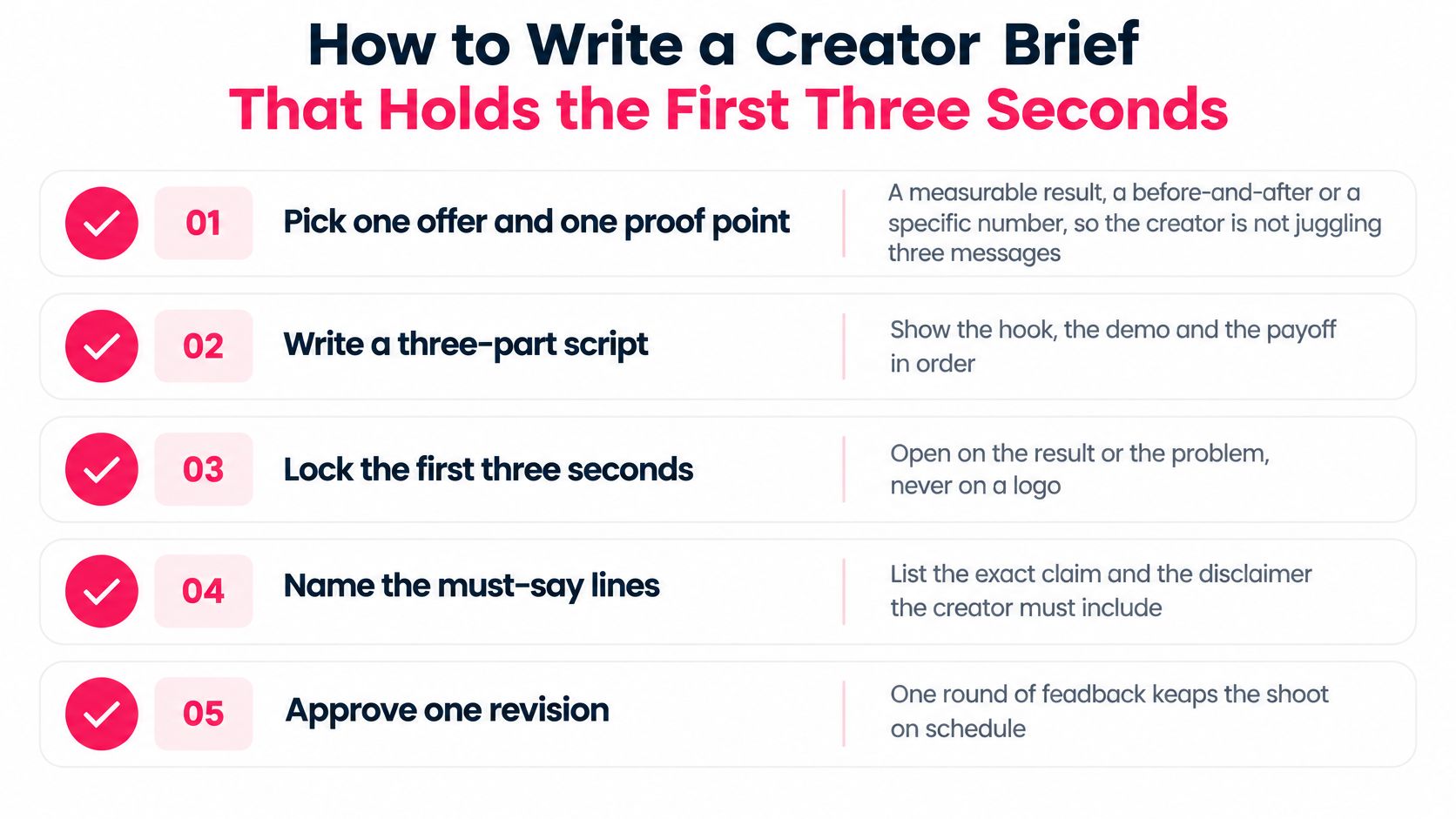
A creator can deliver polished footage that still fails as an ad if the opening is unclear. Give them a specific message, a visible first frame, and room to make the delivery feel natural. Seven decisions make the brief usable.
- Choose one offer and one proof point. Use a measurable result, a before-and-after, or a specific product detail. If the creator has to juggle three messages, the viewer gets none of them. Write the proof point as a sentence the creator can say aloud.
- Set three script beats. Open with the problem or desired outcome, show the product in use, then give the proof point and one direct call to action. Keep the structure simple, while letting the creator phrase it naturally.
- Specify the format. Ask for vertical 9:16 footage, sound-on delivery, at least 720p, and no blur or pixelation. A handheld, natural look can retain the feel of native content without making technical quality optional. TikTok's creative guidance covers that balance.
- Make the opening concrete. The first two seconds carry much of an ad's impact on recall and awareness. Put the product or problem on screen immediately. Skip the logo card and slow build.
- Set overlay guidance. Keep captions readable, state the core proposition within three seconds, and get the main hook across within six. For example, a skincare creator could open with a claim about dry skin, demonstrate the application, and show “fragrance-free, use twice daily” on screen. The wording and product claims still need to match what the brand can substantiate.
- Request multiple hooks. Two or three opening variations from the same creator give you options to test without changing the rest of the concept.
- Set approval expectations before filming. Name one decision-maker, define the feedback round, and give the creator a response deadline. Unclear ownership and late feedback are common sources of avoidable reshoots.
The brief test: Give the opening instructions to someone unfamiliar with the product. If they cannot describe what appears in the first two seconds, make the brief more specific.
Watch for three common problems: a delayed product reveal, language that sounds like a corporate announcement, and a dim or cluttered first frame. Each can weaken the hook before the viewer has a reason to keep watching.
When choosing creators, shortlist three to five whose portfolios show native, sound-on vertical video and an audience relevant to your buyer. Then compare their hooks under the same conditions. Our guide to writing a creative brief that creators can follow offers more direction on structure.
Acceptance checklist before review: the hook is visible in the first two seconds, the product appears early, spoken benefits have matching on-screen captions, and each hook and creator can be tracked separately.
Disclosure, Rights and Approval Records
Publishing permission is not paid-usage permission. That assumption costs brands more than any creative misstep, because it surfaces after the money is spent and the ad is running.
Paid creator content has to be disclosed under TikTok's branded-content rules, and the obligation applies whether the content is organic, boosted, or used as a paid ad, according to the platform's Creator Trust responsible-media guide. Creators switch on the branded-content setting when they post. Advertisers declare AI-generated material in Ads Manager. That same guidance requires creators to disclose AI-generated content, which lands on the brand when it commissions synthetic footage.
Because Spark Ads promote the creator's own post, the paid version keeps the original voice and the original disclosure. So the brief should name who enables the setting and require written confirmation before launch. Informal "ad" wording in a caption isn't a substitute.
The bigger gap is scope. A creator who says yes to a video has agreed to a video, not to an edited cut, an indefinite run, a new market, an AI-altered version, or a re-use of their face in a placement they never saw.
| Right | Question to Settle | Example Agreement |
|---|---|---|
| Organic posting | Can the brand repost from its own account? | Yes, reposted from the brand account with creator credit |
| Paid amplification | Which paid window and placements apply? | Spark Ads for 30 days, TikTok only |
| Edits | Can the brand cut, caption or re-voice the video? | Cuts and captions allowed, no new voiceover |
| Territory | Which markets can run the ad? | United States and Canada only |
| Duration | How long can the asset stay live? | 60 days, then renegotiate or pull |
| AI alteration | Can the face, voice or script be generated or changed? | Not without written consent |
| Disclosure | Who turns on the branded-content setting? | Creator enables it before posting; brand checks before launch |
| Takedown | How quickly must a video come down on request? | Turnaround stated in writing in the contract |
Fill that matrix in before the first shoot, not after the first winner. The terms you agree when nobody knows whether the video will perform are the terms you're stuck with when it does, and that's when renegotiation gets expensive.
Set the approval timeline before filming, limit feedback to key stakeholders, and record sign-off against the contract owner. A finished asset with no documented approval is an asset you can't legally use.
Our breakdown of UGC usage rights covers the negotiation language for each row.
Activating Winners with Spark Ads
Spark Ads don't build a new ad from a video file. They promote the creator's existing post, with its handle, likes and comments intact, which is why the activation sequence starts with an agreement rather than a media plan.
- Agree the paid window before filming. Decide whether this is a test or a long run, and write it into the terms.
- Publish the approved post organically. The organic post is the raw material; the ad inherits its engagement.
- Generate the authorization code from that post. The creator does this from their side.
- Enter the code in Ads Manager and choose the authorization period. Per TikTok's Spark Ads documentation, the options available when creating Spark Ads for Smart+ campaigns are 7, 30, 60 or 365 days.
- Run a short test. Seven days is enough to read two-second and six-second view rates against a controlled baseline.
- Extend authorization only for proven winners. Everything else comes down.
The period you pick changes the plan, not just the paperwork. Seven days suits a hook test where you expect to kill most variants. Thirty days covers a typical seasonal push with room for optimization. Sixty days fits a launch window that needs a second creative refresh. A 365-day authorization is a brand asset decision, and it needs the pricing, exclusivity and territory terms to match, because you're holding a creator's likeness in market for a year.
Specs are looser than most buyers expect. TikTok's listed specifications place no restriction on ratio, resolution, file type, duration, bitrate or file size, though its separate guidance says Spark Ad videos should generally stay within one minute. Practical read: don't let a spec sheet talk you out of a good 60-second creator post, but don't authorize a three-minute vlog and expect it to hold completion rates either.
Take a 60-second creator video, authorized for 30 days. If completion holds after week one and incremental cost per acquisition beats your baseline, extend. If completion drops below your account norm, pull it and promote a different hook from the same shoot. Every Spark code from a completed creator campaign arrives automatically at no extra cost, so the supply of testable posts is rarely the constraint.
Pitfalls to watch: a missing authorization that leaves a winning post unboostable, edits that sand away the creator's credibility until the video performs like a brand ad, and a rewritten caption that no longer matches the disclosure.
Post-launch checks in Ads Manager: confirm the ad is running on the creator's original post, confirm the branded-content disclosure survived, and put the authorization end date on the calendar with a reminder a week out.
If you want the format mechanics in more detail, Spark Ads on TikTok walks through the setup screen by screen.
Testing Hooks and Proving Real Lift
Here's where most programs break. A brand runs one creator video, sees a healthy ROAS in Ads Manager, scales it, and never learns whether the video caused the sales or the audience was already going to buy.
Start with test structure. Run three to five creatives per ad group across three to five diversified ad groups, and refresh creative when delivery consistently declines or daily new-user volume falls, per TikTok's creative best practices. That's the volume discipline that makes diagnosis possible. One video tells you nothing.
Then read the funnel in order, because each metric narrows the diagnosis.
| Metric | What It Signals | When Weak, Change |
|---|---|---|
| Two-second view rate | Whether the opening stops the scroll | Rework the first frame and the opening line |
| Six-second view rate | Early retention after the hook | Move the product reveal earlier |
| Completion rate | Whether the story holds to the end | Tighten the middle and cut filler |
| Click-through rate | Pull of the message and offer | Align caption and call to action with the offer |
| Conversion rate | Fit between offer and landing page | Match the landing page headline to the hook's promise |
A high two-second rate with a soft six-second rate tells you the hook works and the middle drags. Move the product reveal earlier and retest the same creator before you change the creator. That single habit, fixing the funnel stage the data points at, saves more budget than any creative insight.
Hold Every Variable Except One
Audience, bid strategy, spend, optimization event and measurement window stay identical across variants. Log every result by creative ID, not by campaign name, so you can separate a genuine creative effect from auction volatility or an audience shift.
TikTok reports that Spark Ads using creator content produced a 30% higher completion rate, 142% higher engagement rate and 43% higher conversion rate than standard in-feed ads, and that creator-led TikTok-specific ads achieved 65% higher two-second view rates, 91% higher six-second view rates and 83% higher engagement rates against its comparison baseline, per the platform's Return on Influence creative impact analysis. Use those figures as a sanity check on expectations, nothing more. The analysis drew on historical EU5 data and TikTok-reported studies, so category, market, creator fit and media buying move the outcome substantially.
The Holdout Changes the Winner
Say a DTC skincare brand runs three creator hooks against a holdout group, each with equal spend and the same optimization event. The platform credits all three with conversions. The holdout shows a large share of those buyers would have purchased anyway, so the true incremental lift is smaller and uneven.
Now rank them. The hook with the best engagement rate often has the worst cost per new customer, because it attracted people who like the video and don't buy the product. The winner under incrementality is the one with the best incremental CAC, and it's frequently not the one the dashboard celebrated.
Randomize creator-made against brand-produced assets, separate organic from paid engagement in every report, and run a geo or holdout test. Report blended CAC, marginal ROAS, assisted conversions and post-purchase retention instead of views.
This is the discipline that answers the question platform dashboards can't. Gains in a TikTok-reported study could come from creator authenticity, existing audience affinity, better creative selection, placement differences, or the platform's own optimization model. A holdout doesn't separate all of those, but it does tell you whether the money you spent produced sales that wouldn't have happened otherwise.
Where Campaigns Actually Fail
Missing Spark authorization. Unclear usage rights. Landing-page messaging that doesn't match the hook. Over-editing that strips the creator's credibility. And the most expensive one: scaling a single winning asset until fatigue sets in, then blaming the channel when performance sags.
Keep a rotating library of hooks, creators, openings and offers. The rotation is the strategy. A single hero video is a deadline.
For the measurement framework that sits around these tests, our guide to measuring marketing campaign effectiveness covers the reporting structure.
Launch a First Test Batch of UGC Ads
You can run this sequence in a week. Here's the order that avoids rework.
- Settle one offer and one proof point. Write both as sentences a creator can repeat without paraphrasing.
- Brief three creators with the three-part script and the two-second rule, asking each for two or three hooks.
- Collect signed usage terms covering scope, duration and territory, and confirm the branded-content setting before any post goes live.
- Authorize the strongest live post for Spark Ads for the window you agreed.
- Set the test with identical audience, budget and attribution window across every variant.
- Log each result by creative ID so next week's decisions rest on your own data.
Three creators delivering two hooks each gives you six creatives in one ad group. Keep spend equal for the first week, read two-second and six-second view rates before adding budget, and let the funnel tell you where to intervene. Approved videos from your library can run as TikTok Spark Ads, Meta ad creative, YouTube pre-rolls or App Store preview content, so a winner found on TikTok doesn't have to stay there.
Decision rule: scale the variants that win on incremental results, not on views. A video that gets watched and doesn't move cost per new customer is entertainment, and you're paying for it.
JoinBrands lets you brief, source and approve TikTok creators in one place, with every posted video arriving with its Spark Ads code at no extra cost, plus full usage rights so the same asset can run across TikTok, Meta and YouTube. You can set the offer and proof point once, brief multiple creators against it, and compare their hooks under the same conditions instead of chasing one polished video. Start your first test batch at JoinBrands and let incremental results pick the winner.